Donald Trump’s crypto business interests now complicate the CLARITY Act at a critical moment. His ties to World Liberty Financial, USD1, and the $TRUMP memecoin have changed the Senate debate. Lawmakers now have to weigh market structure against a president’s direct exposure to the industry.
Trump’s Crypto Empire Is Now at the Center of the CLARITY Act
Why Trump’s Crypto Business Became the Bill’s Biggest Political Problem
Trump is now helping shape crypto policy as family-linked businesses operate inside the same market. That overlap offers an obvious political target to his opposition. Supporters now argue that targeted restrictions can separate public decisions from private business without killing the wider bill.
How Much Money Has Trump Made From Crypto?
Trump’s crypto profits are now large enough to influence the political debate. His disclosures suggest substantial income from digital-asset ventures and related business activity. The exact value would change with token prices, ownership structures, and revenue flows. Nevertheless, the scale makes his exposure hard for senators to ignore.
World Liberty Financial, USD1 and the $TRUMP Memecoin
Trump World Liberty Financial provides the family with exposure to token sales and crypto finance. USD1 offers a stablecoin business with potential income from reserves and payments. The Trump $TRUMP coin provides another revenue stream tied directly to his brand. Together, these projects now span several parts of the crypto market.
What Did Trump Actually Agree to in the CLARITY Act?
The New Crypto Ethics Rules for Trump and Other Officials
The CLARITY Act ethics provisions target senior officials, elected figures, and judges with certain crypto interests. New rules restrict compensated issuance and sponsorship of specific digital assets. They also address major ownership interests in businesses that issue or promote tokens. Ordinary crypto investment is separate from those commercial relationships.
Read more: The CLARITY Act Changed Again: New Crypto Bill Impacts DeFi
Divestment, Blind Trusts and Restrictions on New Crypto Projects
Covered officials may need to sell some business interests, or transfer them into qualified blind trusts. The framework also limits new compensated crypto ventures while an official is in office. Future token launches would therefore be subject to more restrictions than passive investment activity. That difference would matter for any new presidential crypto project.
Why State Attorneys General Can Now Enforce the Ethics Rules
State attorneys general have a role now after lawmakers questioned federal enforcement alone. This change offers another route when Washington fails to act. States still face legal thresholds and procedural limits, however. Nevertheless, their involvement reduces total dependence on officials within the executive branch.
Can Trump Still Make Money From Crypto Under the New Bill?
The World Liberty Financial Loophole
The biggest question concerns how the bill defines a covered crypto business. Diversified companies can now earn revenue from several activities beyond token issuance. That structure could place some World Liberty Financial income outside the strictest rules. As a result, corporate design may matter almost as much as formal ownership.
Can Trump Still Profit From Existing Tokens?
The bill focuses heavily on new issuance, new sponsorship and future commercial activity. Existing tokens do not automatically disappear when the new rules take effect. Trump could therefore retain exposure to assets launched before the restrictions take effect. Critics view that distinction as one of the compromise’s largest weaknesses.
Can Trump Still Hold and Trade Bitcoin and Ethereum?
Yes, the bill does not create a general ban on holding Bitcoin or Ethereum. Ordinary ownership differs from controlling a company that issues or sponsors tokens. Trump’s crypto holdings could therefore still include major digital assets under normal disclosure rules. The stricter restrictions focus on commercial influence and business ownership.
What the Bill Says About Trump’s Name, Image and Crypto Brands
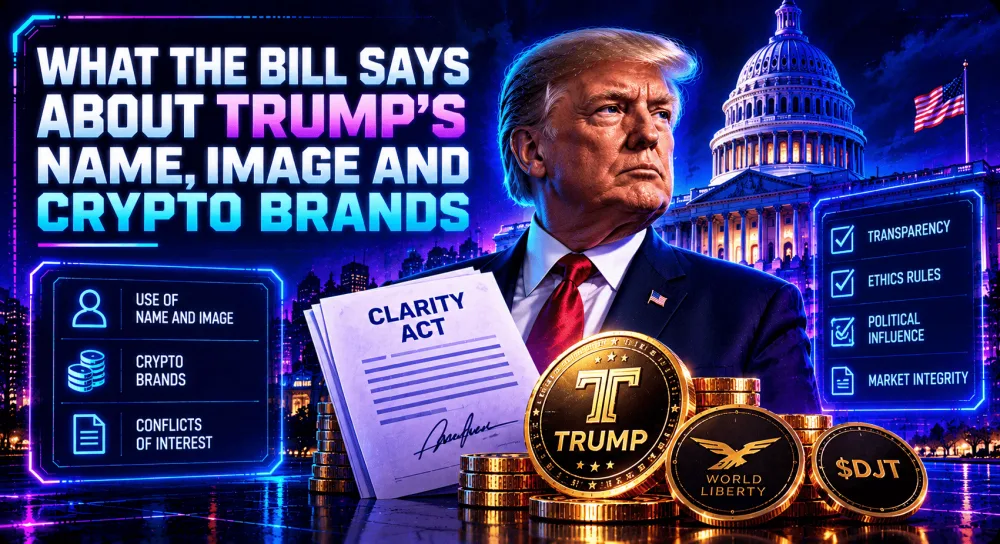
New rules also address paid use of an official’s name, image, or likeness. That matters because the Trump brand itself has commercial value. A branded token creates a more direct link than passive exposure to Bitcoin. Future monetization of political identity through new crypto products could face tighter limits.
| Trump-Linked Crypto Interest | Current Exposure | Impact of CLARITY Act Ethics Rules | Main Open Question |
|---|---|---|---|
| World Liberty Financial | Family-linked crypto business with several revenue streams | Certain ownership and commercial relationships may face restrictions | Could diversified revenue keep parts of the business outside stricter rules? |
| USD1 Stablecoin | Stablecoin connected to the World Liberty ecosystem | New commercial activity could face tighter scrutiny | How broadly will stablecoin-related income fall under covered business definitions? |
| $TRUMP Memecoin | Existing branded token tied to Trump’s name | Existing tokens may receive different treatment from future launches | Can Trump keep benefiting from previously launched tokens? |
| Bitcoin | Personal or investment exposure may remain possible | No general ban on ordinary Bitcoin ownership | What disclosure rules would apply to large holdings? |
| Ethereum | Ordinary investment exposure may remain possible | Treated differently from ownership in a token-issuing business | Could trading activity create separate conflict concerns? |
| New Trump Crypto Projects | Future token launches or paid sponsorships | Significantly more restricted under the new framework | Would any new project require divestment or complete separation from Trump? |
Why Democrats Still Say the CLARITY Act Does Not Solve Trump’s Conflict of Interest
Elizabeth Warren’s Case Against the Crypto Ethics Compromise
Elizabeth Warren argues that the compromise is still too narrow. Her criticism focuses on existing holdings, complex business structures, and enforcement limits. She also questions whether indirect income through family-linked companies could continue. For Warren, formal ownership rules do not capture every possible economic benefit.
Read more: Clarity Act Gets New DeFi Rules as Senate Faces Crucial 60-Vote Crypto Showdown
Does the New Bill Really Stop Trump From Profiting From Crypto?
Not fully. The bill can restrict future projects without eliminating every existing revenue stream. Older assets may continue providing value after the rules start. Businesses outside narrow statutory definitions may also preserve some flexibility.
Who Can Actually Enforce the Ethics Rules?
Federal institutions still have the strongest tools against covered officials. State attorneys general provide another route, but they do not replace Washington. Courts may also shape the restrictions in practice. Nevertheless, enforcement will depend on both legal authority and institutional willingness.
The Biggest Question: Who Would Enforce the Rules Against Trump?
Why the Department of Justice Matters
The Department of Justice is still central to federal enforcement. That can become politically delicate when a possible case involves the sitting president. Legal authority does not guarantee aggressive action, however. Critics focus on whether executive officials would pursue a politically costly case.
What Changes With State Attorneys General Enforcement
State enforcement offers another way to challenge alleged violations. A state attorney general can act if conduct harms the state or residents. This adds pressure when federal authorities are inactive. Nevertheless, states must meet legal conditions before bringing a case.
Could Trump’s Own Administration Police His Crypto Interests?
In theory, federal agencies could investigate violations involving the president or his administration. In practice, those cases would test institutional independence. Political pressure could limit how quickly officials act. That risk explains why enforcement design is so important in the compromise.
What Happens to the CLARITY Act If Democrats Reject the Ethics Deal?
Why Republicans Need Seven Democratic Votes
Republicans need votes beyond their own conference to clear the Senate’s 60-vote cloture threshold. If all Republicans are united, seven additional votes would be required to move the process forward. That arithmetic gives a small Democratic bloc significant leverage. The latest compromise targets that group in its efforts.
What Today’s Senate Cloture Vote Actually Decides
Today’s CLARITY Act vote does not decide final passage. Senators are deciding whether debate can continue past a procedural barrier. A successful vote would allow amendments and later consideration of the bill. Failure could prevent those steps from being taken.
Why a Failed Vote Could Push CLARITY to 2030
A failed vote would not legally delay crypto legislation until 2030. The risk comes from the political calendar and future priorities. Midterms, a new Congress, and the 2028 presidential race could slow another major effort. Rebuilding a bipartisan coalition would take years.
Read More: CLARITY Act or 2030? Senator Lummis Warns US Crypto Regulation Could Face Years of Delay
Could Trump’s Crypto Ethics Controversy Actually Kill CLARITY?
The Case for Passage After Trump’s Concession
Supporters argue that Trump accepted enough limits to remove the main political obstacle. The compromise adds divestment rules, blind trusts, and broader enforcement options. Years of negotiations have produced agreements on market structure and agency roles. Starting over would waste that progress.
The Case Against Passage Despite the New Ethics Rules
Opponents focus on existing assets and business structures that may remain outside strict provisions. They argue that future limits matter little if older revenue channels continue. Another concern involves narrow definitions that complex companies could avoid. Those gaps could weaken the rules when disputes begin.
What the Senate Vote Means for Crypto Regulation
The CLARITY Act Senate vote tests whether Congress can build a durable coalition around digital assets. Passage would bring the US closer to a statutory framework for tokens and exchanges. Failure would leave more authority with regulators and courts. Companies would then face longer uncertainty around classification and oversight.
What CLARITY Act Failure Would Mean for Trump and Crypto
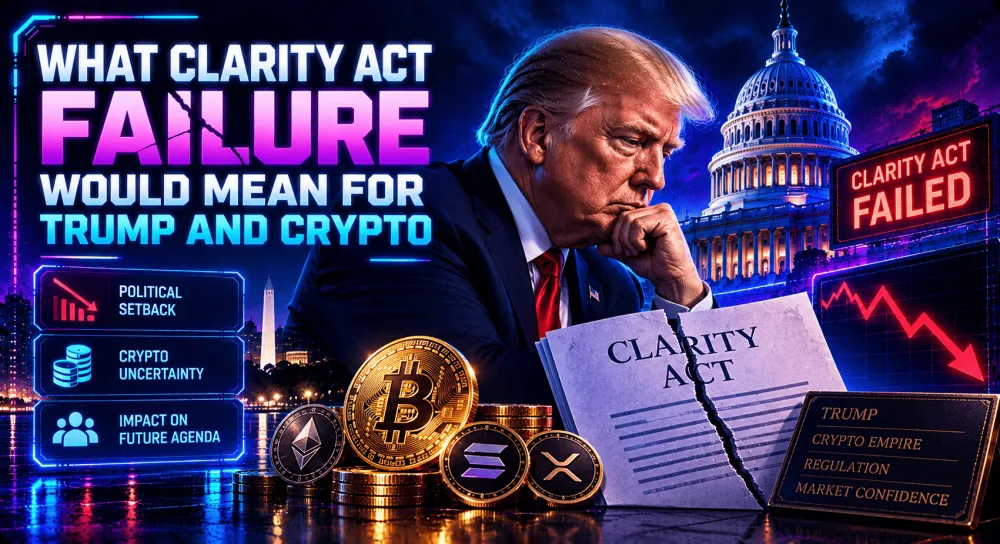
A failed vote would weaken one of Trump’s biggest crypto policy goals. His administration could still pursue friendlier rules through federal agencies. Those policies would be easier for a future administration to reverse. Legislation from Congress would be much more durable.
Coinbase and other US crypto firms will continue operating under law. Business will not cease because CLARITY fails. However, long-term planning will be difficult across listings, custody, and new products. Agency interpretation will continue to play a major role.
Yes, both agencies can continue issuing rules, guidance and enforcement actions. Their authority would still depend on existing statutes and court decisions. CLARITY aims to reduce those gaps by introducing new statutory boundaries. Without it, policy could shift more sharply between administrations.
Possibly, but 2030 is a political scenario rather than a legal deadline. Congress could return to the issue sooner if leaders find support. Another failure would still make a quick restart hard. Lawmakers will need to reopen negotiations over difficult policy areas.
Trump’s Crypto Ethics Problem Is Bigger Than the CLARITY Act
Can a President Regulate an Industry He Personally Profits From?
A president can influence policy affecting industries connected to personal wealth. Crypto makes that situation uniquely visible because token prices react quickly to political signals. Direct business exposure is also unlike holding diversified investments. A family-linked token business creates much closer connections between policy and private value.
Where Does Crypto Regulation End and Political Conflict of Interest Begin?
The boundary is hard to draw when broad rules also affect a president’s commercial interests. Stablecoin regulation can affect the whole market while influencing USD1. Token rules can affect thousands of projects while changing $TRUMP economics. That overlap makes ordinary policymaking hard to distinguish from private benefit.
Why the CLARITY Vote Could Set a Precedent for Future Presidents
The legislation sets up a template for future presidents with digital-asset businesses. Similar rules may govern token issuance, sponsorship, and ownership interests in the future. Future conflicts could involve blockchain products, AI tokens, or prediction markets. The precedent may be long-lasting beyond Trump.
Trump Crypto Ethics vs. the CLARITY Act: What Happens Next?
Next, the Senate must reach 60 votes on cloture. Success would move the Trump CLARITY Act to floor debate. Lawmakers could still amend the text before final passage. Failure would cast serious doubt on the current market-structure push.
The wider regulatory problem would still exist either way. Congress still must define digital assets and divide authority between the SEC and CFTC. It must also decide how officials with direct industry exposure should be treated. The Senate vote will decide whether those issues can be tackled together, or return in another political cycle.