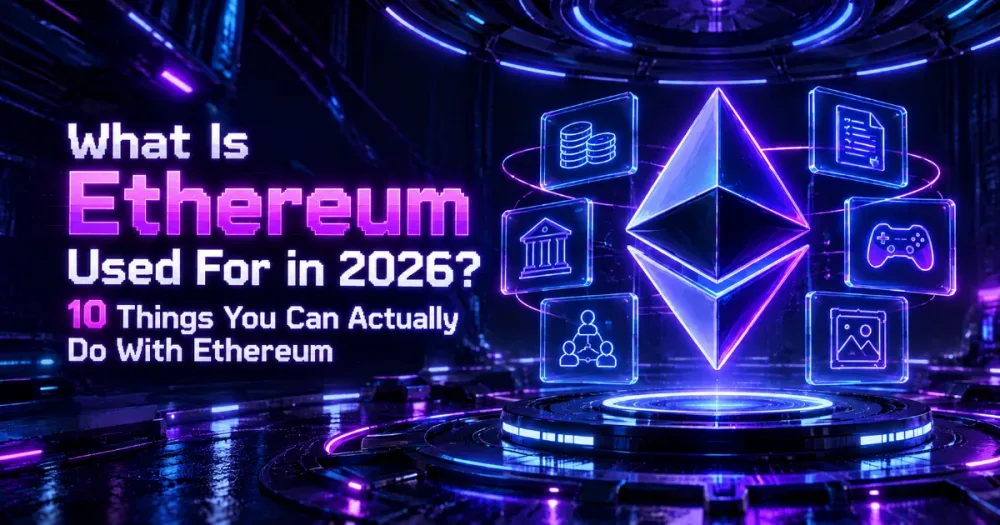
Ethereum is a programmable blockchain that can move value, run programs, and store assets without a central operator. Similar to a blockchain with a payment focus, such as Bitcoin, Ethereum blockchain allows users to transfer value and run programs that execute transactions and enforce rules.
What Is Ethereum Used For?
This programmability is the basis for many of Ethereum uses, including decentralized finance (DeFi), stablecoins, non-fungible tokens (NFTs), and other blockchain applications. Ethereum also provides infrastructure for a number of Layer 2 networks, which support off-chain transactions, while using Ethereum for security, data availability, or settlement.
Ethereum as a Smart Contract Platform
Smart contracts are programs that are stored in blockchain addresses and are executed when a user or other contract sends a transaction to the address. Smart contracts can own assets, define rules, and serve as the backend to decentralized applications dApps on Ethereum blockchain.
Due to the possibility of invoking other contracts, developers do not have to start from scratch and recreate pre-existing protocols and standards, but can instead build on top of them. This composability is especially useful in the development of DeFi and other interoperable onchain infrastructure.
Read More: Ethereum Fees Are Collapsing as Layer 2 Grows: Can ETH Still Capture Value?
Ethereum as a Settlement Layer
Many rollups use Ethereum as a settlement layer and data availability layer. They run the execution environment outside Ethereum, bundle the results, and publish the data or a proof of that data to Ethereum Mainnet. Optimistic rollups and zero-knowledge rollups have different verification mechanisms, but both rely on Ethereum for finality.
The architecture is designed to allow Ethereum Layer 2 networks to perform computation off L1 with Ethereum’s security guarantees, via blob transactions (first introduced in EIP-4844 and then integrated into Ethereum’s scaling roadmap), which allows rollups to access dedicated data-space.
| Ethereum use | What it does | Examples |
| Smart contracts | Executes programmable rules and transactions | DeFi, dApps |
| Settlement | Provides settlement and data availability for rollups | Optimistic and ZK rollups |
| Digital assets | Enables tokens to be issued, transferred and managed | ERC-20 tokens, NFTs |
| Value transfer | Allows users to send ETH between addresses | Payments, transfers |
| Layer 2 infrastructure | Supports networks designed for cheaper, higher-throughput activity | Ethereum rollups |
Ethereum as a Network for Digital Assets
Aside from being a cryptocurrency, Ethereum also enables the issuance, transfer, and management of other crypto-assets. Ethereum’s token standards include ERC-20 for fungible tokens and ERC-721 for non-fungible tokens. It allows assets to be used interchangeably with wallets, exchanges, and decentralized applications within the ecosystem.
Tokens representing currencies, financial instruments, voting rights, collectibles, or other assets make the issuance and management of digital assets the second most important Ethereum use case, after the transfer of value in ETH form.
10 Things You Can Actually Do With Ethereum

So, what can you do with Ethereum beyond holding ETH? The network supports payments, financial services, staking, stablecoins, digital ownership, and applications built with programmable smart contracts. These Ethereum use cases now extend across both Ethereum Mainnet and its Layer 2 ecosystem.
Send and Receive ETH
ETH can be sent directly to another Ethereum address with any Ethereum-compatible wallet. As such, it enables users to send payments internationally without the need for bank involvement, while still requiring network fees.
Use Decentralized Finance
Ethereum DeFi apps are services that offer token swaps, lending, borrowing, and asset management through smart contracts. DeFi does not require a standard bank account, but a cryptocurrency wallet.
These platforms have their own risks, including vulnerabilities in the smart contract and losses when collateral backing the asset is volatile and undercollateralized.
Stake ETH
Ethereum implements proof of stake, allowing holders of ETH to stake their assets to help secure the network by either running their own validator with a minimum of 32 ETH or by using a pooled staking service. The latter poses additional risk in terms of third-parties/smart-contracts.
Validators receive ETH as a reward for their services, thereby making ETH itself a direct participant in Ethereum consensus, and thus taking part in the generation of network security.
Use Stablecoins
Ethereum supports stablecoins that track the value of less volatile assets, such as fiat currencies, which are backed by fiat money, with examples including USDC and USDT.
These Ethereum stablecoins can be sent between wallets or used in decentralized finance applications as a replacement for the more volatile ETH.
Trade Digital Assets
Tokens built on Ethereum blockchain can also be traded on decentralized exchanges, where transactions are executed automatically through smart contracts following the rules of the decentralized protocol. DeFi infrastructure supports complex transactions like liquidity provision and collateralization.
Use Ethereum Layer 2 Networks
Layer 2 networks are networks that process activity off of Ethereum L1, but leverage Ethereum for settlement, data availability, or security depending on the design of the network. Layer 2 networks are designed to increase the throughput and decrease the cost to users on Ethereum.
Using an Ethereum Layer 2 can therefore make applications more practical for frequent or lower-value transactions, provided that users understand the architecture behind their chosen Layer 2 and the risks within.
Buy and Use NFTs
NFTs can represent unique digital items that are represented via blockchain and Ethereum-based NFT standards. They are used for digital art, collectible items, avatars in games, event tickets, and credentials or membership.
They are also designed to be used with compatible smart contracts and applications, rather than simply being a sellable image or collectible.
Tokenize Real-World Assets
Ethereum can be used to create tokens that represent legal rights to or a claim on assets external to Ethereum blockchain. Ethereum tokenization could enable ownership of real estate and other financial or physical assets. The legal ownership of the assets represented by a token depends on the token’s issuer and structure.
Use Decentralized Applications
Wallets can interact with dApps in the domains of finance, gaming, digital ownership, and other services. Ethereum dApps typically consist of a front end and smart contracts that handle the application’s logic on-chain.
Build Smart Contracts and Blockchain Applications
Developers can create applications that run on Ethereum, as well as applications that run on top of smart contracts. Smart contracts can manage assets, perform computations, and implement transaction logic without requiring developers to host a centralized backend.
This programmability is central to what Ethereum can be used for: developers can create new applications or compose existing onchain components rather than using the blockchain solely for cryptocurrency transfers.
| What you can do | How Ethereum is used |
| Send and receive ETH | Transfer ETH between Ethereum addresses |
| Use DeFi | Swap, lend, borrow and manage crypto assets |
| Stake ETH | Help secure Ethereum and earn validator rewards |
| Use stablecoins | Transfer and use assets such as USDC and USDT |
| Trade digital assets | Exchange tokens through decentralized protocols |
| Use Layer 2 networks | Access lower-cost, higher-throughput transactions |
| Buy and use NFTs | Own and transfer unique digital assets |
| Tokenize real-world assets | Represent claims on financial or physical assets |
| Use dApps | Access finance, gaming and digital ownership services |
| Build applications | Create smart contracts and blockchain-based apps |
Why Is ETH Needed on Ethereum?
ETH is Ethereum’s native token and plays an important role in the economic model of the network since fees are charged exclusively in ETH and validators need to stake ETH to participate in the validation of blocks.
These functions further explain why is Ethereum important as more than an application platform, as the native asset is tightly coupled to computation and network security.
ETH and Gas Fees
Every Ethereum transaction requires gas, an amount of computational effort required to process a transaction. Fees are based on the gas used, as well as the base fee and the priority fee, and are paid in ETH.
Charging gas is also how Ethereum is able to limit the impact of infinite resource requests.
ETH as Staking Collateral
In proof of stake, validators deposit ETH as collateral to help secure the network and are rewarded with ETH for performing their duties honestly. Validators can also lose part of their deposit for performing their duties dishonestly.
Ethereum staking thus becomes another primary use case for ETH, giving it a financial stake in validator participation in addition to being a payment token.
ETH in DeFi
ETH is widely used in DeFi. According to Ethereum.org, ether is one of the most commonly used collateral types in DeFi lending markets, where people borrow assets against collateral.
Also available in Ethereum DeFi is wrapped ether (WETH), a version of ether that is ERC-20 compatible and is used in many applications to interact with token-based smart contracts more easily.
Additionally, each of these applications has risks beyond holding ETH, such as smart-contract risks and also collateral risks specific to each individual protocol.
What Happens to ETH Used for Gas?
However, not all ETH paid for gas goes to validators. EIP-1559 introduced a base fee, calculated by the protocol and burned on every transaction, permanently removing that ETH from the supply.
Tips, paid separately to the validator in addition to a transaction, work as a mechanism to burn ETH, therefore reducing the supply during increased activity to counteract the issuance given to rewards received by proof-of-stake validators for minting ETH.
How Does Ethereum Work?

To understand how does Ethereum work, think about it as a shared computer: all the nodes have Ethereum’s state, all state changes are requested as transactions, and Ethereum Virtual Machine (EVM) computes and changes the state.
Ethereum Proof of Stake
Since 2022, Ethereum switched to proof of stake and staking ETH to propose and attest on blocks, instead of competing for computing power in proof of work. Ethereum is divided into 12 second slots in which a random validator is selected as a proposer to propose a block.
To provide finality, consensus requires validators to vote on checkpoints. If a checkpoint reaches a certain vote threshold, it becomes finalized. Ethereum uses the Casper FFG and LMD-GHOST fork-choice rule.
Validators and Staking
This solo validator deposits 32 ETH, runs the execution, consensus and validator clients, checks blocks, makes attestations, and waits to be chosen to propose blocks in order to receive rewards.
Ethereum staking includes incentives for the honest behavior of stakers in the form of ETH for timely attestations and block proposals. Stakers may also be punished with slashing for provably dishonest actions.
Read More: Ethereum Updates 2026: Can Vitalik Buterin Keep ETH in the Top 3? The Roadmap That Could Decide Ethereum’s Future
Smart Contracts
Ethereum smart contracts are at blockchain addresses and are programs with associated code and state data, which are executed when a transaction or call to the address is made.
Smart contracts are used for applications such as tokens and decentralized exchanges. State-changing transactions require gas, while those only reading the stored state of a contract do not.
Ethereum Transactions
Ethereum transactions are cryptographically signed instructions that update Ethereum network state. This could be sending ETH, deploying a new contract, or calling a function from an existing contract. All transactions requiring execution must be included in a justified block.
The transaction is then broadcast to the network and enters the pool of pending transactions. The transaction might be included in a block by a validator, which might then become a finalized part of Ethereum blockchain transaction history logged in the proof of stake consensus cycle.
| Ethereum component | What it does |
| Transactions | Request changes to Ethereum’s state |
| EVM | Executes transactions and smart contract code |
| Smart contracts | Run programmable logic stored on Ethereum |
| Validators | Check blocks, attest and propose new blocks |
| Proof of stake | Coordinates consensus using staked ETH |
| Blocks | Record transactions and resulting state changes |
| Finality | Makes confirmed blocks economically difficult to reverse |
Ethereum and Layer 2 Networks
Ethereum’s scaling plan largely relies on Layer 2 networks, especially rollups, which execute most transactions outside of the mainnet while utilizing Ethereum as a settlement and data availability layer.
The reason is mainly to do with scalability: rollups allow multiple transactions to be bundled into a block and posted with either their data or output to Ethereum, such that less computation is required on L1 per user transaction. Therefore, Ethereum Layer 2 infrastructure is part of Ethereum’s scaling roadmap.
Ethereum has created additional blob space for rollup data. The scaling of L1 execution and blobs remains a priority of Ethereum Foundation as of 2026.
Rollups execute transactions off L1 and post data to Ethereum. Optimistic rollups can challenge invalid state transitions; ZK-rollups post cryptographic validity proofs to Ethereum, which validates them.
Both approaches allow for many transactions to be processed off of Mainnet while preserving connection to Ethereum’s security and settlement layer.
Ethereum Mainnet is the base layer where consensus happens, while layer 2 rollups are separate execution environments built on top of Ethereum Mainnet, which batch transactions more efficiently and then use Ethereum to secure or finalize their state depending on their design.
For users, this means assets and applications that may be hosted on L2 rather than on Mainnet, with the ability to move between them through bridging. Layer 2s may include centralized components such as sequencers, but it is possible for every layer 2 to implement and decentralize differently.
Ethereum and Stablecoins

Stablecoins are one of Ethereum’s biggest use cases, with approximately $160 billion worth of stablecoins existing on its L1 network and even more existing on its Layer 2 networks.
Why Do Stablecoins Use Ethereum?
With Ethereum’s programmable token standards and the mature ecosystem of wallets, exchanges, and DeFi protocols, Ethereum stablecoins are not only used as transfer protocols for digital dollars, but also as trading, lending, or payment assets.
Stabilized tokens, often referred to as stablecoins, avoid the volatility in the price of ETH by being pegged to some other value, such as a reserve of fiat money.
USDT and USDC on Ethereum
The two largest fiat-backed stablecoins on Ethereum are USDT and USDC. USDC is natively issued on Ethereum as an ERC-20 token, and is supported by a wide variety of Ethereum DeFi applications.
USDC can be redeemed 1:1 for U.S. dollars by eligible customers of Circle. It is supported by dollar-denominated reserves, cash, and cash-equivalent assets. Stablecoins are not the same as holding dollars in a bank account. Rather, they come with issuer, reserve, smart-contract, and regulatory risks that bank deposits do not.
Ethereum as a Stablecoin Settlement Layer
Ethereum supports 24/7 transfers and programmable settlement, and Layer 2 networks provide lower-cost on-chain rails for higher-frequency usage. According to its institutional portal, Ethereum L1+L2 are the dominant layer for stablecoin supply at more than 60%.
This scale helps explain why people use Ethereum for stablecoin settlement: tokens can move between wallets and interact directly with exchanges and DeFi protocols within the same broader ecosystem.
Ethereum and Real-World Asset Tokenization
Ethereum tokenization refers to the representation of traditional on-chain assets such as government bonds and equities on Ethereum. Ethereum’s institutional data hub lists $20.4 billion of real-world assets on Ethereum or an Ethereum Layer 2.
Tokenized Treasuries on Ethereum
U.S. Treasuries and cash equivalents are another important category. Ethereum’s institutional portal shows $7.4 billion in Treasuries and cash equivalents across Ethereum and L2s, including BlackRock’s BUIDL, Superstate’s USTB, and Ondo’s OUSG.
In 2026, BlackRock proceeded with onchain finance expansion by launching Ethereum-based tokenized share classes for select institutional European money market funds.
Stocks and Other Tokenized Assets
Aside from Treasuries, Ondo also offers hundreds of tokenized U.S. stocks and ETFs on Ethereum and other blockchains, and some can be used as collateral in Ethereum’s DeFi ecosystem.
In July 2026, Ondo launched the tokenized IVV ETF and Micron stock in the United States as a custodial model, meaning that these tokens on Ethereum are backed 1:1 by these securities in the incumbent custody system.
Read More: The Ethereum Developer Exodus: Why Builders Are Looking Beyond ETH in 2026
Why Do Institutions Use Ethereum?
Ethereum offers institutions settled infrastructure, with established deep onchain liquidity, connection to stablecoins and DeFi, and affordable execution in Ethereum’s L2 ecosystem that ultimately settles on Ethereum L1.
This institutional adoption is one reason why is Ethereum important increasingly extending beyond crypto-native markets: asset managers and financial firms are using its infrastructure for tokenized funds, securities, and settlement rather than simply transferring ETH.
Ethereum Staking Explained

Ethereum staking secures the proof-of-stake consensus mechanism of Ethereum blockchain. Stakers lock ETH and process consensus operations in exchange for rewards, but can be penalized for non-performance or malicious behavior.
How Does Ethereum Staking Work?
Anyone who deposits 32 ETH or more can run their own validator by running an execution client and a consensus client. A validator will attest to blocks and may also be chosen to propose blocks.
Who Can Stake ETH?
Anyone can use ETH to become a validator, requiring 32 ETH for the solo method and any amount for the pooled methods. However, pooled methods are not part of Ethereum protocol; they are a third-party solution.
What Are the Risks of Ethereum Staking?
Rewards can be lost, and penalties issued for solo validators who have gone offline, and slashing behavior can cause a fraction of the validator’s stake to be destroyed and the validator to be removed from the validator set.
In addition, pooled staking and delegated staking expose users to smart-contract risk, counterparty risk, execution risk, and custody risk, depending on the service.
How Do Ethereum Staking Rewards Work?
Validators can earn ETH for activities such as attesting the network, proposing blocks, and serving on the sync committee. Ethereum.org estimates current staking APR to be about 2.5% per year.
When staking solo, you receive protocol rewards directly. With third-party staking services, they may take fees or have their own policies regarding rewards.
Ethereum vs. Bitcoin

Despite both Bitcoin and Ethereum being decentralized blockchain networks, the projects were created with different goals in mind; Bitcoin’s main purpose is to serve as peer-to-peer electronic cash, whereas Ethereum was created specifically to act as a programmable platform for applications and digital assets.
Bitcoin as Money vs. Ethereum as Infrastructure
However, where Bitcoin is mostly focused on transferring and storing the BTC currency, Ethereum is also focused on transferring value, but also on applications, stablecoins, decentralized finance, NFTs and more.
That reality helps explain what is Ethereum in concrete terms: Ethereum is a blockchain network, a software platform, and ETH is Ethereum’s native cryptocurrency.
Bitcoin Transactions vs. Ethereum Smart Contracts
In contrast with Bitcoin, which simply tracks BTC transactions, Ethereum runs programs on Ethereum Virtual Machine (EVM), where developers can program how a contract behaves using programmable logic.
Ethereum smart contracts are programs that run on Ethereum blockchain and are stored as part of the network. Ethereum smart contracts can be used for decentralized exchanges, blockchain games, financial protocols, and more.
BTC vs. ETH: Different Roles in Crypto
Bitcoin’s currency has a maximum supply of 21 million. Ethereum’s currency, ETH, has no maximum supply, and functions mainly as a means for users to pay for transaction fees and stake in the network’s security.
As a result, what is ETH used for also involves paying the cost to execute smart contracts, and it also gives the economic underpinning behind Ethereum’s proof-of-stake consensus.
| Feature | Bitcoin | Ethereum |
| Primary role | Peer-to-peer digital money | Programmable blockchain platform |
| Native asset | BTC | ETH |
| Supply | Maximum 21 million BTC | No fixed maximum ETH supply |
| Consensus | Proof of work | Proof of stake |
| Programmability | Limited scripting | General-purpose smart contracts |
| Main uses | Store and transfer BTC | Payments, DeFi, stablecoins, NFTs and dApps |
| Network security | Mining | Validators staking ETH |
Ethereum vs. Solana
Ethereum and Solana both intend to support smart contracts and decentralized applications, but the two chains have fundamentally different architectures, with Ethereum becoming an increasingly scalable L1 with a large rollup ecosystem, whereas Solana is designed for high throughput given a shared global state.
Different Approaches to Blockchain Scaling
Ethereum’s roadmap combines increasing L1 capacity and rollup scaling, in which transactions are processed outside Ethereum chain, and Ethereum only provides data availability and settlement. The 2025 Fusaka upgrade increased L2 data availability with the introduction of PeerDAS.
Instead, according to Solana’s documentation, Solana has most application execution on L1, where DeFi programs mingle in an all-encompassing state, composing within atomic transactions.
Ethereum Layer 2s vs. Solana’s Monolithic Model
Ethereum Layer 2 model involves distributing execution across several networks, which may increase throughput and reduce fees; however, it also separates users, assets, and liquidity across several environments. Researchers from Ethereum have previously acknowledged that smooth interoperability between rollups is an active area of research.
Solana does not shard state and hopes to scale applications by keeping everything on the same shared state. This allows for composability, although some sharded and application-specific scaling solutions are being explored for the Solana state machine.
Different Roles of Ethereum and Solana
Both networks support DeFi, payments, and programmable applications. The key difference is in their architecture: Ethereum has evolved into one L1 plus a larger ecosystem of independent L2s, whereas Solana has one single L1 execution environment for all core application activity.
What Are the Biggest Problems With Ethereum?

Ethereum’s architecture is complicated and fragmented across L2s, and its user experience is inconsistent. Ethereum Foundation’s 2026 priorities are scaling, user experience, and strengthening the security of L1.
Ethereum’s Complexity
Given Ethereum’s composition of L1, multiple L2s, bridges, different security models and evolving account system, Ethereum Foundation believes that L2s inherit different subsets of Ethereum’s properties and that their security characteristics need to remain transparent to users.
Fragmentation Across Layer 2 Networks
Potentially, a multichain architecture could lead to liquidity and transaction activity being split over a number of blockchains. In March 2026, Ethereum Foundation wrote that fragmentation was the main downside and interoperability and shared liquidity needed more work.
The protocol roadmap therefore also includes continued work to enable frictionless trust-minimized cross-L2 communication.
Read More: Ethereum ETFs Are Back: Could Institutional Money Finally Ignite the Next ETH Rally?
Fees and User Experience
Rollups are generally cheaper than Mainnet, but need inter-chain communication and bridges to one another. Ethereum’s scaling roadmap includes blob capacity, which provides cheaper transactions on rollups.
At the same time, Ethereum is scaling L1 itself via the Glamsterdam upgrade set to be released in Q4 2026, which increases execution capacity and improves gas predictability.
Competition From Other Blockchains
Ethereum also has competing smart-contract platforms that compete for developer attention, liquidity and users, for example Solana, which is built quite differently with a shared L1 state and low-latency execution.
Ethereum has a roadmap to 2026 that includes improvements such as L1 capacity, interoperability and improved security, beyond L2 scaling.
| Ethereum challenge | Why it matters | Current direction |
| Complexity | Users navigate L1, L2s, bridges and different security models | Better UX and clearer security assumptions |
| L2 fragmentation | Liquidity and activity can be split across networks | Cross-L2 interoperability |
| Fees | Mainnet can be expensive for some transactions | Rollups, more blob capacity and L1 scaling |
| User experience | Moving assets across networks adds friction | Improved interoperability and account UX |
| Blockchain competition | Other networks compete for users, liquidity and developers | Higher capacity, stronger security and continued scaling |
Is Ethereum Still Relevant in 2026?
Ethereum has become a key platform for decentralized finance, and stablecoins, tokenized real-world assets, and other protocols are increasingly built on top of Ethereum protocol on Ethereum Mainnet and Layer 2.
Ethereum’s Role in DeFi
Ethereum DeFi applications continue to allow for lending, decentralized exchanges, derivatives and other onchain financial applications; networks that compete with Ethereum for DeFi applications have become likewise sized, and Ethereum does not have an unbroken monopoly.
It is also used by L2s, allowing applications to take advantage of less expensive execution while remaining within Ethereum ecosystem.
Ethereum’s Role in Stablecoins
Ethereum L1 has an estimated $160 billion of pegged-value assets to fiat, whereas Ethereum L2s host $12.3 billion of pegged-value assets, while the official Ethereum institutional portal claims Ethereum has more than 60% of all stablecoin supply according to RWA.xyz.
For anyone asking what is Ethereum used for besides buying crypto, stablecoin payments, trading, and settlement provide a practical answer, as these assets can interact directly with wallets, exchanges, and DeFi protocols.
Ethereum’s Role in Tokenization
More than 75% of tokenized RWAs reside on Ethereum and its major layer-2s. According to Ethereum’s institutional portal, which references data from RWA.xyz, these include tokenized Treasuries, funds, stocks, and other financial instruments.
This activity provides another answer to what are the main uses of Ethereum in 2026: the network increasingly serves as infrastructure for issuing and settling traditional financial assets onchain.
Ethereum’s Development Roadmap
Ethereum development continues, with Glamsterdam in devnet testing, aiming for release in Q4 2026. No release was set for the mainnet, but key changes will include block-level access lists for L1 scaling and enshrined proposer-builder separation.
Next after Hegotá in 2027, and the protocol’s priority, is censorship resistance and account support. More generally, Ethereum Foundation has noted it prioritizes scaling, user experience, and L1 security for the protocol overall, with priorities open to change as it develops.
FAQ
What Is Ethereum Used For?
Ethereum is a blockchain that can send value and run programmable applications. Major use cases include DeFi, stablecoins, NFTs, tokenized assets, and smart contracts.
What Is ETH Used For?
ETH is Ethereum’s native cryptocurrency. What is ETH used for primarily comes down to paying gas fees, staking to secure the network, transferring value, and participating in applications such as DeFi.
Is Ethereum a Blockchain or a Cryptocurrency?
Ethereum is the name of a blockchain and a programmable computer platform; the cryptocurrency that runs on it is called ether. The two terms are often confused but mean different things.
How Does Ethereum Make Money?
Being a protocol, Ethereum does not operate as a profit-seeking entity. In response to the question of how does Ethereum make money, the answer is that Ethereum transaction fees consist of the burned base fee and miner fees or gas rewards. New ETH is also issued as staking rewards.
What Are Ethereum Smart Contracts?
Ethereum smart contracts are programs, stored in the blockchain, that run when triggered by a transaction, enabling applications such as exchanges, lending protocols, decentralized autonomous organizations, non-fungible tokens, games, and others that need a programmable base layer.
What Is Ethereum Staking?
The main security mechanism of Ethereum’s proof of stake is the concept of staking, in which validators deposit ETH, propose and attest to blocks, and are rewarded for honest participation and punished for dishonest participation.
What Are Ethereum Layer 2 Networks?
Layer 2s are scaling networks built on Ethereum that process transactions separately from L1 while deriving security guarantees from Ethereum. Rollups bundle transactions and submit data to Ethereum, helping increase throughput and reduce per-user costs.
Why Are Stablecoins Built on Ethereum?
Ethereum can also be used to create stablecoins, which are tokens that can be sent between wallets and used in dАpps. USDC and USDT are examples of fiat-backed Ethereum stablecoins.
Is Ethereum Decentralized?
Ethereum has no central authority and is maintained by independent nodes, consensus by validators, and multiple implementations of Ethereum clients that run in many different jurisdictions around the world.
What Is the Difference Between Ethereum and Bitcoin?
Bitcoin was designed primarily as a peer-to-peer digital currency network and uses proof of work. Ethereum uses proof of stake and was designed as a programmable platform where smart contracts can power applications and digital assets in addition to transferring ETH.