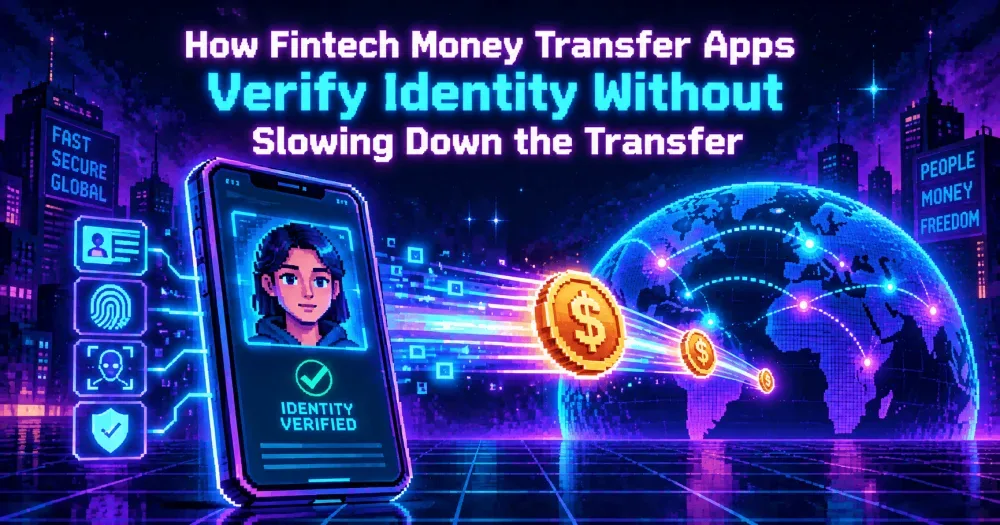
From Tang Dynasty’s fei chien (flying money) and the Knights Templar’s letter of credit to the faster, modern money transfer methods, there has always been a need to vet and verify both recipients and senders when moving money across borders.
Where ancient systems could take weeks, traditional banks, using SWIFT, take a few hours to a few days to exchange messages with intermediary financial institutions to verify senders and receivers.
But as technological advancements streamline processes across industries to deliver faster results, users within money transfer markets now expect instantaneous services across the board, from account setup to funds delivery.
Although seemingly an impossible feat in the past, fintech money transfer apps have made users’ expectations a reality.
This article examines the mechanisms fintech apps adopt to verify users and provide secure money transfer services without adding extra steps in the process.
Phone Number as the Entry Point
Fintech money transfer operators use existing, SIM-based databases/APIs managed by mobile network operators, global telecommunication data aggregators, intelligence networks, and central banks to verify the identity of users.
By using phone numbers as the primary identifier, contrary to funneling users through endless forms, fintech apps can work silently in the background to confirm the authenticity of the identification data provided by users in real time.
The mobile identity and data APIs provided by the Global System for Mobile Communications Association (GSMA), for instance, allow fintech operators to conduct checks in the background, including:
- SIM swap detection: To determine if the phone number provided during an ongoing account setup or money transfer has been involved in a recent account takeover.
- Number verification: Fintech operators can query network carrier data to confirm a user’s mobile phone number against their active mobile device without having to send an OTP, which malicious actors could intercept.
These and similar features enable fintech money transfer operators to complete initial compliance and fraud checks quietly while the user continues their activity.
At the user end, this translates to seamless, one-tap sign-in/sign-up that creates frictionless access to money transfer services while maintaining high security.
Flexible, Region-Specific ID Acceptance
Rather than enforcing a single document standard, fintech money transfer apps adopt broader, region-specific identification standards that are flexible enough to accommodate regional differences and contexts in their KYC pipeline.
Localization, in this regard, means accepting a range of ID types based on what’s applicable/acceptable in the target region. Where the required ID document for one region/country could be the passport, the required ID document for another country could be a voter’s card or national ID card.
By widening the threshold for document standards by regional contexts and integrating localized verification databases in their systems, fintech platforms can cross-reference and instantly validate users’ IDs against applicable official registries without manual reviews.
Digital ID Capture Replacing Manual Review
Smartphone technologies, such as optical character recognition and biometric facial matching, enable fintech money transfer operators to confirm user identity without requesting a visit to a physical branch for further verification.
These digital ID capture technologies complete complementary functions in real time:
- Optical character recognition (OCR): OCR APIs enable money transfer operators to automatically extract necessary information from users’ IDs (including driver’s licenses, passports, national IDs) and match the extracted information against user-submitted registration data or official databases, such as central bank databases or a national identity database.
- Biometric facial matching: When a user submits a selfie or opens their camera for live facial verification, the biometric facial matching API automatically cross-references the image against the photo in the ID document submitted by the user, and immediately accepts or rejects the user’s application based on set protocols.
Real-time digital ID verification enabled by camera-based document capture and automated checks is also especially important in eliminating human error and preventing identity fraud, owing to the use of advanced algorithms to ensure accuracy, compliance, and security.
Most importantly, the entire verification process could take from a few seconds to a few minutes.
Tiered Verification by Transaction Size/Risk
Fintech platforms optimize both verification security and speed by implementing risk-based, tiered verification models.
Essentially, fintech operators adjust compliance requirements based on transaction size, where:
- Small transactions and first-time transfers have lighter checks like phone verification or biometric authentication, allowing users to send money instantly.
- Larger or unusual transfers trigger escalated verification protocols, and in response, the fintech money transfer app may request additional documentation or proof of funds.
By strictly reserving rigorous compliance checks for large or high-risk transactions, fintech operators are able to maintain strict AML compliance while keeping the vast majority of transactions seamless.
Real-Time Status and Tracking as a Trust Substitute
As much as fintech money transfer operators have met user demand for faster verification checks that streamline access to services, there still remains a need to build and maintain user trust without adding extra verification steps.
For many operators, the solution lies in push notifications, which provide users with real-time status of their transactions. Instead of having to wait and wonder if their ID has been verified or if their funds have been safely sent, fintech platforms provide live status updates at every stage of the transaction cycle.
This level of visibility and transparency can build confidence and trust in the system, as users feel more in control of their finances and empowered to react quickly to failed transactions or suspicious activities before they morph into bigger problems.
Ultimately, real-time notifications reassure customers, keep them informed at all times, and allow fintech platforms to deliver a fast, secure, and user-friendly experience throughout the customer lifecycle.
Conclusion
It is clear that with fintech money transfer platforms, speed and compliance are no longer an issue for customers at various points of verification, whether at account creation, sign-in, or other in-app activities that may require authentication.
This shift, driven by technological innovations in the fintech space, is what’s led to the move from bank counters to phones, allowing users to access cross-border money transfer services and complete transactions within minutes from wherever they are at the time.
Continued integration of AI and machine learning into instant account verification networks promises to deliver even faster and more secure processes.