
Mexican federal and state authorities seized a suspected cryptocurrency mining facility in Tlaola, a municipality in Puebla’s Sierra Norte region.
Mexico Seizes Hidden Crypto Mine With 300 GPUs
The Mexican Navy, Puebla state authorities, and the Federal Attorney General’s Office took part. The property and the equipment are still in the process of being traced back to their origin and the crime.
There remain questions over the Mexico crypto mining farm, and whether any crypto assets produced there may have actually been used to launder illicit cash. However, investigations have confirmed simply that it is a lead currently under investigation.
What Police Found Inside the Puebla Crypto Farm
Several police officials confirmed the discovery of a large computing, electrical, and communications infrastructure. Puebla security officials stated that there were around 300 custom-made computers and 8 satellite internet antennas.
The scale of the Puebla crypto mining farm went well beyond a small private setup. Authorities secured the property and equipment, while no arrests were initially reported.
300 GPUs, Transformers and 80 Medium-Voltage Terminals
According to officials, the facility contained a pedestal-mounted transformer, about 80 medium-voltage terminals for 300 specialty computers, and eight satellite internet antennas for connectivity.
The machines are classified as GPUs by some, but official reports taken as sources by most major Mexican media describe them as specialized computing machines. The 300 GPUs seized Mexico case therefore requires careful terminology until investigators disclose detailed hardware specifications.
| Key Detail | What Authorities Found |
| Location | Tlaola, Sierra Norte, Puebla, Mexico |
| Mining hardware | Around 300 specialized computing units |
| Power infrastructure | Pedestal transformer and about 80 medium-voltage terminals |
| Connectivity | 8 satellite internet antennas |
| Investigation | Suspected electricity theft and possible money laundering |
| Cartel connection | Not established by authorities |
Why the Mining Operation Was Hidden in the Sierra Norte
It was located in Tlaola, a montane municipality in the Sierra Norte region of Puebla. While its location has been detailed in the media, there is no evidence that the operators intentionally obscured the mine’s location.
In addition to the power infrastructure, satellite communication and hundreds of computers were also found, leading to the greater issue of illegal crypto mining Mexico, and speculation over how it was controlled and operated.
How the Illegal Crypto Mining Operation Was Discovered

Puebla security chief Francisco Sánchez González stated that the authorities were aware of crypto-mining in the area and had been coordinating with the federal government prior to beginning the multi-day operation. Investigators were also looking into possible electricity theft, which also caused the Federal Electricity Commission to launch an investigation.
The main issue is electricity theft to power the crypto farm. Cryptocurrency mining is not illegal in Mexico, but stealing electricity is a crime.
Unusual Electricity Consumption Raised the Alarm
Crypto mining is energy-intensive and noisy. According to Sánchez, authorities had been keeping track of suspected crypto farms, including a large electricity connection, near that dam.
In the illegal crypto mining Mexico investigation, the power footprint is one of the components, examining electricity use more than the mining process or crypto operations as the alleged crime.
Why Remote Locations Are Ideal for Illegal Crypto Mines
Sánchez-related the noise and energy consumption associated with these mining sites to incentivize the operators to seek out more isolated areas, which explains the authorities’ interest in the remote areas of Puebla’s Sierra Norte.
Tlaola fits this geographic pattern, although the reasons for selecting this particular property have not been made clear by authorities.
The Connection to the Nuevo Necaxa Hydroelectric System
Sánchez justified the chosen location due to its proximity to the Nuevo Necaxa dam. EL PAÍS stated that the site had an illegal connection to a dam in the federal hydroelectric complex, and that CFE had joined the investigation into power theft.
The Necaxa dam is part of the hydroelectric power system whose infrastructure is owned by the national government. The alleged illegal electricity connection is part of the Puebla crypto farm investigation.
Was the Puebla Crypto Mine Linked to a Mexican Cartel?

It does not appear that the Tlaola site has been identified by Mexican authorities as the property of or operated by any cartel. The crypto mining cartel theory stems from the broader investigation into criminal financing, as authorities have not established that any cartel operated the Tlaola facility.
What Authorities Are Investigating
The CFE and Federal Attorney General’s Office, along with the Navy and Puebla authorities, are investigating the suspected electricity theft with regard to the origin, use, and possible criminal connections of the utility infrastructure that was seized.
A second line of inquiry is whether the machines were being used in Mexico crypto money laundering schemes to launder the proceeds of illicit activity as legitimate revenue.
Read More: The CLARITY Act Changed Again: New Crypto Bill Impacts DeFi
Why Cartel Involvement Has Not Been Proven
Thus far, however, no official source has identified the Sinaloa Cartel, CJNG, or any other criminal organization as responsible for the farm, nor a suspect who operated it as a cartel-affiliated operator.
This distinction is important for the Puebla crypto farm cartel investigation, because while cryptocurrencies had been used by Mexican criminal groups, this does not imply ownership or control of the crypto mine.
The Money Laundering Theory Behind the Investigation
One theory has been that the generated cryptocurrency was intended to launder the illicit funds. The Puebla investigative police have stated that they are investigating if money laundering was the motive behind the crime, although they have yet to find evidence of the laundering.
For the time being, crypto mining money laundering is one avenue of investigation alongside the more concrete allegation of electricity theft. Any claim that the site was a crypto mining farm linked to a Mexican cartel would therefore be speculation and not something that authorities have established.
| Investigation Question | Current Status |
| Cartel ownership | Not established |
| Named cartel involved | None confirmed |
| Electricity theft | Under investigation |
| Money laundering | Investigative theory, not proven |
| Source of mining equipment | Still being examined |
| Tlaola operators | Not publicly identified |
How Criminal Groups Can Use Crypto Mining to Launder Money
Mining can also be used to launder cryptocurrency. Mining rewards provide a seemingly legitimate on-chain origin for a cryptocurrency. For example, the blockchain analysis firm Chainalysis has reported that ransomware actors, scammers, and state-linked actors have used mining pools to obscure the links between illicit and subsequent transactions.
In Puebla, authorities have said only that they are investigating whether assets that may have been amassed surreptitiously on site could have been used to launder illegitimate profits; they made no allegations to that effect.
Buying Mining Equipment With Illicit Funds
Criminal proceeds could theoretically finance mining infrastructure, converting capital into equipment capable of generating cryptocurrency. This illustrates how criminal groups use crypto mining, but no evidence has been released to link the criminal profits to the approximately 300 machines in Puebla.
It was uncertain what portion of the hardware was bought as investigators examined the equipment and the facility.
Turning Stolen Electricity Into Cryptocurrency
Electricity is the most expensive commodity in proof-of-work mining. Local authorities are investigating Tlaola for illegally siphoning power from the Nuevo Necaxa hydroelectric complex. Electricity theft is a key allegation against Tlaola.
Stolen electricity would be used to power mining hardware, using the unpaid electricity to generate computational power to mine cryptocurrencies for profit. This helps explain how illegal crypto mining operations work, although authorities have not disclosed which cryptocurrency was being mined.
Why Newly Mined Crypto Can Look Different on the Blockchain
According to Chainalysis, the fact that mining revenues are not directly linked to a known criminal wallet may be of interest to malicious actors. Laundering through mining pools has been documented in a number of cases.
Regardless, newly issued cryptocurrencies can be tracked based on spending patterns at the wallet, mining pool, and exchange levels, as tracked by blockchain analysis.
From Mining Rewards to Exchanges and Crypto Wallets
Often, the mining payout is sent to intermediary wallets, which then send the funds to services that offer crypto-to-fiat conversion, which are common in crypto laundering flows.
These cases show criminals mixing criminal money with crypto-mining profits before transferring funds to exchanges, thus demonstrating the potential crypto mining and cartel money laundering risk, but there is no public evidence that the Puebla operation followed this route or was cartel-controlled.
Why Cartels Are Interested in Cryptocurrency

US authorities have noted that Mexican cartels launder and transfer drug proceeds, and pay foreign suppliers, using digital assets. The US Treasury Department’s 2026 National Money Laundering Risk Assessment says that the Sinaloa Cartel and CJNG use digital assets for such purposes.
This larger cartel crypto mining context does not apply to Puebla, where authorities have not been able to prove that cartel groups operate the crypto mining facility.
Moving Money Without Traditional Banks
Cryptocurrency allows value to move from wallet to wallet without each transaction being processed through the banking system. In May 2026, the US Treasury reported that a network linked to the Sinaloa Cartel would route drug revenue collected in the US via cryptocurrency to the cartel in Mexico without each transaction being processed through the banking system.
They also provide speed and ease of cross-border transactions. Blockchain transactions are not anonymous, as Chainalysis explains, but the same public transaction records are available to criminal investigators to follow cartel-linked flows.
Bitcoin, Tether and Other Crypto Assets in Criminal Finance
While specific cryptocurrencies like Bitcoin and stablecoins like Tether’s USDT are sometimes used in crimes, cryptocurrency is not generally viewed as a single-purpose criminal tool.
Treasury also now describes digital assets as financial instruments employed by the Mexican cartels to launder, repatriate, and pay for precursor chemicals.
There is no publicly available evidence that Bitcoin, USDT, or any specific coin was mined at the Puebla facility, so describing the case as illegal Bitcoin mining Mexico would be premature.
How Crypto Can Help Criminal Groups Move Funds Across Borders
Digital assets support cross-border transfers without the need to physically move cash across borders. Treasury described Sinaloa-affiliated money brokers exchanging U.S. drug proceeds for cryptocurrency and transferring value to Mexico.
According to Chainalysis, cartel-linked funds laundered from wallets through centralized exchanges to chemical suppliers abroad.
Although this aspect of cross-border services helps explain the role of cryptocurrency in criminal finance, it also allows blockchain analytics to track transactions between addresses and services and to infer relationships that cash transactions would obfuscate.
| Crypto Use | Why It Can Appeal to Criminal Groups |
| Cross-border transfers | Moves value internationally without transporting physical cash |
| Digital wallets | Enables direct wallet-to-wallet transactions |
| Bitcoin | Can transfer value globally through a public blockchain |
| USDT | Stablecoin designed to track the U.S. dollar |
| Supplier payments | Can facilitate payments to counterparties abroad |
| Blockchain transactions | Traceable and potentially analyzable by investigators |
The Dark Side of Mexico’s Crypto Mining Boom
The Puebla case also shows that, while cryptocurrency mining is not banned in Mexico, stealing electricity to power it is. Authorities say the Tlaola plant was illegally hooked up to a federal hydroelectric complex.
Reports of illegal mining operations in Puebla allegedly drawing from the CFE grid existed prior to the project; crypto farm electricity theft is a continuing concern by local authorities.
Electricity Theft and the Economics of Illegal Mining
Electricity costs are one of the largest factors in whether bitcoin mining is profitable, and the Cambridge Bitcoin Electricity Consumption Index takes this into account in estimating mining profitability for certain hardware.
That expense could be avoided with an illegal connection. Investigators found about 300 computing units and dedicated electrical infrastructure in Tlaola. CFE is also part of the power theft investigation.
Why Crypto Farms Need Huge Amounts of Power
Proof-of-work requires dedicated hardware to run continuously on complex calculations, heavily consuming electricity. Cambridge also tracks the network-wide power demand and annualized consumption of Bitcoin.
The Puebla facility, authorities say, contained a transformer, around 80 medium-voltage terminals and hundreds of computing units.
How Criminal Operators Hide Large Mining Facilities
Puebla security chief Francisco Sánchez González has noted that the enormous amounts of power and noise needed for mining may drive miners to remote locations outside of population centers.
Tlaola provided a setting in Puebla’s mountainous Sierra Norte region, with satellite antennas providing a connection. Investigators have not determined whether concealment was one reason the operators chose the site.
Puebla Has Already Seen Other Illegal Crypto Mines

The Tlaola seizure was not the only one of its kind. EL PAIS reported three more operations that state and federal authorities dismantled at the same time in the states of Puebla and Tlaxcala. The newest Puebla crypto farm is part of a series of investigations of alleged energy theft.
Three Similar Mining Operations Found Since 2025
In March 2025, Puebla Public Security Secretary Francisco Sánchez González said authorities had found three illegal mining operations in Puebla and Tlaxcala. Earlier in Nuevo Necaxa, authorities also raided alleged sites that illegally tapped off the CFE electrical distribution grid.
According to a report by Reuters, the 2026 Tlaola raid was the fourth such raid in the region since the beginning of 2025.
The Growing Pattern Across Puebla and Tlaxcala
The investigations have extended to other municipalities. In 2025, Puebla officials noted that intelligence from the neighboring state of Tlaxcala has helped identify suspected mining sites, with both state governments sharing information.
Since the discovery, authorities have uncovered new suspected facilities and continued investigating illegal connections to CFE infrastructure, broadening the scope of illegal crypto mining Mexico investigations.
Read More: What Is BFS Crypto? Is the MrBeast Coin Actually Legit?
Are Mexican Authorities Facing a Larger Underground Mining Network?
These seizures naturally raised the question of whether these sites are part of a centralized operation, but authorities have not publicly established a link between them. Evidence of a regional trend in illegal mining and suspected electricity theft does not prove that these operations are under central control.
The still-continuing Mexico crypto farm cartel investigation has not yet uncovered public evidence linking the Tlaola site, or any of the previous farms, to a specific cartel, or even the same operator. Investigations into ownership, financing, and possible money laundering are still continuing.
How a Cartel-Linked Crypto Mining Operation Could Work
An existing cartel mining scheme could support cartel proceeds, mining infrastructure, and cryptocurrency transactions. According to U.S. Treasury reporting, Mexican cartels use cryptocurrency to launder and repatriate cartel funds. There is no public evidence that indicates the Puebla facility used this scheme.
Step 1: Criminal Proceeds Enter the Operation
Alternatively, illegal proceeds can be reinvested in mining hardware or operating costs and thus convert a portion of a criminal organization’s capital into physical infrastructure for digital asset production.
For the Puebla case, authorities have not publicly established the source of the funds used to acquire the seized equipment.
Step 2: Mining Equipment Converts Capital Into Digital Assets
Proof-of-work hardware creates cryptocurrency from energy and computational effort the miners are directing to the blockchain, and miners are rewarded with cryptocurrency for their work. This creates a potential criminal cash flow.
Chainalysis has described examples of mining pools being used by criminals to legitimize their assets. This does not, however, constitute proof that Puebla operators have actually used this method of crypto mining money laundering.
Step 3: Mining Rewards Move Through Crypto Wallets
Once created, cryptocurrency can be sent to a recipient address directly or through intermediary addresses. The FATF highlighted the risks of unhosted wallets and peer-to-peer transactions for illicit finance, and recommended further regulation.
Transfers between wallets where available are nevertheless recorded on public blockchains and can be analyzed by investigators and compliance firms.
Step 4: Funds Enter Exchanges or Other Financial Channels
Digital assets may then be transmitted to exchanges, brokers or other digital-asset services to be traded, or converted. FATF has identified exchanges, peer-to-peer services, OTC brokers and other virtual-asset services as entry or exit points for laundering.
Chainalysis has identified illegal funds associated with mining pools and intermediary wallet deposits sent to exchange deposit addresses. This may suggest a connection between illegal bitcoin mining and money laundering, but neither bitcoin mining nor this route has been mentioned in connection with the Puebla investigation.
| Stage | How the Hypothetical Process Could Work |
| 1. Criminal proceeds | Illicit funds finance mining hardware and operating costs |
| 2. Crypto mining | Computing power generates new cryptocurrency rewards |
| 3. Wallet transfers | Mining rewards move to direct or intermediary crypto wallets |
| 4. Financial channels | Assets reach exchanges, brokers or other crypto services |
| Investigation status | No evidence confirms the Puebla facility used this scheme |
Why Illegal Crypto Mining Is So Difficult to Detect
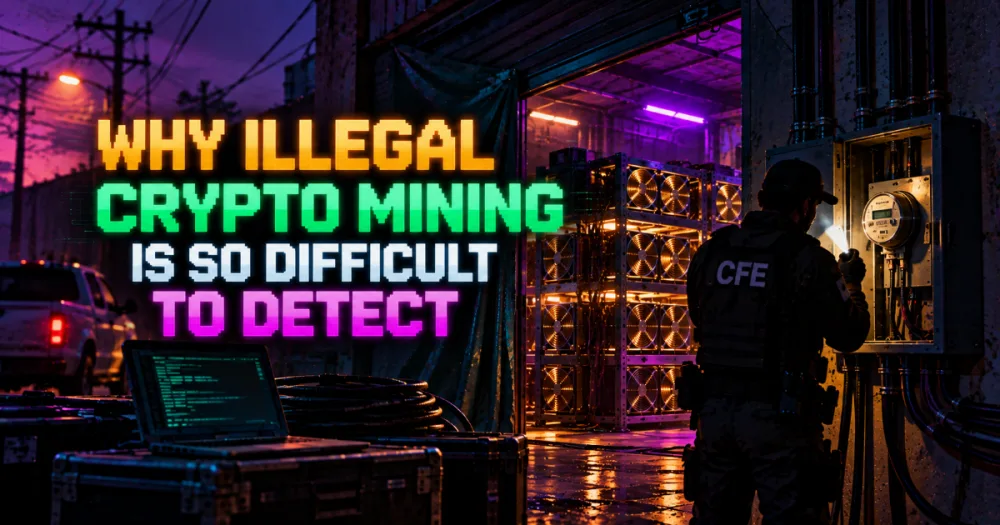
Illegal mines have both a physical footprint and a digital one. In Puebla, the unusually large power connection, excessive electricity usage, and noise tipped the police off to the activity hidden in the remote Sierra Norte that would otherwise have gone unnoticed.
The Electricity Trail
The power consumption could provide one of the clearest signals. According to Puebla security chief Francisco Sánchez González, authorities had been aware of the mining activity around Nuevo Necaxa and of the new large power connection. Additionally, the CFE has started determining if power was stolen.
The issue is if the business would be committing a crime just because it is consuming a lot of energy, and because crypto mining is legal in Mexico, the authorities would need to prove that the business stole electricity.
The Blockchain Trail
Public blockchains can serve as public transaction records. Investigators can trace transactions to wallets and services. Flows from mining can be analyzed for links to suspicious wallets, according to Chainalysis.
Mining does add extra layers of obfuscation, as a reward is generated, and Chainalysis has documented criminals using mining pools in an attempt to further obfuscate the source of their coins.
The Problem of Proving Who Controls a Mining Farm
Finding hardware does not necessarily answer the question of who funded, ran, or even owned the operation itself. In the case of the Mexico crypto farm seized, according to Reuters, investigators are still trying to determine who was behind the Puebla operation, and whether organized crime was involved.
This evidentiary gap may be most relevant in the case of the crypto mining farm linked to Mexican cartel theory; however, while the facility may be large, evidence of cartel possession is lacking.
Mexico’s Growing Fight Against Crypto-Related Money Laundering
n 2025 and 2026, Mexico improved the efficacy of its AML-CFT regime, including with respect to virtual asset provisions. In August, the Financial Intelligence Unit (UIF) cited new regulations that clarified the regulatory obligations of entities carrying out activities considered vulnerable under Mexico’s AML legislation.
Amid record seizures from criminal organizations and cryptocurrency, in May 2026 the UIF identified a network that allegedly laundered fentanyl profits using cryptocurrency payment systems. This illustrates the Mexico crypto money laundering challenge.
How Mexican Authorities Track Suspicious Crypto Transactions
Mexican law classifies professional virtual-asset exchanges as a vulnerable activity outside the financial system, and their providers are required to register, identify customers, and submit notices on their activities to authorities.
The UIF uses financial, fiscal, and corporate analysis during investigations. In July 2026, the UIF identified transfers and operations related to virtual assets within networks allegedly connected to the CJNG, among other signs.
The Role of Federal Prosecutors and Security Agencies
The Tlaola operation involved the FGR, the Mexican Navy, and the Public Security Secretariat of the State of Puebla. The authorities confiscated around 300 specialized computers and a large electrical and satellite-internet system.
Their inquiry has sought to understand if virtual assets included in the property were used to help disguise the illegal source of the funds. So far, authorities haven’t said if laundering occurred.
What Happens to the Seized Mining Equipment?
Puebla government said that the property and everything found inside, including the computing equipment, transformer, medium-voltage terminals and satellite antennas, was put at the disposal of the skilled authority while investigations continue.
No final disposition of the seized hardware has been disclosed, and the hardware remains as evidence in the active investigation, so it is too early to say whether or not the hardware will be sold, destroyed, or reused.
| AML Enforcement Area | Mexico’s Approach |
| Virtual-asset services | Covered by AML obligations for designated vulnerable activities |
| Customer identification | Providers must identify customers under applicable requirements |
| Transaction reporting | Qualifying activity must be reported to authorities |
| Financial intelligence | UIF analyzes financial, fiscal and corporate information |
| Criminal investigations | FGR and security agencies investigate suspected offenses |
| Seized mining hardware | Held by authorities while the investigation continues |
What Happens Next in the Puebla Crypto Farm Investigation

The investigation continues. The Federal Attorney General’s Office, the Navy, Puebla security forces, and the Federal Electricity Commission are investigating the alleged electricity theft and possible financial crime connection. Items and equipment remain in official custody pending the outcome of investigations.
Authorities Search for More Mining Sites
Authorities in Puebla plan to broaden their searches to other municipalities. Security chief Francisco Sánchez González said that authorities found similar operations in neighboring states but did not specify which states.
This search came after three other mining operations in Puebla and Tlaxcala in 2025 had been shut down, though authorities have not determined if these operations were linked.
Read More:Iran Is Using Tether to Bypass Sanctions: Crypto’s Biggest Real-World Use Case Just Got Darker
Investigators Examine the Source of the Equipment
Also seized were typically 300 specialist GPUs, a pedestal transformer, 80 medium-voltage terminals and eight satellite internet antennas. The government stated that such infrastructure has been secured and is under investigation.
Authorities have not disclosed who may have purchased or supplied the hardware, making it unknown which specific criminal organizations provided the equipment for the attacks.
The Key Question: Who Was Behind the Operation?
Authorities did not reveal the identity of the facility’s owner or operators; Reuters stated that, while authorities are investigating whether the facility is funded by organized crime, they have not proved it is controlled by the cartel.
That distinction has been at the heart of the Mexico crypto farm cartel investigation, an inquiry into whether the Tlaola crypto-mining farm’s output could have been used to launder cartel money, and who was behind the operation.
FAQ
That being said, it has not been confirmed. It is unknown whether criminal groups have financed the Tlaola facility, and no cartel has claimed to own or operate it. The federal prosecutor’s office told Reuters it would not comment, as the investigation was still under way.
The Puebla government reported that nearly 300 units of specialized computing hardware, or GPUs, had been found there with approximately 80 medium-voltage terminals, along with a transformer and eight satellite internet antennas.
Yes. Cryptocurrency mining is not banned in Mexico. In the case of Puebla, the alleged illegality was not the act of mining, but the stealing of electricity.
Because mining operations of this scale use vast amounts of power, authorities are investigating whether the Tlaola operation was illegally drawing power from the nearby hydroelectric infrastructure to avoid one of the highest costs of mining.
Possibly: Chainalysis reported that the stolen cryptocurrency may have been disguised as the proceeds of mining by passing it through mining pools.