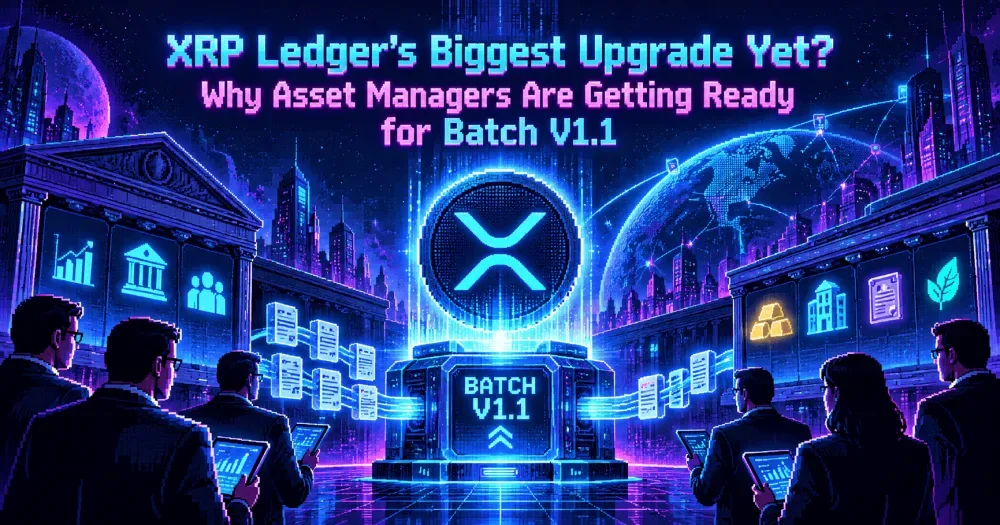
The XRP Ledger is approaching one of its most consequential upgrades in years. Batch V1.1 would let users bundle up to eight transactions into a single operation, making it possible for multiple transfers to succeed together — or fail together. Ripple says asset managers and other commercial projects are already preparing to use it.
If validator support remains above the required threshold, the amendment is expected to activate shortly after September 29.
That sounds like a relatively technical change. In practice, Batch V1.1 could solve one of the biggest problems facing institutions moving traditional financial assets onchain: how to guarantee that every part of a complex transaction settles exactly as intended.
Related: XRP RSI Hits a 13-Year Low: Is XRP Finally Setting Up for a Reversal?
For asset managers, exchanges and tokenization platforms, that may matter far more than another increase in raw transaction speed.
What Is Batch V1.1?
Today, multiple XRP Ledger transactions normally execute separately.
Suppose an investor buys a tokenized bond. One transaction transfers the bond. Another transfers the payment. A third might collect a platform fee.
If these are separate transactions, one can succeed while another fails. That creates settlement risk and forces developers to build additional systems around the blockchain to manage incomplete trades.
Batch V1.1 changes that.
The amendment introduces a Batch transaction capable of containing up to eight inner transactions. Developers can determine how those transactions should behave as a group.
There are four execution modes:
- All or Nothing: Every transaction succeeds or the entire batch fails.
- Only One: Transactions are attempted until one succeeds.
- Until Failure: Transactions execute sequentially until one fails.
- Independent: Each transaction executes independently while remaining inside the same batch.
The first mode is particularly important for financial institutions because it enables atomic transactions: either every required part of a trade occurs, or none of it does.
Why Are Asset Managers Interested in Batch V1.1?
RippleX has confirmed that asset managers and other commercial projects are already preparing products around Batch V1.1.
The companies have not yet been named. RippleX engineering head Ayo Akinyele said more details about work with key asset managers would be disclosed after the feature goes live.
The attraction is straightforward.
Traditional finance already relies heavily on transactions containing multiple linked obligations. A buyer receives an asset only if the seller receives payment. Fees may need to be distributed. Custodians and intermediaries may have separate requirements.
Blockchains can move assets quickly, but speed alone does not eliminate the risk that one leg of a complicated transaction completes while another does not. Atomic settlement does.
With Batch V1.1, the XRP Ledger can enforce that relationship directly at the protocol level.
Why Delivery-Versus-Payment Matters
The clearest institutional use case is delivery-versus-payment, or DvP.
DvP links the delivery of an asset directly to its payment. The asset does not transfer unless the money transfers too.
Imagine an institution buying $10 million of tokenized Treasury securities.
Without atomic execution, the buyer does not want to send $10 million before knowing the securities will arrive. The seller does not want to release the securities before knowing payment will arrive.
Traditional markets solve this through clearing, custody infrastructure and trusted intermediaries.
With Batch V1.1, both transfers could be placed inside an all-or-nothing batch. If either side cannot complete, neither transaction settles.
That is not merely a convenience. It reduces counterparty and settlement risk — two issues that become increasingly important as tokenized assets move from crypto-native experiments toward institutional markets.
Related: XRP Defies $1.38 Billion Ripple Unlock as Institutional Demand Rewrites the Market
Could Batch V1.1 Boost XRP Ledger Tokenization?
This is where the upgrade fits into a much larger XRPL strategy.
Ripple has increasingly targeted tokenized real-world assets, institutional payments and capital markets. The XRP Ledger already supports issued assets, Multi-Purpose Tokens, decentralized exchange functionality and permissioned financial infrastructure.
Ripple has also been expanding its relationships with companies serving asset managers, including investments in transfer-agency specialist ZILO and tokenization platform Licuido.
Batch V1.1 does not suddenly create institutional tokenization on its own. What it does is remove an important piece of operational friction.
A tokenized fund could potentially connect asset issuance, payment and fees. Marketplaces could bundle a customer transaction with their service charge. Two counterparties could swap tokenized assets without either side having to move first.
These are basic capabilities in sophisticated financial systems. Building them directly into XRPL makes the network easier to use as financial infrastructure rather than merely as a payment blockchain.
Exchanges and Wallets Could Benefit Too
Asset managers are getting most of the attention, but Batch V1.1 is not exclusively an institutional feature.
Consider a crypto exchange charging a service fee.
At present, the customer’s transaction and the exchange’s fee may need to be processed separately. Batch transactions can combine them so the payment and fee either both execute or neither does.
Wallets and marketplaces could use the same approach.
The upgrade also supports multi-account transactions. That makes trustless swaps possible without requiring one participant to transfer an asset first and hope the other side follows.
Other potential applications include NFT transactions, complex offers and operations where developers want several ledger actions to behave as a single logical transaction.
In other words, Batch V1.1 makes XRPL considerably more programmable without turning every workflow into a smart contract.
There is an important reason this upgrade is called V1.1.
An earlier version of Batch was approaching activation in February 2026 when security researchers discovered a critical vulnerability in its signature-validation logic.
The flaw was serious.
Under specific conditions, an attacker could potentially include transactions from another account inside a batch without possessing that account’s private keys. That could theoretically have enabled unauthorized transfers or other ledger changes.
Crucially, the amendment had not activated on XRPL Mainnet. No user funds were exposed.
Validators were told to stop supporting the original amendment, and rippled version 3.1.1 prevented it from activating.
Developers then replaced it with Batch V1.1 rather than simply pushing the original version forward.
Read More: Stablecoin KYC Rules Should Not Cover P2P Transfers, Blockchain Association Warns
The security failure delayed Batch, but it also led to a much more aggressive review process.
RippleX says developers redesigned parts of the signing and authorization system and subjected the replacement implementation to multiple layers of testing.
That included four senior engineering reviewers, internal adversarial testing, AI-assisted analysis, a public Sherlock security competition and independent work involving security firms Halborn and Common Prefix.
Reviewers discovered additional problems during that process, including issues involving signatures, authorization checks and potential server crashes.
The corrected implementation shipped with xrpld 3.3.0 on August 6.
That history matters because the original failure could easily be framed as evidence that Batch was unsafe. A more accurate interpretation is that the dangerous version was caught before activation, withdrawn and subjected to substantially deeper testing before validators were asked to consider its replacement.
There is never a guarantee that complex protocol software contains no undiscovered bugs. But Batch V1.1 has undergone considerably more scrutiny precisely because V1.0 failed its first security test.
The amendment crossed the XRP Ledger’s required validator threshold in September.
XRPL amendments need support from more than 80% of trusted validators for two consecutive weeks before activation.
The countdown for Batch V1.1 began on September 15 at approximately 14:06 UTC. As of the latest publicly reported tally, 30 of 35 tracked validators (85.7%) supported the amendment.
If that support remains above 80%, activation is expected shortly after September 29.
The date is not guaranteed.
Validators can change their votes. If support drops back below the threshold before the two-week period ends, the countdown stops and would need to begin again after the amendment regains sufficient support.
So Batch V1.1 is close to activation, but it is not live yet.
“Biggest” depends on what is being measured.
Batch transactions will not suddenly make XRPL dramatically faster, nor do they replace every other feature being developed for the network.
Their significance comes from something less flashy: coordination.
Financial markets rarely involve one isolated action. Assets, payments, fees and permissions interact. Institutions need confidence that linked operations will behave predictably even when one component fails.
Batch V1.1 gives developers a native way to create that behavior without relying on a separate smart-contract layer.
That makes it particularly relevant as XRP Ledger moves toward tokenized funds, securities, collateral and other institutional assets.
Read More: Stablecoin KYC Rules Should Not Cover P2P Transfers, Blockchain Association Warns
The strongest evidence may be what happens after activation. Ripple has not yet named the asset managers preparing to use the technology.
If those projects move into production, Batch V1.1 could turn out to be much more important than its simple description — “up to eight transactions at once” — initially suggests.
FAQ
What is Batch V1.1 on XRP Ledger?
Batch V1.1 is an XRPL amendment that allows up to eight transactions to be packaged together and processed according to predefined execution rules, including an all-or-nothing atomic mode.
When will Batch V1.1 activate?
If validator support remains above 80% for the full two-week voting period, the amendment is expected to activate shortly after September 29, 2026.
Why do asset managers care about Batch V1.1?
The feature can support atomic delivery-versus-payment, allowing an asset and its payment to transfer together or not at all. That can reduce settlement and counterparty risk in tokenized financial markets.
Was the original Batch upgrade hacked?
No. Researchers found a critical vulnerability before the original Batch amendment activated on Mainnet. The vulnerable version was withdrawn, and no user funds were exposed.
Does Batch V1.1 require smart contracts?
No. Batch transactions are native XRP Ledger functionality. Developers can coordinate multiple transactions directly through the protocol without deploying a separate smart contract.