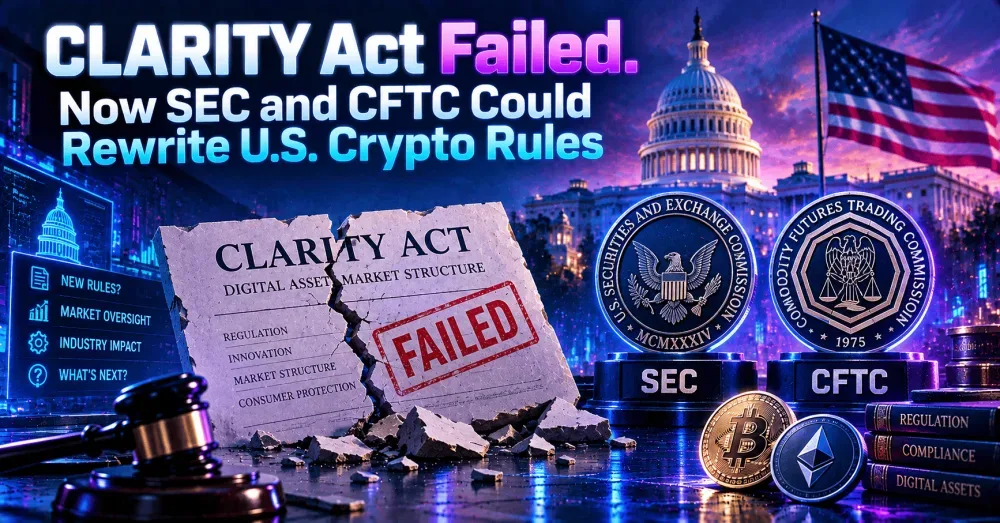
The CLARITY Act failed to advance in the Senate. The attention now turns to SEC crypto regulation, agency rulemaking, tokenized markets, and another possible congressional attempt.
CLARITY Act Failed in the Senate: What Happens to U.S. Crypto Regulation Now
Why the CLARITY Act Failed to Advance
The CLARITY Act failed during a procedural Senate vote, not a final vote on the legislation itself. Lawmakers needed 60 votes to advance the measure, but supporters failed to secure the required support.
Related: Crypto Legislation in Trouble? Experts React After CLARITY Act Vote
Disagreements spanned ethics provisions, stablecoin rewards, banking concerns, and the treatment of decentralized finance. These disputes prevented supporters from building a coalition big enough to move the bill forward.
The result leaves US crypto regulation dependent on existing securities and commodities laws. Although regulators can still act, Congress has not established a broad statutory division of responsibility.
The 49-50 Senate Vote That Changed the Crypto Timeline
The CLARITY Act Senate vote ended 49-50. This outcome was eleven votes below the threshold voters needed to move forward. This outcome dramatically reduced the time available for another attempt during 2026.
Senators can still revisit the measure, but negotiations would need to build upon sufficient additional support. Election activity adds pressure to the remaining congressional calendar.
This delay matters since the CLARITY Act crypto bill sought to establish a clearer market structure for digital assets. It also sought to establish clearer roles for the SEC and CFTC.
Bernstein Sees SEC and CFTC Taking Over the Next Phase
Bernstein crypto analysts expect regulators to take over because their efforts become more important after the failed Senate effort. Their view focuses on rulemaking under authorities already available.
The Bernstein CLARITY Act overview views address targeted rules as well. Agencies can address specific areas, but they cannot fully replace a legislative approach.
That approach could still accelerate change in token classification, trading infrastructure, custody, and other areas. However, it cannot replace legislation if new authorities are needed.
Read more: Crypto Vote: Why the CLARITY Act Just Failed in the Senate
SEC and CFTC Could Move Faster Without a Crypto Bill
SEC Chair Paul Atkins Signals Rulemaking Will Continue

SEC Chair Paul Atkins has noted that crypto rulemaking will continue despite the Senate setback. The agency has already moved towards targeted rules for digital assets and tokenized markets.
Its agenda covers token classification, capital raising, custody, trading, and tokenized securities. This means SEC crypto regulation is central to the next steps in policy development.
However, the agency cannot develop new powers, since Congress refuses to confer them. Its activities must still fit existing federal statutes.
The SEC will focus on areas within its own jurisdiction and rulemaking authority.
H3: CFTC Could Expand Its Role in Crypto Market Regulation
The CFTC also has the potential to take on a larger role in digital asset oversight. Its current authority already extends to crypto derivatives and commodity-related conduct.
The CFTC crypto regulation agenda could involve trading venues, derivatives products, reporting, intermediaries, and other areas connected to commodity markets.
Coordination with the SEC may reduce the risk of divergent approaches. However, the agency does not have comprehensive spot-market jurisdiction by virtue of the failed bill. Congress would still need to grant any broader powers.
That distinction still matters for companies operating both spot and derivatives markets. Their responsibilities may continue to depend largely on the particular product structure.
Related: Why Is Crypto Crashing? Bitcoin, Ethereum and XRP Sink After CLARITY Act Vote
Project Crypto Becomes More Important After the Senate Vote
Project Crypto has become vital to the regulatory landscape, as a joint SEC and CFTC initiative seeking to harmonize federal oversight of crypto assets. The program provides a common platform for regulators, providing an opportunity to make coordinated rulings.
Project Crypto’s importance increases when Congress cannot establish a comprehensive market structure. Agreements on joint interpretations and parallel rulemaking may close important jurisdictional gaps.
It also may reduce situations in which similar assets have differing treatment. Exchanges and issuers may receive guidance to help them understand what regulatory path to follow.
However, joint agency action does not end all unresolved jurisdictional questions, and broader legislative changes may still be necessary.
Which Crypto Rules Could the SEC and CFTC Change First?
Token Classification and the Securities Question
Token classification remains one of the central questions in crypto regulation US policy. Corporations seeking to avoid securities law treatment must know when a transaction crosses legal thresholds.
The SEC has already moved towards clearer definitions. Further rules could address decentralization, managerial involvement, and other issues affecting classification.
This could help issuers launch their tokens more safely. Exchanges would receive greater guidance as to which assets require a securities-compliant approach.
The securities question spans custody, disclosures, registration, and secondary transactions. A clearer framework may address several issues at once.
DeFi and Self-Custody Rules
DeFi regulation and U.S. policy are another area likely to see rulemaking. Self-custodial wallets and interfaces do not neatly conform to traditional intermediary standards. Recent regulatory changes have begun separating software from more standard brokerage activity.
Rules could specify when developers, interface providers, or protocol operators move across regulatory lines. Control over assets and transaction execution will always be important factors.
Self-custody appears likely to receive a different regulatory treatment than traditional custodial platforms. Similarly, regulators may distinguish autonomous software from businesses controlling user transactions.
Innovation Exemptions for Crypto and Tokenized Assets
Innovation exemptions may see greater use after the CLARITY Act fails. These exemptions permit limited activity under specific conditions. The SEC has already applied them to certain tokenized stocks.
Temporary relief allows regulators to observe market activity before they adopt more permanent requirements.
An SEC innovation exemption strategy could allow other onchain market structures to proceed under limited permissions. Such exemptions must always have a credible legal foundation.
They can reduce barriers for companies experimenting with new market infrastructure. However, they may create uncertainty about long-term liability and regulatory treatment.
Related: CLARITY Act Stalls in Senate as Crypto CEOs Slam Vote and Lawmakers Defend Opposition
Trading Platforms, Exchanges and Broker-Dealers
Crypto exchanges regulation represents one of the largest unresolved gaps in crypto regulation. Exchanges can offer a variety of assets under multiple legal frameworks.
The SEC likely will clarify requirements for venues that trade crypto asset securities. Separate rules could apply for broker-dealers supporting tokenized securities and onchain transactions.
Meanwhile, the CFTC could establish its own standards for markets that fall under commodity and derivatives law. Coordination with the SEC could reduce the risk of duplicated compliance requirements. Trading platforms will watch registration requirements carefully. They may also focus on custody, settlement, disclosures, and asset classification as important issues.
| Area | SEC | CFTC | Congress / CLARITY Act |
|---|---|---|---|
| Token Classification | Can clarify when tokens fall under securities law | Oversees commodity-related products within existing authority | Could create a clearer statutory division between securities and digital commodities |
| Spot Crypto Markets | Covers platforms trading crypto securities | Limited authority over broader spot markets | Could grant the CFTC wider spot-market oversight |
| Crypto Exchanges | Can adjust exchange and broker-dealer requirements | Can regulate relevant derivatives venues and intermediaries | Could establish a unified registration framework |
| DeFi And Self-Custody | Can clarify treatment of interfaces, custody, and intermediaries | May regulate activities connected to commodity markets | Could establish broader legal protections and responsibilities |
| Tokenized Stocks | Can use innovation exemptions and securities rules | Limited direct role | Could establish longer-term statutory standards |
| Crypto Derivatives | Role depends on whether securities are involved | Primary regulator for crypto derivatives | Could clarify jurisdiction where agency responsibilities overlap |
| Innovation Exemptions | Can provide conditional regulatory relief | Can introduce relief within its existing powers | Could create permanent legal frameworks instead of temporary exemptions |
| Regulatory Stability | Rules may change under future SEC leadership | Rules may change under future CFTC leadership | Federal legislation could provide a more durable US crypto regulatory framework |
SEC Moves on Tokenized Stocks After CLARITY Act Setback

What the New Five-Year Innovation Exemption Allows
The SEC has approved a five-year framework for certain tokenized National Market System stocks. Eligible venues can operate under conditional relief from exchange registration requirements.
Some liquidity providers can also request conditional dealer relief. The framework permits specified tokenized stocks to trade through permissioned onchain systems. This exemption also includes investor protection conditions and restrictions on eligible assets. Tokenized shares must preserve the rights attributable to their corresponding traditional securities.
Issuers receive a mechanism to object to third-party tokenization. Synthetic products that merely mirror a stock price receive different treatment. The framework distinguishes between tokenized ownership and products that only track a stock price, which may provide a useful distinction for future tokenization rules.
Why Tokenized Stocks Could Become an Early Test of SEC Rulemaking
Tokenized stocks SEC policy presents an immediate test of the agency’s new regulatory approach. Equities already have established rights and disclosure requirements, compared to many decentralized crypto assets.
This may make it easier to place tokenized stocks within an existing regulatory framework. Regulators can examine more closely the infrastructure and settlement details.
Venue data will influence future SEC crypto rules. Trading activity, liquidity, protections, and risks will serve as useful indicators for other rule areas. Tokenized equities could also test whether settlement using blockchain works within traditional securities law, prompting further experiments.
What Crypto Companies Lose Without the CLARITY Act
No Congressional Framework for SEC and CFTC Jurisdiction
The greatest disadvantage is the absence of the complete statutory division between the two major market regulators. Companies remain exposed to overlapping legal questions.
The CLARITY Act sought to establish how digital commodities and securities-related activity would conform to federal oversight. Without it, statutes remain decisive.
A token issuer may need one legal analysis, while an exchange may need another. DeFi projects can face different questions again. This can add legal and compliance costs. Larger firms can absorb these more readily than small market participants.
Why Agency Rules May Be Easier to Change or Challenge
Agency rules can provide meaningful clarity, but they do not offer the level of permanence associated with legislation. Future commissioners can revisit rules they approve.
Courts can also examine whether regulators acted consistently with their statutory authority. Major rules may face litigation or subsequent administrative changes.
Businesses that make long-term investments often prefer stable, legislative frameworks. Shifting rules can raise compliance costs, as well as product development expenses.
This does not eliminate the value of agency action. It merely limits the degree of long-term certainty it offers.
What This Means for Exchanges, Token Issuers and DeFi
Exchanges now need to follow both SEC crypto rules and CFTC crypto rules. Exchanges may have to consider classification decisions.
Token issuers need to consider securities registration, exemptions, disclosures, and safe harbors. Regulatory treatment may depend heavily on the distribution structure and promised managerial efforts.
DeFi projects face different questions regarding custody, control, interfaces, and execution. Self-custodial designs may see a distinctive approach from regulators considering managed platforms.
Companies may narrow product offerings, or wait before they expand in the United States, as they examine emerging regulatory conditions.
Is the CLARITY Act Actually Dead?
Why the Bill Could Still Return Before Congress Adjourns
The failed procedural vote did not kill the CLARITY Act, since Senate rules still permit reconsideration. Supporters could reopen negotiations and rework disputed provisions.
A revised agreement would then need enough senators to pass the bill again. Banking disputes, stablecoin rewards, ethics provisions, and DeFi are all potential areas.
The bill could return if lawmakers manage to secure a broader agreement. However, it will require significant revisions to support another attempt.
The Narrow Window for Another Senate Vote
Time may prove the most critical factor. The Senate faces limited opportunities before election campaigning dominates the calendar.
A new CLARITY Act vote would require negotiations, revised wording, and sufficient political support. Each of these competes for precious legislative time. If lawmakers fail to find agreement, comprehensive crypto market structure legislation may move into the next Congress.
What Comes Next for U.S. Crypto Regulation
SEC and CFTC Rulemaking vs. Congressional Legislation
Rulemaking can move faster than legislation in areas where existing law already grants regulators authority. Agencies can propose rules, issue interpretations, and grant exemptions.
Congress has a different role, as it crafts new authorities. Lawmakers can divide jurisdiction and establish durable obligations across the entire market.
Neither entirely replaces the other, but the combination can address a vast array of US crypto regulation needs.
What Crypto Markets Will Watch Next
Markets will watch the SEC’s approach to tokenized stocks. Expansion of tokenized securities could be the first step towards broader adoption.
Attention will focus on CFTC crypto rulemaking and joint Project Crypto initiatives. New guidance could have an impact on exchanges, derivatives markets, and digital commodities.
Token classification will continue to dominate for issuers and trading platforms. DeFi regulation US developments will matter for wallets and decentralized interfaces.
Finally, markets will watch Congress for the chance to pursue new negotiations. Another CLARITY Act vote could quickly change the outlook for the US crypto regulatory framework.
FAQ
Yes, the Senate failed to advance the legislation during a procedural vote. The result was 49-50. This outcome did not reflect a final passage or a definitive rejection of the bill.
SEC and CFTC officials can continue rulemaking within their areas of responsibility. Congress can also attempt to revive or revise the legislation.
Agency action takes on increased importance in the short term, but fundamental issues will still require congressional action.
Not completely. Agencies can regulate within laws already on the books. They cannot create every type of power addressed in legislation.
Congress still holds responsibility for jurisdictional changes, although SEC CFTC rulemaking can tackle many other US crypto regulation questions.
It can address token classification, crypto capital raising, tokenized stocks, exemptions, trading infrastructure, and broker-dealer treatment.
The agency can also provide expanded guidance on custody and market structure. Innovation exemptions may also be used for targeted experimentation.
The CFTC can explore crypto derivatives and commodity-related trading rules. It can establish reporting rules and coordination with the SEC through Project Crypto.
Its authority over spot markets appears limited unless Congress grants any further jurisdiction.
They will provide an important test of the new five-year innovation exemption. Results from this experiment could help define future tokenized asset rules.
Regulators can study venue characteristics, liquidity, investor protections, and risks before they finalize other regulatory changes.