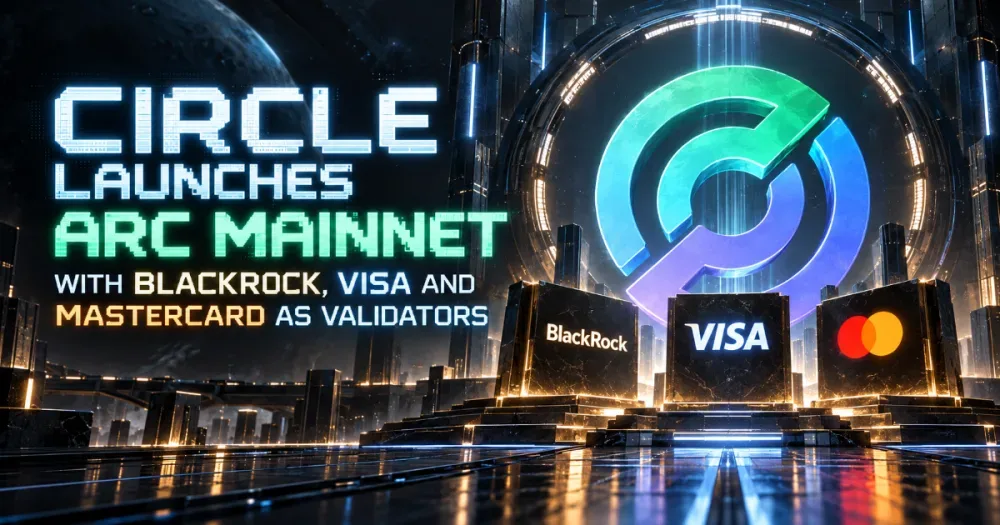
Circle has launched Arc Mainnet, a Layer 1 blockchain seeking to power financial markets, stablecoin payments, and a new wave of AI-fueled economic activity. Arc went live on 16 September with 100+ applications and 100+ institutions and ecosystem participants. Circle’s infrastructure has since expanded past USDC to include a Layer 1 settlement layer.
Because Arc uses USDC for gas, there is no need for volatile gas. According to Circle, the network has sub-second finality and uses post-quantum signatures.
It is EVM-compatible and supports Ethereum-compatible Solidity contracts and tooling. Privacy for confidential balances and transactions is in development, to be available for the entire network.
The validator group bringing traditional finance to Arc includes founding members BlackRock, DTCC, Galaxy, ICE, Mastercard, MoneyGram, SBI Group, Standard Chartered, Sumitomo Corporation, Visa, and Worldpay — a subsidiary of Global Payments. Banks, asset managers, exchanges, custodians, payments companies, and DeFi protocols have committed to building on or integrating with the Arc network.
Arc is built out with payments, foreign exchange, trading, and credit infrastructure. Circle StableFX provides 24/7 programmable foreign exchange settlement, and Circle Payments Network is fully integrated for cross-border payments.
On the infrastructure side, there is Aero, fomo and Uniswap. On-chain lending markets include Aave and Morpho. On-chain tokenized products available in the ecosystem include Circle’s USYC, BUIDL, private credit products, and cirBTC.
Read More: Circle Built Its Own Blockchain: What Is Arc and Why It Matters for USDC
Circle positions the Arc product line for autonomous AI agents that can execute economic transactions. According to Circle, 98.8% of the transaction volume of autonomous AI agents using its products is conducted using USDC.
Circle Agent Stack also includes policy-controlled wallets and nanopayments. Via Arc Portal, agents can fund their wallets, set spending limits, and assign onchain tasks. AgentVM, a component of Agent Stack under development, will enable sensitive computations to be carried out in secure enclaves while retaining onchain verifiability.
There is a large developer community, with more than 75,000 active Arc House members, 10,000 Architect ambassadors, and more than 1,200 projects built on Circle’s network, according to Circle.
Arc’s testnet processed over 700 million transactions within the first 11 months. In addition to its mainnet, Circle has launched Arc Studio, an AI-powered code generator for app and smart contract development, and Arc App Kits, an SDK that allows developers to incorporate payments, swaps, onramps, and yield into their apps.
Circle is planning to deploy dedicated network sectors for privacy, high-volume payment transactions, and agents that use artificial intelligence on the network and is considering a migration from Proof of Authority to Proof of Stake in 2027. The genesis mint of 10 billion ARC tokens has been completed in the United States.
Circle envisions the ARC as the network’s future security, utility, and governance coordination mechanism, with fees paid in USDC, with their mint not being an obligation for Circle to release an ARC token publicly.