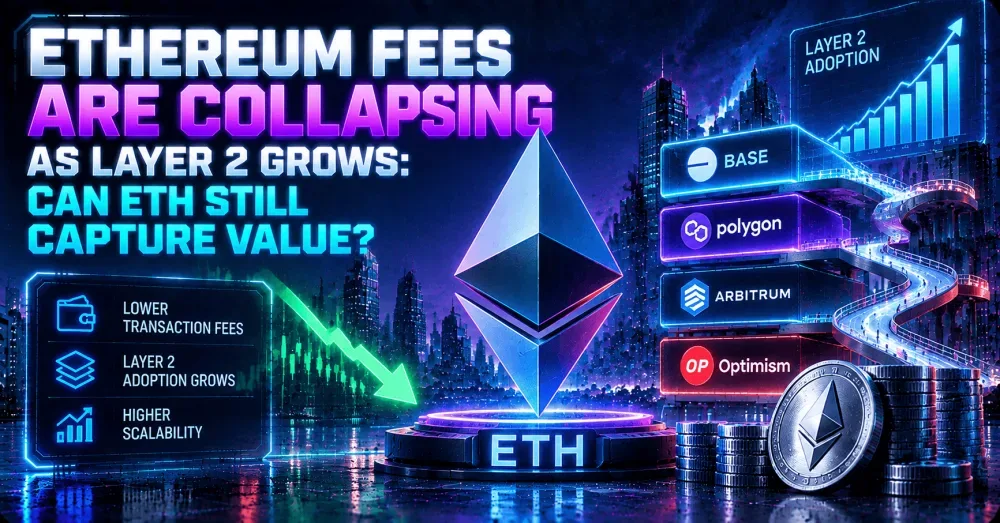
Ethereum is entering a new scaling phase as Layer 2 networks reduce transaction costs and move more activity away from the mainnet. While cheaper fees improve adoption, they also raise questions about ETH value capture, revenue, and whether Ethereum can benefit from the growth of its expanding Layer 2 ecosystem.
Ethereum Fees Are Falling as Layer 2 Activity Grows
Ethereum fees have fallen as more users and applications adopt Layer 2 scaling solutions. The networks process transactions separately but rely on Ethereum for settlement and data availability.
The shift explains why Ethereum gas fees in 2026 are much lower than during periods of intense mainnet congestion. Adoption of Layer 2 networks has decreased the load on the main chain.
The balance sheet economics of Ethereum are now challenged by the growth in alternative settlement layers.
Read more: Crypto Vote: Why the CLARITY Act Just Failed in the Senate
Ethereum Gas Fees and Revenue in 2026
Ethereum gas fees are dictated by demand for block space. Gas prices rise when there is competition for limited processing power.
Adoption of Layer 2 networks reduced the demand for block space on the mainnet. The Ethereum fee revenue forecast is now dependent on capturing value from settlements and data availability. The network earns from processing transactions, but the scale is lower than previous years.
How Ethereum Layer 2 Networks Changed Transaction Costs
Ethereum Layer 2 networks reduced transaction costs by adopting a settlement and data availability model. The rollups process transactions separately but settle on the main chain.
Users benefit from cheaper fees while enjoying the security of the Ethereum mainnet. The Ethereum gas fees forecast has been impacted by the rise of cheaper alternative settlement layers.
The shift has changed the value capture dynamics of the network.
Ethereum Mainnet vs Layer 2 Fees
The comparison between Ethereum mainnet vs Layer 2 fees helps explain the value capture dilemma. Mainnet settlement incurs higher fees due to the security it provides.
Layer 2 networks have made settlement cheaper, but they still rely on Ethereum for finality. The choice between the two depends on the needs of the application. While large transactions settle on the mainnet, smaller applications use Layer 2 to avoid high fees.
Why Ethereum Layer 2 Networks Are Taking Transactions Off Mainnet

Layer 2 networks are taking a toll on Ethereum mainnet by settling transactions separately. The approach has enabled the ecosystem to scale without overwhelming the settlement layer.
The growth in Ethereum Layer 2 networks has raised questions about their impact on the economics of the mainnet. Determining the effect requires an analysis of how Layer 2 activity translates into demand for Ethereum.
How Rollups Reduce Ethereum Transaction Costs
Rollups reduce transaction costs by batching multiple transactions into a single mainnet settlement. The approach lowers the demand for block space on the Ethereum mainnet.
Both optimistic and zero-knowledge rollups adopt the same model but with different mechanisms. The Ethereum gas fees forecast has been impacted by their rise and the implied scale. Users interact with applications on a cheaper settlement layer while the rollups capture value from processing fees.
Related: Why Is Crypto Crashing? Bitcoin, Ethereum and XRP Sink After CLARITY Act Vote
Base, Arbitrum and Optimism Activity
Base, Arbitrum, and Optimism have become critical to the Ethereum ecosystem. The networks have enabled adoption to grow despite the high cost of mainnet settlement.
Their popularity indicates the demand for cheaper alternatives to Ethereum mainnet. While they enable adoption to rise, the value capture dynamics are different.
The networks benefit from the demand for blockchain applications but capture value differently from the mainnet.
Ethereum Data Availability and Blob Fees
Blob fees open a new avenue for Ethereum to capture value from Layer 2 growth. The rollups purchase blobs to post transaction data on the Ethereum blockchain.
The demand for blobs determines how much revenue Ethereum captures from Layer 2 activity. Higher adoption of rollups will see increased demand for blobs.
Blob fees will become a significant source of revenue for the Ethereum network.
What Lower Ethereum Fees Mean for ETH
Lower Ethereum fees have both positive and negative implications for ETH value capture. While cheaper fees boost adoption, they reduce revenue from gas fees.
The dilemma around Ethereum gas fees and ETH value capture will be resolved by increased network demand.
Ethereum Fee Revenue and ETH Burn
Ethereum fee revenue has been impacted by the adoption of Layer 2 networks. The mainnet captures a smaller share of transaction fees as rollups settle on the settlement layer.
The shift has implications for ETH value capture as EIP-1559 dictates that some of the revenue is burned. Fewer transactions will reduce Ethereum burn, but increased adoption of applications will boost demand.
How EIP-1559 Affects ETH Supply
EIP-1559 has permanently altered the supply economics of ETH. Part of the transaction fees that would have been minted as new tokens are burned.
The mechanism lowers the rate at which ETH enters circulation, reducing its inflationary nature. How does EIP-1559 affect ETH supply? The response depends on network demand. During periods of high adoption, more ETH will be burned, but the demand will offset the increased supply.
Is Lower Gas Demand Reducing ETH Deflation?
Gas demand plays a critical role in determining the rate of ETH deflation. The value captured from transaction fees is offset against supply to determine the net impact on price.
Fewer transactions imply less ETH captured from fees and hence lower deflation rates. Does Layer 2 reduce ETH burn? The impact depends on network demand. The shift to cheaper settlement layers reduces the burn rate, but increased adoption will boost demand for Ethereum.
How Much Value Does Ethereum Still Capture From Layer 2s?
Ethereum captures value from Layer 2 networks by providing settlement and data availability. The security guarantees provided by Ethereum reduce the risks associated with adopting alternative settlement layers.
Determining Ethereum value capture from Layer 2 requires an analysis of the interplay between the two networks.
Layer 2 Sequencers and Ethereum Settlement
Layer 2 sequencers process transactions and determine how to capture value from them. Settlement on Ethereum is inevitable for any application that adopts Layer 2.
The sequencers benefit from the demand for cheaper transactions, but they capture value differently from the mainnet.
Blob Fees and Ethereum Revenue
Blob fees enable Ethereum to capture value from Layer 2 growth. The rollups purchase blobs to post transaction data on the Ethereum blockchain.
The demand for blobs determines how much revenue Ethereum captures from Layer 2 activity. Higher adoption of rollups will see increased demand for blobs. Fees will become a significant source of revenue for the Ethereum network.
Where Layer 2 Transaction Fees Actually Go
Layer 2 fees are distributed differently depending on the network. Some of the revenues go to sequencers while others accrue to Ethereum as settlement fees.
The distribution of Ethereum value capture from Layer 2 is important in understanding their combined economics.
Ethereum vs Layer 2: Who Captures the Economics?
Ethereum and Layer 2 networks have divergent but intertwined economics. The former provides settlement and data availability while the latter captures value from transaction fees.
The relationship will determine the future of ETH value capture.
Ethereum Mainnet Revenue
Ethereum mainnet revenue comes from transaction fees, blob fees, and demand for block space. Layer 2 growth has reduced the share of fees captured by the mainnet.
The network is now reliant on increased adoption to boost revenues from settlements.
Layer 2 Sequencer Revenue
Layer 2 sequencers generate revenue from the demand for cheaper transactions. Their popularity has been driven by their ability to capture value from processing fees.
Sequencers compete amongst themselves to capture a larger share of the market.
MEV and Transaction Economics
MEV captures value from the order of transactions on the blockchain. Both Ethereum and Layer 2 networks benefit from MEV and its associated revenues.
The combined influence will dictate transaction economics in the future.
The Value of Ethereum Settlement
Ethereum settlement provides security to applications that adopt Layer 2. The feature will become the most valuable aspect of Ethereum in the future. Settlements guarantee security without the need for applications to conduct transactions on the mainnet.
| Category | Ethereum Mainnet | Ethereum Layer 2 Networks |
|---|---|---|
| Transaction Processing | Handles final settlement and security verification | Processes transactions separately before settling on Ethereum |
| Transaction Fees | Higher fees due to limited block space and strong security guarantees | Lower fees because transactions are bundled and compressed |
| Main Purpose | Provides security, decentralization, and settlement | Provides scalability and cheaper execution |
| Revenue Source | Gas fees, blob fees, settlement demand, and network activity | Transaction fees collected from users and applications |
| Role In Ecosystem | Base settlement layer for the entire network | Execution layer that expands Ethereum capacity |
| ETH Value Capture | Benefits from demand for block space, blobs, staking, and security | Captures value from transaction execution and user activity |
| Impact On ETH Burn | Higher mainnet activity increases ETH burn through EIP-1559 | Lower direct Ethereum fees can reduce ETH burn if activity moves away from mainnet |
| User Experience | More secure but usually more expensive | Faster and cheaper for everyday applications |
| Security Model | Protected by Ethereum validators and staking | Relies on Ethereum for final settlement and security |
| Future Growth Driver | Demand for settlement, data availability, and blob space | Adoption by applications, users, and developers |
Ethereum’s Layer 2 Strategy Has a Trade-Off

Ethereum’s strategy of relying on Layer 2 networks has a trade-off. While it boosts adoption, the value capture from transactions is reduced.
The network has to rely on increased demand for its services to offset the loss.
More Transactions at Lower Cost
Layer 2 adoption enables more transactions to settle without overwhelming the mainnet. Increased demand for settlement will benefit Ethereum even as fees decline.
More applications can adopt blockchain technology and participate in its economy.
Related: Bitmine Just Bought $69M in Ethereum — Tom Lee Is Closing In on 5% of All ETH
Lower Fees and Reduced ETH Burn
Fewer fees captured from on-chain transactions reduce the rate of ETH burn. Lower supply of ETH will increase demand for the cryptocurrency.
Increased adoption will offset the negative impact of reduced burn rates.
Scalability vs ETH Value Capture
Scalability of Ethereum is at odds with its ability to capture value from each transaction. More demand for blockchain services will increase revenues from settlements and blobs.
Greater adoption of Layer 2 networks implies increased demand for Ethereum services.
Can Ethereum Capture More Value From Layer 2 Growth?
Ethereum can capture more value if the growth in Layer 2 networks increases demand for blobs, settlements, staking, and adoption. Future enhancements to blob space will boost revenues as long as demand sustains.
Increasing Demand for Ethereum Blob Space
Increased adoption of Layer 2 networks will impact Ethereum’s revenues from blobs. The popularity of blobs will dictate how much the network benefits from their availability. Blob space utilization will be a key determinant of Ethereum’s future revenues.
Ethereum Staking and Network Security
Ethereum staking guarantees network security and enhances settlement confidence. Staking will become critical to boosting revenues from Layer 2 networks. The popularity of Layer 2 networks will increase the value of Ethereum staking.
Interoperability and Shared Liquidity
Interoperability between Layer 2 networks will boost liquidity and adoption. Shared liquidity will increase demand for settlement on the Ethereum blockchain. A more liquid network will capture more value from each transaction.
Future Changes to Ethereum’s Fee Market
Ethereum’s fee market will continue to evolve to enable the network to capture more value. Future changes will be geared towards boosting revenues from Layer 2 growth.
The focus will be on enhancing settlement security to increase value capture.
Is Ethereum Still the Economic Hub of Its Layer 2 Ecosystem?
Ethereum faces a challenge as Layer 2 networks grow in popularity. While they rely on Ethereum for security, their popularity threatens to undermine the value capture capabilities of the mainnet.
The long-term value of Ethereum will be determined by its ability to offset these risks.
Ethereum’s Role as a Settlement Layer
Ethereum’s role as a settlement layer enables it to capture value from Layer 2 activity. The value of its blobs, settlements, and staking will define its future as the leading blockchain.
Ethereum will maintain its position as the preferred settlement layer despite competition from other blockchains.
Layer 2 Dependence on Ethereum
Layer 2 networks will continue to depend on Ethereum for security and settlement. The reliance will ensure that their popularity does not come at the expense of the mainnet.
Competition From Solana and Other Layer 1 Networks
Solana and other Layer 1 networks pose a threat to Ethereum’s dominance in the blockchain space. They offer similar benefits but at a lower cost. Their popularity is a concern for Ethereum as the two blockchains vie for supremacy.
Ethereum Fees and ETH Value Capture: What the Data Shows
The data highlights the changing dynamics of Ethereum’s value capture from on-chain transactions. While revenues have declined, the network enjoys greater adoption, which will boost future revenues from settlements.
Ethereum Fees vs Layer 2 Fees
Ethereum fees are higher than those of Layer 2 networks due to their superior security guarantees. The security of the mainnet comes at the expense of higher fees.
ETH Burn vs New ETH Issuance
ETH burn dictates how much of the transaction fees captured by Ethereum are offset against supply to determine net impact on price.
New ETH issuance will dictate how much the supply of the cryptocurrency will increase.
Ethereum Revenue and Layer 2 Growth
Ethereum revenue will be dictated by the demand for Layer 2 networks. Their popularity will boost revenues for the mainnet even as gas fees decline.
Can ETH Capture More Value as Ethereum Scales?
ETH can benefit from increased demand for Ethereum services as the network scales. Greater adoption will boost revenues from settlements, blobs, staking, and new issuance.
The popularity of Layer 2 networks will increase the value of Ethereum settlement.
FAQ
Layer 2 networks pose a risk to Ethereum’s ability to capture value from each transaction. Their popularity will reduce the revenues earned by the mainnet.
Ethereum fees are low because many transactions settle on Layer 2 networks. The popularity of Layer 2 networks reduces congestion on the mainnet, thus lowering gas fees.
Ethereum earns money from Layer 2 networks by capturing value from settlements, blobs, and staking. The value capture mechanism is different from how Ethereum earned revenues before the rise of rollups.
Layer 2 networks pose a risk to Ethereum’s revenues from each transaction. The popularity of Layer 2 networks threatens to undermine the value capture capabilities of the mainnet.
EIP-1559 dictates that part of the revenues captured from transactions are burned. The impact of EIP-1559 on ETH supply depends on the level of network demand.