XRP Scarcity Index Turns Negative: What Does It Mean for XRP Price?
Binance's XRP scarcity index has dropped into negative territory, hitting approximately -0.94. Despite this increase in exchange supply, XRP prices have held near $1.50, supported by robust institutional demand and significant long-term fund holdings.

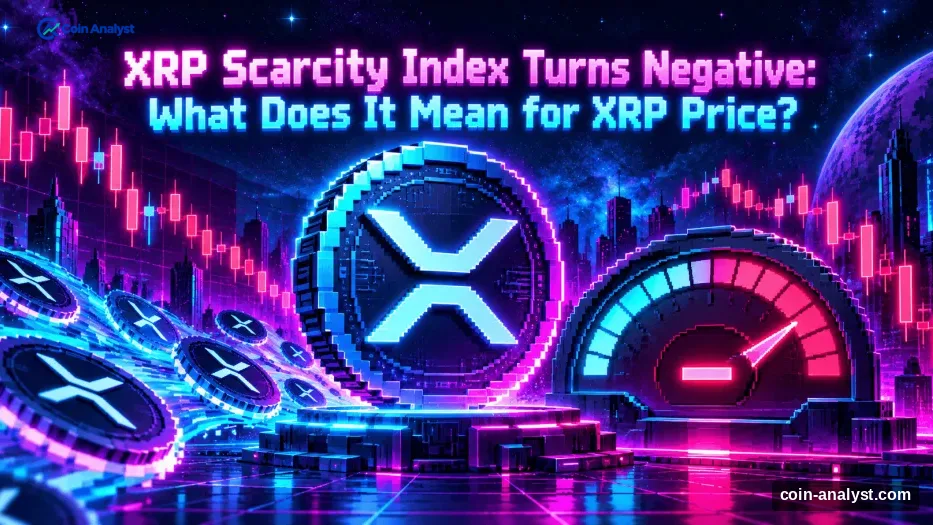
A fresh supply metric suggests XRP is facing a new hurdle on-chain. Binance’s XRP scarcity index has dipped into negative territory, hitting an average of approximately -0.94—its lowest point since January 2025. Only three months prior, the exact same indicator hovered close to a two-year high.
On the surface, this development appears bearish, implying an increase in readily available trading supply. However, the signal is complex, especially with XRP maintaining a price near $1.50, exchange reserves remaining far below their 2024 peaks, and institutional funds retaining over a billion tokens.
What has shifted, and does a negative XRP scarcity index automatically signal declining token prices?
Related: XRP 2016 Pattern Returns: EGRAG Crypto Says $50 Could Be in Play
What Is the XRP Scarcity Index?
The XRP scarcity index measures the relative availability of XRP on Binance relative to past baseline conditions.
The fundamental concept is straightforward:
- A higher index indicates a lower volume of readily accessible XRP on Binance.
- A lower index indicates a higher volume of readily accessible XRP on Binance.
- A negative index denotes an unusual abundance of XRP compared to the historical baseline.
This distinction matters because crypto assets stored on centralized exchanges can be liquidated nearly instantly, whereas tokens kept in self-custody, institutional vaults, or long-term storage are far less likely to flood the open market immediately.
Consequently, exchange liquidity heavily influences the immediate sell-side pressure an asset might encounter.
When demand surges while circulating exchange supply is scarce, buyers are often forced to drive up bids to attract sellers. Conversely, if exchanges are well-stocked, that same wave of demand can be absorbed with less dramatic price shifts.
The XRP scarcity index attempts to capture these precise liquidity differences.
Why Has the XRP Scarcity Index Turned Negative?
The shift into negative territory occurred with striking speed.
As noted, the Binance XRP scarcity index climbed to about 0.77 in July—its highest reading in roughly two years—before plunging below zero in early September and dropping further to about -0.94 by late September.
That represents a massive transformation over a brief window.
Individually, this points to a substantial decrease in exchange-based scarcity for XRP.
Recent activity on trading platforms supports this trend. Data from CryptoQuant revealed that Binance reserves averaged roughly 2.68 billion XRP toward the end of September, tracking about 2.4% above their 90-day baseline.
Yet, a vital nuance remains.
Current reserves still sit well under historical peaks, such as November 2024, when Binance held upwards of 3.2 billion XRP.
Does a Negative XRP Scarcity Index Mean Investors Are Selling?
Not necessarily.
Transferring XRP to an exchange increases liquidation potential, but it does not confirm a trade has taken place.
Recent inflows and outflows on Binance highlight this distinction.
While XRP deposits onto Binance spiked significantly above recent averages during September, withdrawals also surged substantially. As a result, total Binance reserves shifted far less than gross deposit volumes might imply.
This pattern points more toward heavy trading and portfolio repositioning rather than a wholesale rush to exit positions.
Consider an exchange like a busy highway: high traffic can pass through during the day without the parking lot remaining full by midnight.
Ultimately, the XRP scarcity index tracks prevailing market conditions rather than the underlying intent of traders.
Read more: Ripple Brings Brazilian Fund Records to XRP Ledger in Live Regulated Market Rollout
Why Has XRP Price Held Up?
If XRP has grown noticeably less scarce on Binance, why hasn’t its market value collapsed?
It appears that active demand has successfully absorbed the extra liquidity.
XRP traded close to $1.50 throughout late September and early October, even as the scarcity index continued its downward trajectory. This highlights a crucial dynamic: although supply metrics worsened, prices resisted any sharp downturn.
Robust institutional demand may be a primary driver behind this resilience.
According to XRP Insights, U.S.-listed spot XRP funds held roughly 1.16 billion XRP as of October 2. When including allocations through the Bitwise 10 Crypto Index ETF, that cumulative total neared 1.19 billion XRP.
Fund flows have also remained positive. XRP investment vehicles absorbed roughly 51 million tokens during the week concluding September 25. Although inflows slowed significantly the following week, aggregate holdings stayed near historic highs.
This creates a unique supply-demand ecosystem.
While higher volumes of XRP may be tradable on Binance, massive quantities are simultaneously locked away within long-term investment structures.
Consequently, the negative scarcity index acts as a headwind, but not an overwhelming market force.
Is the XRP Scarcity Index Bearish for XRP Price?
In moderate terms, yes. The metric removes a key factor that previously bolstered the bullish outlook for XRP.
When the scarcity index marched toward 0.77, the bullish case was straightforward: exchange supplies were drying up, meaning any surge in demand would force buyers to compete over a dwindling pool of tradable assets.
That potential supply squeeze has now weakened.
A reading hovering near -0.94 signals that traders can no longer rely on tightening liquidity on Binance. Should holders initiate aggressive liquidations, ample accessible supply exists to facilitate that selling activity.
However, asset pricing always depends on both sides of the ledger.
A negative scarcity reading paired with:
- Expanding Binance reserves
- Positive exchange net inflows
- ETF outflows
- Sluggish spot market demand
- Declining asset prices
would present a far more distinctly bearish setup.
At present, that paints an incomplete picture. Instead, XRP has experienced higher exchange availability alongside relatively stable price action near $1.50, implying that buyers continue to mop up substantial portions of available supply.
Related: Best Crypto to Invest in: Bitcoin, Ethereum or XRP? What the Latest ETF Flows Reveal
What Matters More Than the XRP Scarcity Index?
The index yields the most reliable insights when analyzed alongside several complementary indicators.
Binance XRP Reserves
Investors should monitor whether reserve balances genuinely sustain an upward trajectory.
If Binance holdings continue climbing steadily while the scarcity index remains deeply negative, the bearish interpretation gains validity.
This would indicate tokens are actively accumulating on the platform rather than merely passing through.
Conversely, if reserves stabilize or begin declining, the negative scarcity signal loses its potency.
Exchange Netflows
Gross deposits can create misleading impressions if massive inflows are neutralized by equally large outflows.
Sustained positive netflows would confirm that more XRP is entering exchanges than leaving them.
That trend would supply firmer proof of mounting sell-side pressure.
XRP ETF Flows
Exchange-traded funds have emerged as a vital pillar of structural XRP demand.
If ETF balances keep climbing in tandem with expanding exchange supply, institutional buying could successfully absorb the extra liquidity.
Should ETF flows shift persistently negative while Binance reserves grow, however, XRP would forfeit one of its strongest demand cushions.
Spot Price
Market pricing serves as the ultimate litmus test.
A deeply negative scarcity index carries far greater consequence if XRP simultaneously breaks through key support thresholds.
If XRP sustains prices around $1.50 or appreciates despite ample exchange liquidity, the market proves that buyer demand remains robust enough to absorb the circulating supply.
What Would Turn the Signal Bullish Again?
The cleanest bullish roadmap involves a turnaround in the scarcity index accompanied by renewed exchange outflows.
If Binance reserves head downward while ETF holdings and spot demand climb, XRP would face expanding appetite against a diminishing pool of tradable tokens.
This dynamic fosters an environment where scarcity can exert a powerful upward force.
The inverse scenario presents more risk: if the scarcity index stays deeply negative while exchange reserves swell and demand flags, XRP would encounter pressure from both sides of the market.
For now, the market rests comfortably between these two extremes.
What Does the XRP Scarcity Index Mean for XRP Price?
The latest metric reading acts as a cautionary flag rather than a definitive forecast.
XRP has surrendered a portion of the supply advantage it enjoyed earlier in 2026. Binance liquidity is no longer exceptionally tight, reducing the likelihood of an immediate supply squeeze.
Even so, the price of XRP has demonstrated striking resilience.
That strength may be the most critical takeaway. If XRP can maintain its footing near $1.50 while its scarcity index languishes at lows not seen since January 2025, token scarcity is clearly not the sole factor supporting market valuations.
Ultimately, the next price movement will hinge on whether this abundant exchange liquidity transforms into active selling.
FAQ
01What Is the XRP Scarcity Index?
The XRP scarcity index measures how scarce the token is on Binance compared to historical conditions.
02Why Is the XRP Scarcity Index Negative?
The index declined because XRP has become more readily accessible on Binance relative to past periods, falling from roughly 0.77 in July 2026 to about -0.94 by late September.
03Is a Negative XRP Scarcity Index Bearish?
It functions as a bearish supply indicator because a larger volume of XRP is available for potential sale. However, it does not confirm active liquidations. Traders must weigh overall demand, net exchange flows, ETF activity, and ongoing price action.
04Can XRP Price Rise While the Scarcity Index Is Negative?
Yes, provided buyer demand remains strong enough to absorb the available token supply—a diverging behavior XRP demonstrated throughout September 2026.
05What Should XRP Investors Watch Next?
Key indicators to monitor include Binance XRP reserves, exchange netflows, ETF holding trends, and whether XRP can defend crucial price levels while the scarcity metric remains negative.