When Will Nvidia Stock Go Down? Here’s What Could Trigger It
When will Nvidia stock go down? Nobody can name an exact date, since the share price moves with…

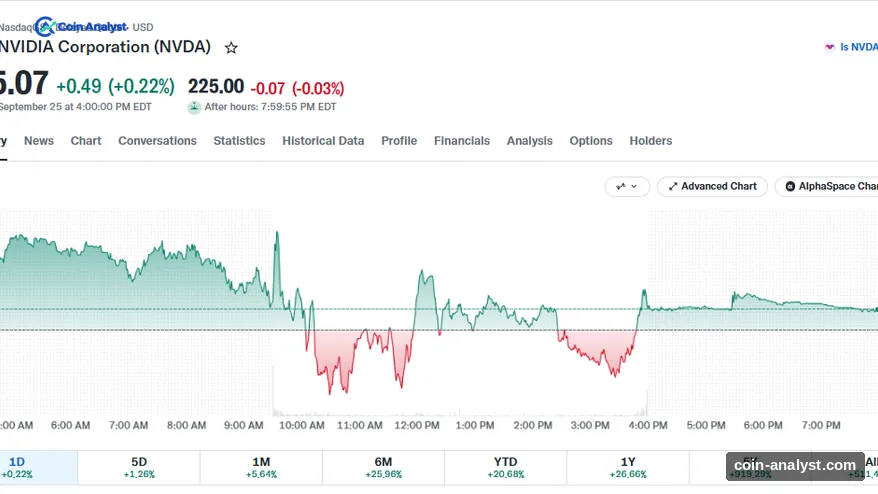
Pinpointing the exact date when Nvidia stock will decline is impossible, as share prices fluctuate based on market forces and real-time economic data. Traders can nevertheless monitor key catalysts, including decelerating AI growth, major clients creating proprietary chips, supply constraints, export controls, and a wider market downturn. Based on the September 25 close, NVDA trades at $225.07. Wall Street maintains a bullish outlook for Nvidia stock, with an average price target of $328.66. Nonetheless, tangible risks have kept the 2026 rally for Nvidia shares relatively restrained thus far.
When Will Nvidia Stock Go Down? Risks, Forecast And Price Targets
Investors often wonder when NVDA might drop if business growth continues at this pace. Nvidia posted $96.2 billion in revenue for the second quarter of fiscal 2027, marking a 106% increase year-over-year.
Nvidia CEO Jensen Huang stated in the Q2 fiscal 2027 earnings release:
“AI has reached its inflection point. It’s doing useful work.”
However, the share price has not fully kept pace. Driven by lingering market concerns over an AI bubble, the stock’s year-to-date gain for 2026 sits at roughly 18%. The answer to a potential downturn likely lies less in corporate earnings and more in external factors.
Supply Limits And Customers Building Their Own Chips
Predicting when supply issues might push Nvidia stock down is difficult, but supply constraints remain a subtle risk for NVDA shares. Management projected approximately 70% growth for fiscal 2028, linking that figure directly to available supply, with CFO Colette Kress highlighting memory scarcity as the primary bottleneck.
Jensen Huang noted the following during the August 26 earnings call:
“Our demand is much greater than 70%.”
A more substantial long-term threat stems from major clients like Google, Amazon, and Meta developing their own chips in-house. Such a drop would likely materialize once these large buyers significantly decrease their reliance on Nvidia GPUs.
Taiwan, Export Rules And Market Shocks
Because TSMC manufactures Nvidia’s most advanced processors and concentrates much of that production in Taiwan, any disruption in the region could severely impact the stock. International chip sales are further constrained by trade policies and export restrictions. Additionally, NVDA exhibits notable volatility, registering an annualized volatility rate of roughly 41.9%. During a broader market sell-off, NVDA stock would likely fall rapidly—highlighting risks that remain completely outside the company’s control.
What Analysts Expect From The NVDA Stock Price Target
The current Nvidia stock forecast remains strongly bullish. A survey of 61 analysts conducted by S&P Global yields a consensus Strong Buy rating for NVDA. The average Nvidia stock price target stands at $328.66, representing an upside of about 46% from the current price. Conversely, the lowest target of $180 illustrates the potential downside if AI spending slows down. Reaching that level would require the realization of Wall Street’s most bearish prediction.
Regarding AI spending, Jensen Huang offered this perspective:
“The AI infrastructure buildout is at full steam.”
Also Read: Nvidia vs. SpaceX: Which AI Stock Has More Potential?
Ultimately, what will drive Nvidia stock down? Current forecasts suggest that underperforming financial results are unlikely to be the catalyst. Instead, the 2026 outlook for Nvidia stock hinges primarily on supply constraints, proprietary customer chips, geopolitical shocks in Taiwan, or a widespread market sell-off.