Pepe (PEPE): 9% Slide Puts Lower Support Zone in Focus
Pepe declined over 8% to trade beneath $0.0000045, putting lower support zones between $0.0000040 and $0.0000042 into focus as analysts weigh breakout conditions.

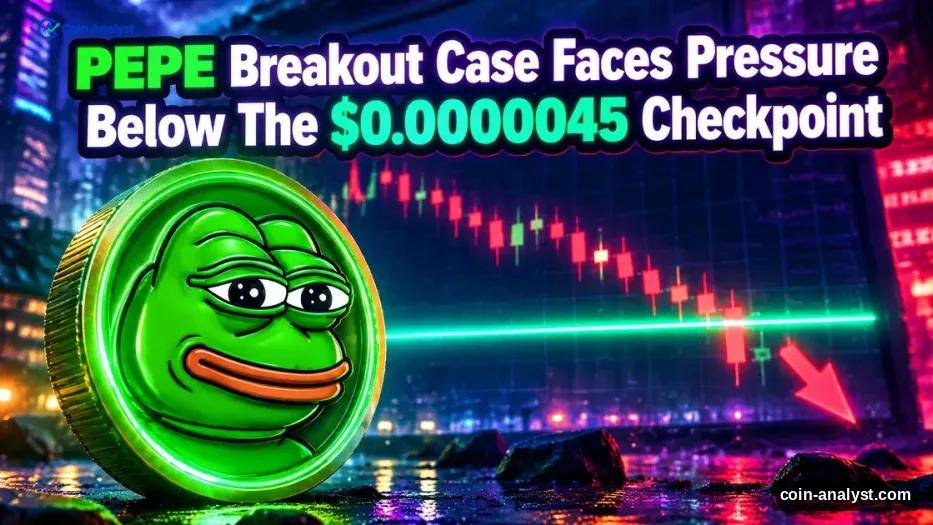
PEPE traded at $0.000004386 on October 24, 2026, at 08:37 UTC, falling 8.71% over a 24-hour period, according to market data from DEX Screener. This downturn pulls the PEPE price forecast beneath $0.0000045, which analysts had flagged as a crucial downside checkpoint during the previous day’s rally.
The immediate question is whether buyers can reclaim that threshold prior to a potential test of the lower $0.0000040–$0.0000042 support range. Earlier bullish projections relied on clearing resistance levels situated well above the current valuation.
What Is PEPE Crypto? The Token Behind the Forecast
Which PEPE Token Does This Prediction Cover?
This overview focuses on the Ethereum-based meme token linked to pepe.vip and the @pepecoineth handle. Distinguishing this asset is essential, as numerous other cryptocurrencies trade using Pepe-inspired names and tickers.
Read More: Pepe Coin Price Prediction: What Would It Take for PEPE to Reach a $10B Market Cap?
The project positions PEPE as a community-driven digital asset centered around Pepe the Frog imagery. Documentation from MetaMask notes that demand for the token is driven by cultural familiarity, community backing, and speculative trading interest.
Why Did PEPE Attract Attention in October?
On October 23, bullish commentary highlighted an upward retracement toward resistance, a pickup in social engagement, and the possibility of further gains. PEPE also touched a monthly high that day before the October 24 pullback reversed those momentum gains.
This shift alters the baseline for price forecasts. Buyers must now attempt to recover the previously cited downside level before they can realistically target the breakout zones discussed during the recent advance.
PEPE Price Prediction: October’s Breakout Case Meets a Pullback
What Would Revive the Bullish PEPE Scenario?
An analysis published on October 23 by Coinpedia established the primary breakout barrier at $0.0000055. Its conditional roadmap pointed toward $0.0000060 following a decisive breakout, with $0.0000065 marked as a subsequent resistance hurdle.
Reaching $0.0000055 from the current price would necessitate a rally of approximately 25%. Pushing to $0.0000060 requires a gain of roughly 37%, while attaining $0.0000065 would demand an increase of about 48%. These figures represent the percentage distance to those targets rather than a guarantee that PEPE will reach them.
Which Downside Levels Matter After the Decline?
The same analysis designated $0.0000045 as an initial pullback target and the $0.0000040–$0.0000042 range as a deeper retracement floor if the sell-off persisted. PEPE’s latest price trades below the first threshold and above the lower support band.
A recovery back to $0.0000045 requires an increase of roughly 3%. Conversely, a drop to $0.0000042 translates to an additional decline of about 4%, while sliding to $0.0000040 would represent roughly a 9% drop. Successfully holding the lower zone or recapturing $0.0000045 would provide bulls with a stronger foundation for another test of resistance.
What Other Conditions Did Analysts Set?
Coverage from CryptoPotato on October 23 cited Token Talk’s projection that PEPE’s market capitalization needed to surpass $2.21 billion. The analyst offered a clear caution: “resistance is resistance until proven otherwise.”
Crypto With Gopal highlighted a potential inverted head-and-shoulders reversal pattern featuring a neckline between $0.0000050 and $0.0000053. Meanwhile, Sjuul, writing as AltCryptoGems, emphasized the need for buyers to defend a flipped support-and-resistance level. Both perspectives relied heavily on follow-through buying.
What Could Break the Recovery Case in October?
The October 23 reports also pointed out a Relative Strength Index (RSI) reading of 94 alongside exchange inflows outpacing outflows. These warning signals accompanied the price surge, indicating overextended momentum and a transfer of tokens toward centralized trading platforms.
For the remainder of October, a constructive outcome hinges on reclaiming the lower thresholds, maintaining steady market participation, and eventually breaking through overhead resistance. Continued selling pressure beneath $0.0000045 keeps the focus squarely on the $0.0000040–$0.0000042 support band.
What PEPE Offers Holders and How Tokens Were Allocated
What Supports Demand for PEPE?
MetaMask classifies PEPE as a tradable cultural token that offers no voting rights, dividend yields, fee distributions, application access, or claims on underlying collateral. Consequently, its investment appeal relies heavily on the ongoing community valuation of its meme branding and cultural relevance.
This dynamic places sentiment at the core of any price scenario. While recognizable branding can drive trading activity, token holders receive no revenue sharing or utility features—as outlined in token guides—to offset any waning speculative interest.
How Were PEPE Tokens Distributed?
Historical data from MetaMask indicates that 93.1% of the initial supply was directed into a public liquidity pool. The remaining 6.9% was allocated to a multisignature wallet reserved for future exchange listings and cross-chain bridging.
These figures outline the original token distribution structure rather than the current reserve balance. The project launched without conducting a presale, meaning these allocations reflect initial token placement rather than funds raised through a token sale.
Which Blockchain Hosts the Main PEPE Market?
The primary token analyzed here operates on the Ethereum network, where its main decentralized liquidity pool is housed in a Uniswap PEPE/WETH trading pair. Official acquisition guides similarly instruct users to procure ETH and swap it for PEPE.
Market listings for the token also encompass platforms on Avalanche, BNB Smart Chain, and Arbitrum. Users must differentiate these network listings from independent projects sharing the same name when selecting an asset or chain.
PEPE Price, Market Cap and Trading Volume on October 24
As of 08:37 UTC on October 24, CoinGecko ranked PEPE 52nd, boasting a market capitalization of roughly $1.84 billion alongside a total 24-hour trading volume of approximately $636 million.
| Metric | October 24 Value |
|---|---|
| Price | $0.000004386 |
| 24-hour change | -8.71% |
| Market capitalization | ~$1.84 billion |
| 24-hour trading volume | ~$636 million |
| All-time high, per MetaMask | $0.00002803 |
The $2.21 billion market cap target cited by Token Talk sits approximately 20% higher than its current valuation. Achieving this milestone requires broad market expansion before that specific bullish condition is satisfied.
MetaMask lists PEPE’s all-time high at $0.00002803. The current price trades roughly 84% below that peak. Reclaiming the all-time high would demand a price increase of about 539% from $0.000004386, making the near-term analyst targets much closer benchmarks.
MetaMask records PEPE’s initial fixed supply at 420.69 trillion tokens, accounting for subsequent token burns. The fractional token price is a direct mathematical result of this large initial supply paired with the asset’s overall market capitalization; thus, the roughly 25% gain required to reach the noted breakout threshold serves as a more practical gauge of the immediate hurdle than the nominal token cost.
Why PEPE Drew Attention: Social Activity and Whale Buying
What Did Social and Network Activity Suggest?
The price analysis from October 23 highlighted sharp spikes in PEPE’s social dominance metrics and active wallet addresses. The bullish thesis relied on this engagement persisting alongside a technical breakout rather than fading quickly after an initial price push.
This factor remains relevant following the pullback. Renewed buying accompanied by steady network participation would reinforce a recovery narrative, whereas declining engagement leaves any rebound vulnerable to profit-taking.
How Much PEPE Did the Whale Buy?
Data from Lookonchain, shared by U.Today on October 22, documented a whale purchase of 43.3 billion PEPE tokens valued at approximately $195,000. In total, the wallet acquired about $7.22 million across nine distinct assets.
A whale bought ~$7.22M worth of tokens over the past 24 hours, including:
378,129 $LIT ($1.4M)
6.61M $ENA ($1.34M)
3M $ONDO ($1.34M)
1.154M $AERO ($948K)
241.8 $ETH ($591K)
2,944 $QNT ($589K)
61,252 $UNI ($443K)
1,387 $TAO ($368K)
43.3B $PEPE ($195K)https://t.co/9IgfeLT9A8 pic.twitter.com/ZeCPztInZV— Lookonchain (@lookonchain) October 22, 2026
PEPE accounted for roughly 3% of that overall expenditure. While the transaction underscores notable accumulation by a large market participant, the scale of their wider portfolio should not be conflated with the amount allocated specifically to PEPE.
PEPE reclaimed the fourth position among meme coins on October 23 after briefly slipping behind MemeCore on October 22. During that recovery phase, its market capitalization climbed past $2.13 billion, pushing its overall cryptocurrency market rank to 50.
By October 24, PEPE’s market rank shifted to 52. This fluctuating position underscores the fierce competition for speculative capital, with PEPE’s rebound relying entirely on its ability to attract and sustain buyer interest.
PEPE Risk Review: Token Identity, Anonymous Creators and Demand
Which Risks Matter Most to the Forecast?
PEPE was created by anonymous developers, according to records from MetaMask. Its heavy reliance on community sentiment, paired with sharp daily price pullbacks, exposes the token to sudden shifts in momentum and rapid profit-taking.
The previously noted warnings regarding high RSI levels and net exchange inflows also present headwinds for the recovery hypothesis. Any new upward movement must successfully absorb prevailing sell pressure while generating enough fresh demand to challenge overhead resistance levels.
The official project website states that PEPE features zero transaction taxes, burned liquidity provider tokens, and a renounced smart contract. Project materials describe the smart contract as immutable and the liquidity pool as permanently locked; however, these are claims made by the project creators rather than findings from an independent security audit.
These operational features pertain to specific token parameters. They do not establish a price floor or provide holders with income streams and asset claims, which remain absent from the token’s defined utility profile.
Why Is the Shared PEPE Ticker a Concrete Risk?
Alternative Pepe-themed tokens circulate across Solana, Base, Tron, and other blockchains. Consequently, a familiar frog illustration or identical ticker symbol can easily lead traders to an asset entirely distinct from the Ethereum-based PEPE evaluated in this forecast.
Traders should verify the token’s exact identity and underlying network prior to executing transactions. Market capitalization metrics, price predictions, and trading histories tied to Ethereum PEPE cannot be transferred to another asset simply because it employs similar branding.
How to Buy PEPE and Verify the Token
Aggregate market listings for PEPE include centralized exchanges such as Binance, OKX, KuCoin, Gate, and Bybit. The project’s official website also references availability on Coinbase, Robinhood, Kraken, and Uniswap.
Users should review platform-specific account guidelines and regional compliance requirements before placing orders. For decentralized swaps, the project outlines utilizing a Web3 wallet like MetaMask, acquiring ETH, and connecting directly to app.uniswap.org.
Begin by visiting pepe.vip and cross-referencing the Ethereum listing details on established market tracking sites before selecting PEPE within a wallet or exchange interface. Users should verify the complete smart contract address rather than relying solely on search engine tickers or logos. Finally, confirm the correct blockchain network and trading conditions—especially when navigating centralized platforms, Ethereum markets, or similarly named tokens across alternative networks.
PEPE vs DOGE, SHIB and Other Pepe-Branded Tokens
MetaMask’s comparative analysis highlights that Dogecoin operates on its own dedicated proof-of-work blockchain, whereas Shiba Inu utilizes the Shibarium Layer 2 scaling network. In contrast, PEPE functions primarily as an Ethereum-based cultural token.
These architectural differences shape distinct narratives for each project. PEPE’s current market outlook depends on social engagement, network participation, and speculative demand, rather than documented infrastructure expansion or dedicated network utilities.
Traders must compare underlying blockchains, official project channels, and exact contract identities before evaluating relative pricing. A Solana- or Base-based token named Pepe may represent an entirely separate project governed by its own history and trading dynamics. Shared visual branding implies neither formal affiliation nor malicious intent; for the purposes of this analysis, only the validated Ethereum token’s price action and dated analyst levels are relevant.
FAQ
01When Did PEPE Launch, and Did It Had a Presale?
PEPE launched on April 14, 2023. The project describes its rollout as a stealth release conducted without a presale phase.
02What Is Publicly Known About PEPE’s Creators?
MetaMask identifies the project creators as anonymous developers whose personal identities remain undisclosed. Documentation also confirms that the launch took place without venture capital backing or dedicated team token allocations.
03How Does PEPE Relate to Matt Furie’s Original Character?
The token utilizes artistic imagery inspired by Pepe the Frog, originally created by Matt Furie in 2005 for his comic series Boys Club. MetaMask clarifies that the token was developed independently and holds no official endorsement or licensing agreement from Furie or his representatives.
04What Token Burn Did PEPE Carry Out in October 2023?
MetaMask notes a permanent burn of 6.9 trillion tokens executed from the project’s multi-signature wallet in October 2023. This supply reduction occurred subsequent to the token’s initial distribution.
05Why Is PEPE’s Price Per Token So Small?
With an original fixed supply of 420.69 trillion tokens, the asset’s total market valuation is distributed across a massive number of individual units. Consequently, a fractional unit price coexists comfortably with a multi-billion-dollar market capitalization.
06What Costs Should Traders Check Alongside PEPE’s Zero-Tax Claim?
The project’s zero-tax assertion applies strictly to the token’s internal smart contract mechanisms. Traders must still review applicable platform transaction fees, network gas costs, and total execution expenses displayed by trading venues prior to finalizing any order.
07What Asset Is PEPE Paired With in Its Main Uniswap Market?
The primary decentralized liquidity pool referenced in this overview trades PEPE against WETH on the Ethereum network. Official acquisition guides recommend funding wallets with ETH prior to executing the token swap.
This article is for information only and is not financial advice.