What Is the Tether Inquiry? Reported $6.3M Nxum Deal and Policy Risks
Sen. Richard Blumenthal is investigating Tether and Nxum Group over a reported $6.3 million arrangement involving former White House crypto adviser Bo Hines, raising policy and ethics concerns.

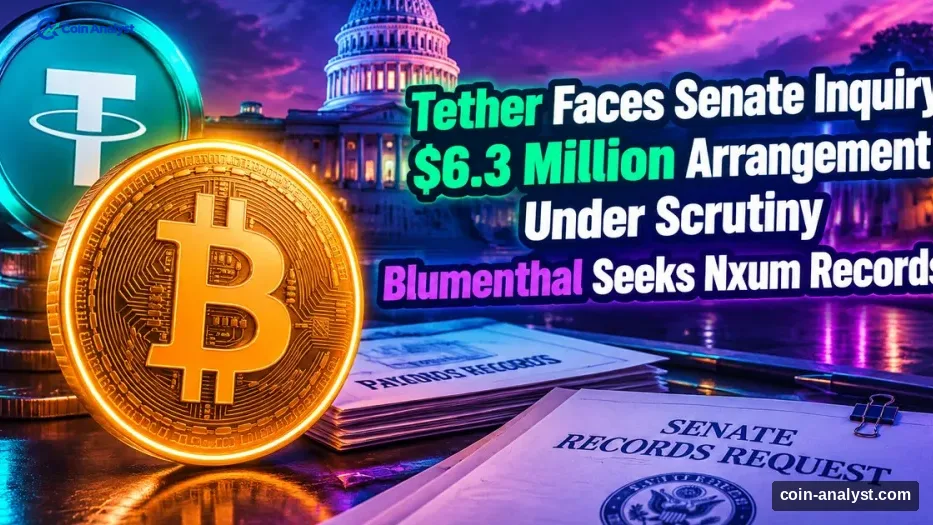
Sen. Richard Blumenthal is seeking records from Tether and Nxum Group. His letters, dispatched on Oct. 22, request a response by Nov. 3, 2026, regarding a reported $6.3 million arrangement backed by Tether and involving the consultancy co-founded by former White House crypto adviser Bo Hines. The focus of the Tether inquiry centers on this reported $6.3 million financial arrangement funded by the stablecoin issuer.
The central questions for Tether involve timing—specifically when funds were transferred, the nature of Hines’s stake, and who engaged in lobbying for stablecoin legislation. Blumenthal, who serves as the top Democrat on the Senate Permanent Subcommittee on Investigations, is requesting voluntary cooperation. Hines currently leads Tether’s U.S. division, placing his transition from government service into the stablecoin sector at the heart of the inquiry.
Tether Inquiry Seeks Contracts, Payments and Lobbying Records
What Did Blumenthal Ask Tether and Nxum to Produce?
The requests demand contracts, payment records, communications, and lobbying information. The letter addressed to Tether was sent to CEO Paolo Ardoino, while a separate request was directed to Nxum Group, the consultancy established by Hines alongside his father and another partner.
Read More: Senator Probes Cantor Fitzgerald’s $10B Tether Stake Over Iran Sanctions Claims
Additionally, Blumenthal is asking for a detailed breakdown of payment dates and methods. This granular information would enable investigators to track the arrangement from the initial contracted services to the delivery of each payment.
What Prompted the $6.3 Million Inquiry?
An investigation by the Wall Street Journal revealed that Nxum generated $6.3 million in Tether-funded revenue, according to PrimeXBT’s coverage of the reporting and letters. The payments reportedly began while Hines was contributing to stablecoin policy formulation at the White House and continued after his departure.
The scope of work encompassed strategic communications and public affairs. Blumenthal is requesting the underlying contracts and correspondence to clarify the exact services performed, the individuals involved, and how the business relationship evolved following Hines’s exit from public office.
Bo Hines Connects Nxum, the White House and Tether US
Which Roles Did Hines Hold?
Hines served as executive director of the President’s Council of Advisers on Digital Assets from January to August 2025. Upon leaving the White House, he transitioned to a strategic adviser role at Tether before advancing to CEO of Tether US.
This position differs from that of Ardoino; Hines manages the U.S. subsidiary, whereas Ardoino acts as Tether’s overall CEO and received Blumenthal’s correspondence. The investigation evaluates the prior consultancy arrangement in conjunction with Hines’s government duties.
<
Who Else Appears in the Business Relationships?
Blumenthal’s inquiry questions why the marketing firm Notorious, alongside its CEO Peter Vincer, functioned as an intermediary. He also inquires why Tether and Nxum shifted to direct contracting after Hines departed the White House.
Furthermore, Harry Jung—another former White House crypto adviser—exited government service in July 2026 and assumed the role of managing director at Nxum in August. This appointment strengthens the consultancy’s connections to past administration advisers, though the payment allegations outlined in the letter specifically target Hines’s ownership and policy responsibilities.
GENIUS Act Lobbying Is Central to Blumenthal’s Allegations
What Does the Senator Say About Hines’s Ownership?
Blumenthal alleges that Hines failed to divest his one-third stake in Nxum during his tenure in the White House. This holding forms the core of the senator’s concerns: an official tasked with shaping stablecoin policy maintained a financial interest in a consultancy receiving funds connected to a stablecoin issuer.
His letter characterizes the arrangement as raising “alarming ethical and legal concerns.” However, the records request represents an ongoing inquiry rather than a definitive finding of wrongdoing.
<
What Lobbying Activity Does the Letter Describe?
According to the senator, Hines utilized encrypted messaging platforms to coordinate with Nxum regarding lobbying and advocacy efforts directed at members of Congress evaluating stablecoin legislation. His letter explicitly references the GENIUS Act.
In Blumenthal’s assessment, Tether directly coordinated Nxum’s lobbying efforts, with Ardoino allegedly urging the firm to “obliterate” the legislation’s opponents. Cointelegraph cited these allegations directly from the senator’s letter.
The requested communications could potentially link the consultancy’s services to specific policy debates and identify who directed the advocacy. Concurrently, the questions regarding contracting address a separate phase of the same timeline: why an intermediary was utilized initially and why the entities later transitioned to direct dealing.
Why the Tether Inquiry Matters for Stablecoin Policy
Why Is the Overlap Between Ownership and Policymaking Important?
The conflict-of-interest inquiry centers on the intersection of Hines’s stablecoin policy work, his alleged ongoing stake in Nxum, and the flow of Tether-backed revenue to the consultancy. Contracts, ownership records, and communications are all viewed as essential to understanding how these elements connect.
Equally significant are Nxum’s assertions regarding Hines’s recusal. Questions concerning whether he engaged in company operations while holding public office and how the firm managed his financial interest go directly to the conduct under review.
What Does This Mean for USDT Holders and the Industry?
The situation focuses squarely on policy advocacy and potential conflicts of interest. It does not impact USDT’s redemption terms or its underlying reserve assets, with the immediate attention directed at the commercial relationship among Tether, Nxum, and a former government official.
For the broader industry, these lobbying records highlight the methods cryptocurrency firms use to interact with officials drafting regulations that impact their operations. Additionally, the transitions of Hines to Tether and Jung to Nxum draw attention to the broader movement of personnel from public service into crypto-related employment.
The next substantive developments for Tether will depend on its formal response to the letters or potential subsequent actions by the committee. Presently, the companies are tasked with reviewing their contracts, payment histories, and policy-related communications.
The $6.3 Million Arrangement and the Dates That Matter
What Do the Payment Total and Ownership Stake Represent?
The $6.3 million figure reflects the revenue generated by Nxum via the Tether-funded arrangement, as detailed in the Journal investigation summarized in the reports. This total spans the duration of Hines’s government employment and the subsequent period.
The one-third figure designates the Nxum ownership interest that Blumenthal alleges Hines maintained. The inquiry seeks a detailed payment breakdown and business documentation to examine how the firm’s revenue, ownership structure, and Hines’s official duties aligned.
Which Dates Anchor the Sequence?
Hines’s tenure at the White House spanned from January to August 2025. His departure was followed by his appointment as a strategic adviser to Tether and subsequent leadership of Tether US.
Jung departed government service in July 2026 and joined Nxum the following month. Blumenthal issued his letters on Oct. 22, 2026, establishing a requested response deadline of Nov. 3.
This chronology is critical because the senator is reviewing payments that occurred across shifts in Hines’s employment status and adjustments to contracting frameworks. Payment timelines and contemporaneous correspondence are intended to contextualize the consultancy’s work within this timeframe.
Tether and Nxum Dispute the Allegations About Hines
How Has Tether Responded?
Tether stated that its external counsel previously conducted an “in-depth internal investigation” which “found no evidence of wrongdoing.” The company acknowledged that the allegations underpinning Blumenthal’s letter originated from the Journal investigation.
CoinDesk published Tether’s statement alongside the senator’s concerns regarding the business relationship. Tether maintains that its independent legal review uncovered no infractions.
What Has Nxum Said About Hines’s Participation?
A representative for Nxum informed the Journal that Hines was entirely unaware of the firm’s dealings with Tether while serving in government and had recused himself from company operations, per PrimeXBT’s summary. The representative also asserted that Hines maintained no economic ties with Tether during his time at the White House.
This response addresses the core issue of Hines’s involvement while in public office. Blumenthal’s demand for communications and financial details aims to secure documentary evidence concerning participant involvement, the timing of the work, and the operational structure of the arrangement.
Contracts may clarify the services Nxum was contracted to deliver, payment records can establish the trajectory and timing of funds, and lobbying communications could identify the individuals directing or executing the advocacy.
Nov. 3 Responses Are the Next Step in the Tether Inquiry
What Authority Does Blumenthal Have?
The letters seek voluntary cooperation by Nov. 3, 2026. Pursuant to subcommittee regulations, the chair—or a designee appointed by the chair—possesses the authority to authorize and issue subpoenas; Blumenthal’s status as ranking member does not automatically confer this power.
This procedural framework places emphasis on the companies’ voluntary responses. Substantive replies, contracts, or payment records could move the inquiry beyond the public allegations and conflicting statements released by the firms.
How Could the Elections Affect the Investigation?
The requested deadline coincides with U.S. Election Day on Nov. 3. Should Democrats reclaim the Senate majority, Blumenthal could resume his role as subcommittee chair, granting him expanded authority to compel the production of records and direct the agenda.
Such outcomes hinge on election results and subsequent decisions regarding committee leadership. In the interim, key developments to monitor include responses from Tether and Nxum, any disclosures of business documentation, and potential further steps by the subcommittee.
FAQ
01When Are Tether and Nxum Asked to Respond to Blumenthal’s Letters?
Both entities were requested to submit responses by Nov. 3, 2026, following the issuance of letters on Oct. 22. This date serves as a target deadline for voluntary participation in the Senate inquiry.
02Which Payment Records and Communications Do the Letters Request?
The requests encompass contracts, detailed payment breakdowns, dates and methods of payment, and communications related to lobbying activities. Blumenthal also seeks clarification regarding the intermediary’s role and the subsequent transition to direct contracting.
<
03How Does This Voluntary Inquiry Differ From a Subpoena?
The current correspondence asks the companies to cooperate on a voluntary basis. Under subcommittee rules, subpoena power rests with the chair or a designated representative, rather than being automatically available to the ranking Democratic member.
04When Did Bo Hines Serve as the White House’s Crypto Advisory Council Executive Director?
Hines held the executive director position from January to August 2025. Following his exit from public service, he joined Tether as a strategic adviser before later assuming the role of CEO of Tether US.
05Which Marketing Firm Acted as an Intermediary in the Arrangement?
Blumenthal’s letters reference Notorious and its CEO, Peter Vincer, when inquiring about the intermediary’s function. The senator also asks for an explanation regarding why Tether and Nxum began contracting directly following Hines’s departure.
06What Has Tether Said About Its External Counsel’s Review?
Tether maintains that outside counsel previously conducted an exhaustive internal review of the matter, which reportedly concluded that no wrongdoing took place.
07What Has Nxum Said About Hines’s Knowledge of the Tether Business?
A Nxum spokesperson told the Journal that Hines had no knowledge of the firm’s transactions with Tether during his government tenure and had recused himself from company affairs. The spokesperson further stated that Hines had no financial relationship with Tether while serving in the White House.
This article is for information only and is not financial advice.