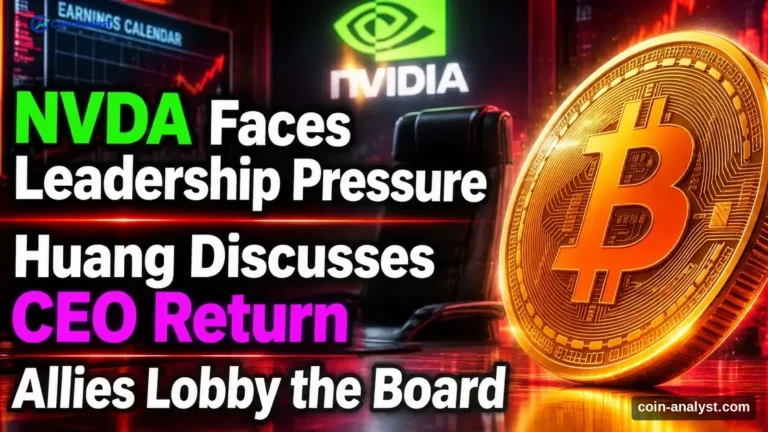
Nvidia Faces $108B Earnings Test in First Report Under Kress
Nvidia faces a high-stakes $108 billion earnings test in its first quarterly report under interim CEO Colette Kress, following the resignation of long-time leader Jensen Huang amid escalating memory prices and significant supplier obligations.


Nvidia (NVDA) is set to report quarterly financial figures on November 17, marking its inaugural earnings presentation under interim CEO Colette Kress, against a projected revenue target of approximately $108 billion. The upcoming results will bring the commercial trajectory of Nvidia’s innovation into sharp focus following the departure of Jensen Huang.
As reported by BeInCrypto, the chief financial officer stepped into the interim chief executive role after Huang’s November 12 resignation. Kress now confronts inquiries regarding escalating memory prices and $279 billion in contractual supplier obligations while unveiling the artificial intelligence chip manufacturer’s quarterly performance.
Nvidia Approaches Its First Earnings Report Under Colette Kress
What Is Nvidia Scheduled to Report on November 17?
The enterprise is slated to publish its quarterly metrics at approximately 4:20 p.m. New York time on Tuesday. Its August revenue projection stood at roughly $108 billion, contrasting with $57 billion in revenue during the corresponding period last year.
Related: Jensen Huang Reportedly Discusses Nvidia Return 3 Days After Resigning
This makes the disclosure a litmus test for whether Nvidia achieved the nearly doubled revenue it anticipated. The forecast establishes a significant benchmark for Kress’s maiden earnings address as interim chief executive.
What Changed Before the Earnings Release?
Huang stepped down after leading Nvidia for 33 years. Kress, who previously managed corporate finances, assumed the interim CEO position prior to the public announcement.
This transition places the executive who earlier cautioned about memory inflation at the helm of explaining the enterprise’s overarching outlook. Market demand, purchasing liabilities, and input expenses will all factor into the evaluation of its AI operations.
How Did Nvidia Shares Trade Before the Announcement?
Nvidia closed Friday at $162.85, sitting approximately 33% below its record peak of $243.37. On Monday, The Defiant reported equities sliding beneath $160, positioning them roughly 34% under the all-time high.
This downturn amplifies the stakes for the earnings publication. Shareholders will review financial disclosures from a firm whose leadership shifted while its valuation dropped by roughly one-third from its apex.
Kress Takes Responsibility as Huang Allies Discuss His Return
What Responsibility Has Colette Kress Taken On?
Kress transitions from her chief financial officer post to serve as interim CEO. She is scheduled to deliver the results and address corporate strategy at a juncture when financial spending commitments have escalated dramatically.
Her prior August remarks already highlighted a primary operational pressure: memory price hikes had outstripped Nvidia’s projections. The imminent presentation merges that cost warning with total accountability for the company’s strategic trajectory.
What Preceded Jensen Huang’s Departure?
Accounts detailing Huang’s exit point to his disclosure of an affair, subsequent accusations, and an internal board inquiry preceding his November 12 resignation. An alleged tie between the involved individual and Chinese intelligence formed a component of the controversy.
The board stated it found “no reason to believe” that national security or proprietary secrets had been compromised. The stock plummeted as much as 14% on the exact day Huang departed.
What Is Being Discussed About a Huang Return?
Huang and his supporters have engaged in talks regarding a campaign to reinstate him, according to Financial Times reporting referenced in earnings coverage. These discussions introduce an additional leadership complication ahead of Kress’s presentation.
This scenario has also permeated analysts’ evaluations. Baird downgraded Nvidia, pointing to uncertainty regarding Huang’s future, whereas Morgan Stanley removed the firm from its top chip selections while maintaining a buy-equivalent recommendation.
Nvidia Innovation: Blackwell Ultra, Vera Rubin and New Applications
Which Chip Developments Were Described in March 2025?
A March 20, 2025 JollofMash report on Nvidia’s developer conference detailed Huang unveiling Blackwell Ultra, an enhanced iteration of its GPU architecture. It additionally outlined a preview of a Vera Rubin GPU slated for 2026.
Read More: Colette Kress Takes Over as Nvidia Interim CEO After Huang’s Reported Exit
Those unveilings outlined a hardware pipeline alongside Nvidia’s broader push into alternative computing use cases. The November earnings event redirects focus toward the incoming revenue and procurement commitments backing that strategic vision.
Which Automotive and Telecom Projects Were Described?
The historical overview detailed a partnership with General Motors designed to equip forthcoming autonomous vehicles with Nvidia-backed in-vehicle processing. It estimated the computing throughput of these systems at 1,000 trillion operations per second.
It also highlighted initiatives with T-Mobile and Cisco Systems focused on AI-optimized infrastructure for 6G wireless networks. Automotive computing and telecommunication systems expanded the articulated applications beyond the data centers fundamental to Nvidia’s AI enterprise.
How Did Huang Describe the Demand Opportunity?
During the conference, Huang contended that more affordable AI models could broaden market adoption and stimulate demand for high-performance computing. This served as Nvidia’s rebuttal to concerns that cheaper alternatives might erode consumption of its premium semiconductors.
The thesis connected more accessible AI software to heightened deployment of computing infrastructure. The impending results will present a commercial checkpoint for the broader operation as Kress navigates sales forecasts and the expenses tied to securing manufacturing capacity.
Nvidia’s Earnings Carry Weight Across the AI Market
Why Does This Quarter Matter to Shareholders?
Earnings analyses peg Nvidia’s market capitalization at roughly $3.9 trillion. At that magnitude, the corporate revenue trajectory and executive transition bear implications for investors far beyond direct equity holders.
Mainstream U.S. index funds hold Nvidia positions. Consequently, its substantial retracement from record highs impacts portfolios gaining exposure through diversified funds as well as investors taking direct stakes in AI computing.
Which Other AI-Exposed Businesses Have Reacted?
Cryptocurrency miners that lease computing power for AI workloads dropped 5% to 10% on the date of Huang’s resignation, per earnings reports. These entities offer an alternative gauge of sentiment toward AI infrastructure demand.
This market response broadened the leadership narrative past the semiconductor manufacturer itself. Nvidia’s subsequent presentation arrives as investors evaluate both its internal execution and the outlook for enterprises supplying computational capacity to AI clients.
What Was the Wider Technology-Market Backdrop?
On Monday, Nasdaq 100 futures retreated 1.5% and S&P 500 futures fell 0.7%, while Nvidia shares dipped 3% in pre-market activity. The earnings release coincides with this wider softness across technology equities.
The calendar concurrently features another major AI milestone: Anthropic targets a stock market debut on Thursday aiming for a valuation near $1.4 trillion. Together, these milestones subject sector expectations to intense scrutiny during the week.
Nvidia’s $108 Billion Forecast Meets Larger Supplier Commitments
How Does the Revenue Forecast Compare With a Year Earlier?
Nvidia’s August guidance projected roughly $108 billion in quarterly revenue, compared with $57 billion during the previous year. This forecast excludes data-center chip shipments to China.
This exclusion establishes a critical boundary around the revenue yardstick. The comparison investors will draw on Tuesday is between actual performance and a financial outlook compiled without those Chinese market sales.
What Profit Figure Do Analysts Expect?
The Zacks consensus referenced in earnings commentary stands at $2.49 per share. Nvidia surpassed Wall Street earnings estimates in each of the prior four quarters.
Top-line revenue and bottom-line profit expectations provide Kress with distinct metrics to address. Her prior admonition regarding memory expenses renders the cost dialogue particularly pertinent alongside the aggregate sales figure.
How Much Has Nvidia Committed to Suppliers?
Procurement liabilities climbed to $279 billion, up from $119 billion three months prior. The majority of these commitments pertain to memory and foundry capacity.
These liabilities underscore the magnitude of Nvidia’s agreements to lock down supplies and manufacturing throughput. Should AI demand contract, a substantial portion of these contractual obligations would still require payment, generating exposure extending past the immediate quarter.
What Share-Price Move Are Options Traders Anticipating?
Earnings coverage highlights an options-implied shift of approximately 8% in either direction, equating to roughly $300 billion based on current valuation metrics. This pricing implies potential for a pronounced market reaction to both the numbers and executive guidance.
Bitcoin Magazine cited Pepperstone analyst Chris Weston via Reuters regarding an expected earnings-day fluctuation of roughly 7% in either direction. Both projections frame the announcement as a catalyst for substantial volatility.
Nvidia Risks Center on Memory Costs, Obligations and Leadership
What Cost Pressure Has Nvidia Already Identified?
Back in August, Kress noted that memory cost increases “exceeded our prior expectations and are headed even higher into next year.” Her caveat paired escalating input costs with the firm’s ambitious revenue projections.
The quarterly figures will allow stakeholders to weigh financial execution against that warning. Supplier liabilities introduce an additional imperative for close attention to executive commentary regarding procurement expenses and future demand dynamics.
Why Do Supplier Obligations Matter if Demand Weakens?
Nvidia’s liabilities concentrate heavily on memory and manufacturing capacity, which are vital for fueling its computing ecosystem. The risk detailed in earnings coverage is that large portions of these financial commitments remain obligatory if AI growth decelerates.
Consequently, the organization confronts the challenge of securing sufficient resources for expansion while accumulating significant financial liabilities. Robust demand would validate the economic rationale behind such outlays, whereas softer demand would render those obligations burdensome to absorb.
How Does Broader Analyst Sentiment Compare With the Cautions?
Out of 38 analysts issuing price targets over the preceding three months, TipRanks data shows 27 buy recommendations and 11 hold recommendations, with zero sell ratings.
The mean price target settled at $241.73, with the lowest target at $170. Overall sentiment remains constructive, even as specific institutions have tempered their enthusiasm amid executive uncertainty.
What Happens Next at Nvidia’s November 17 Results
Which Benchmarks Will Frame Kress’s Presentation?
The primary quantitative anchors are Nvidia’s approximately $108 billion revenue projection and the $2.49-per-share analyst consensus. Management’s commentary regarding expenses and demand will accompany the evaluation against these metrics.
Kress will also report following a substantial expansion in corporate supplier obligations. Her remarks concerning memory pricing and the trajectory of the AI portfolio will assist investors in gauging the operational headwinds beneath the headline figures.
What Else Is on the AI Calendar?
Anthropic’s anticipated Thursday market introduction follows Nvidia’s scheduled Tuesday disclosure. Its aspiration for a roughly $1.4 trillion valuation introduces another prominent AI enterprise to investors within the same trading week.
For Nvidia, attention remains centered on executing against its revenue targets and navigating the strategic outlook under interim administration. The product roadmap, procurement obligations, and executive transition all converge during Kress’s initial earnings presentation as CEO.
FAQ
01Which chip developments did the March 2025 conference account describe?
The review outlined the rollout of Blackwell Ultra alongside an early look at a Vera Rubin GPU targeted for 2026. These formed elements of the hardware strategy presented by Huang at Nvidia’s San Jose developer conference.
02Does Nvidia’s $108 billion revenue forecast include data-center chip sales to China?
The August projection excludes data-center semiconductor transactions involving China. Nvidia formulated its roughly $108 billion quarterly revenue target absent those sales.
03What quarterly earnings per share do analysts expect?
The referenced Zacks consensus sits at $2.49 per share for the period concluding Tuesday. This expectation follows four straight quarters in which Nvidia outperformed Wall Street earnings expectations.
04What do Nvidia’s $279 billion in supplier commitments mainly cover?
They center primarily on memory and foundry capacity. The aggregate stood at $119 billion three months prior, and a significant portion of these liabilities would remain enforceable if AI demand cooled.
05What does the options-implied earnings move measure?
These projections gauge the magnitude of prospective price fluctuations following earnings in either direction. Earnings reports estimate a move near 8%, while Chris Weston’s forecast is approximately 7%; neither constitutes a directional projection.
06How many of the 38 cited analysts rate Nvidia a buy or a hold?
The distribution comprises 27 buy ratings and 11 hold ratings, with no sell designations. This cohort comprises analysts who updated price objectives across the prior three-month window.
07Which companies feature in Nvidia’s automotive and telecom plans?
The March 2025 overview highlights General Motors regarding upcoming in-vehicle computing systems. It additionally references T-Mobile and Cisco Systems concerning collaborative work on AI-ready infrastructure for 6G networks.