VVV Crypto Gains 33% as Venice AI Privacy Claims Face Scrutiny
Venice Token climbed 10.5% to reach $27.85, successfully rebounding from an overnight selloff sparked by researcher scrutiny regarding its AI platform's privacy protocols and self-hosted claims.

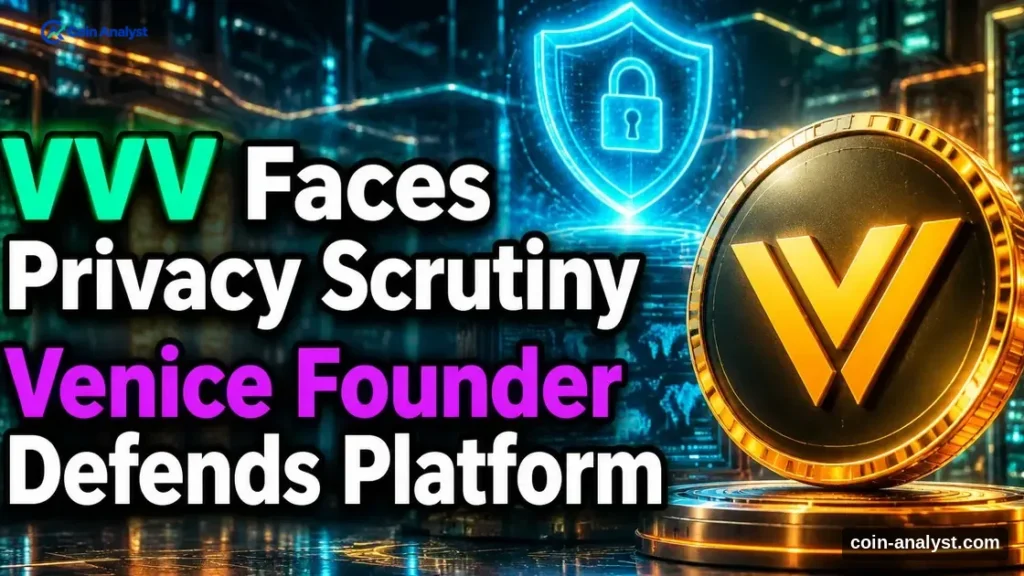
The Venice Token (VVV crypto) climbed 10.5% over a 24-hour window to reach $27.85 on November 26, successfully rebounding from a sudden overnight selloff sparked by concerns regarding its AI platform’s privacy protocols. Erik Voorhees, Venice’s co-founder, acknowledged that the venture must revise its use of the term “self-hosted,” though he firmly defended the mechanisms the platform employs for processing prompts.
This controversy disrupted a robust weekly rally of about 33% leading up to November 25. For VVV holders, the implications go beyond mere brand image: the token unlocks Venice’s suite of AI capabilities, and revenue generated by the platform directly funds token buybacks and burns.
Privacy Dispute Puts VVV Crypto’s Utility Case Under Scrutiny
Operating on the Base network, VVV serves as the native token for Venice, an artificial intelligence platform providing tools for chat, image creation, coding, and more. Both developers and autonomous AI agents utilize the token to purchase inference compute through the Venice API.
Read More: What Is Venice Token? Why This Underrated AI Coin Is Skyrocketing in 2026
Because privacy is foundational to the Venice value proposition, the exact routing of user prompts is critical for the product relied upon by VVV holders. The recent friction emerged just as the token had surged roughly 33% by November 25, outperforming Bitcoin, which dropped about 3.4%. Bullish momentum had also been reinforced by published price projections and a high-profile purchase linked to Arthur Hayes.
Then the market reacted to the privacy debate. VVV tumbled 13.5% within a span of two hours overnight before staging a recovery, leaving it in positive territory for the rolling 24-hour period as of 12:38 UTC on November 26.
What Did the Researcher Challenge?
Operating under the online handle KTibow, researcher Kendell questioned Venice’s characterization of its models as self-hosted after running tests on select models and queries. He asserted that requests were routed to external third-party services and raised doubts about whether Venice or its infrastructure ally Phala could potentially access conversations transmitted via an older encrypted pathway.
In response, Voorhees clarified that certain Private models execute on hardware managed directly by Venice, whereas others run on partner servers in the United States under strict agreements prohibiting data retention. He maintained that the researcher failed to prove the existence of any security vulnerability.
What Did Voorhees Say Needed Changing?
“Private means zero logging of prompts or responses,” Voorhees stated. While conceding that Venice needed to alter its terminology around self-hosting, he insisted that models designated as Private do not retain logs of user inputs or outputs.
Documentation for the Venice API has already replaced references to “self-hosted open-source models” with precise phrasing detailing Venice-operated hardware and partner infrastructure. Consequently, developers selecting models now receive transparent details regarding where their workloads execute.
How Venice Usage Supports VVV Staking and Burns
What Does Holding and Staking VVV Offer?
Participants can stake VVV to gain platform access and accumulate DIEM credits. The digital asset is designed to minimize the cost and friction associated with accessing AI inference through the Venice API.
By targeting developers and AI agents, this economic model directly binds the utility of VVV to overall market demand for Venice’s underlying models.
How Does Platform Revenue Feed Into Burns?
Venice allocates platform earnings toward purchasing VVV on the open market and permanently removing those tokens from circulation. Should privacy apprehensions deter users, a decline in AI service sales could correspondingly diminish the capital available for token buybacks.
How Did the Launch Allocation Burn Differ?
An alternative token burn addressed tokens that remained unclaimed following the initial launch distribution, according to data from Bitrue in March 2025. Venice generated 100 million VVV at genesis, distributing half to users and initiatives within the AI ecosystem.
More than 40,000 users claimed upwards of 17.4 million tokens. While incinerating the unclaimed pool concluded an initial distribution phase, revenue-driven buybacks remain tied to ongoing platform utilization.
VVV Recovers After a 13.5% Two-Hour Drop
Where Did VVV Trade on November 26?
At 12:38 UTC, VVV exchanged hands at $27.85, reflecting a 10.5% gain over 24 hours. Its market valuation stood at approximately $1.38 billion, alongside a fully diluted valuation of roughly $2.26 billion.
Although the asset remained beneath the $30.14 threshold observed prior to the overnight downturn, its resilient daily performance managed to retain a portion of its prior gains.
| Metric | VVV |
|---|---|
| Price | $27.85 |
| 24-hour change | +10.5% |
| Market capitalization | $1.38 billion |
| 24-hour trading volume | $28.2 million |
| Fully diluted valuation | $2.26 billion |
How Did the Two-Hour Drop Unfold?
VVV retreated from $30.14 at 8:40 p.m. ET on November 25 to $26.06 by 10:40 p.m., marking a 13.5% correction. Over the identical timeframe, Bitcoin dipped a mere 0.05%.
By 1:45 a.m. ET on November 26, the token recovered to $27.62. Market participants navigated high volatility in both directions as news of the privacy scrutiny developed.
Analysts Set $32 to $44 VVV Targets Before the Dispute
Where Did the $32, $40 and $44 Forecasts Come From?
Price projections for the Venice token featured a $40 target put forward by Arthur Hayes. Meanwhile, analyst Michael van de Poppe identified $32 as a primary resistance threshold and $44 as a subsequent target region, as reported by CryptoPotato on November 23. Both evaluations preceded the current privacy debate.
Starting from $27.85, advancing to $32 necessitates an increase of roughly 15%. Reaching $40 requires a gain of about 44%, whereas attaining $44 demands an upward movement of approximately 58%. The viability of these bullish scenarios now relies heavily on user trust in the platform.
What Buying and Bullish Attention Accompanied the Advance?
On-chain analytics firm Lookonchain noted that Hayes received 15,000 VVV via Flowdesk following his public endorsement. Additionally, influencer Ansem highlighted VVV, PEARL, and DRV to an audience of 1.4 million followers as assets with distinct bullish narratives.
On November 23, analyst Nebraskangooner viewed the $26 zone as a significant resistance level following a head-and-shoulders reclaim structure. Van de Poppe observed that the chart was holding above its 21-day moving average while outlining a potential retracement toward the $22–$23 range.
What Could Break the Bullish Scenario?
Analyst Arslan reported exiting his position near $26 amid mounting crowds around bullish forecasts. Furthermore, VVV’s relative strength index (RSI) hovered near 70 during the November 23 reporting, indicating overextended momentum at the time.
Sustained confidence and trader sentiment will dictate market direction for the remainder of November. Providing convincing resolutions to privacy concerns could uphold demand, whereas persistent criticism or declining platform engagement risks undermining the fundamental utility driving these optimistic price targets.
VVV Risks: Privacy Allegations, Concentration and Lookalike Tokens
Which Additional Technical Concerns Have Been Raised?
Another researcher, operating as ada cyborg, claimed that Venice directed certain user requests—particularly image generation prompts—to external third-party operators. Additional allegations pointed to unencrypted public-key transmissions, plaintext database keys for chat logs, and seven unencrypted tables out of a total of 21.
The researcher further alleged that users were served outputs generated by swapped models on November 25. While these claims remain unverified, any erosion of user trust poses a risk to the core service supporting VVV’s access and token-burn mechanisms.
<
What Concentration and Trading Risks Matter?
Market metrics from November 23 citing CoinMarketCap indicated that over 90% of the circulating VVV supply was held within the top 10 wallet addresses. Such high concentration can leave trading activity susceptible to large swings driven by a handful of prominent holders.
Tracked market liquidity hovered around $15.1 million on November 26. Combined with the swift overnight reversal, this depth makes order sizing and trade execution crucial factors for market participants.
Why Do Token Identity and Researcher Disclosures Matter?
Several alternative tokens share the Venice name or VVV ticker across the Ethereum, Solana, and Arc blockchains. Because the asset analyzed here operates on Base, traders must carefully verify the correct blockchain network, smart contract address, and intended trading pair.
Kendell disclosed that he accepted OpenRouter credits to conduct surveys of various providers. He also noted that both OpenRouter and his employer, Surplus Intelligence, occasionally route queries through Venice. He stated that he received no financial compensation for his post and that he and his associates retained the freedom to trade VVV.
Venice’s AI Business and VVV Markets
Where Is VVV Listed?
CoinGecko aggregates active VVV trading markets across platforms including Coinbase Exchange, Kraken, Bybit, OKX, Gate, KuCoin, and Upbit. Decentralized liquidity pools on Base—specifically via Aerodrome, Uniswap V3, and Uniswap V4—are also listed.
The VVV/WETH pair on Aerodrome serves as the primary decentralized trading venue tracked here. The official project portal is accessible at venice.ai/home, and users can cross-reference the official contract address against the Venice Token listing page on Base.
What Does Venice Offer Beyond Chat?
Venice advertises a variety of features spanning text generation, image creation, video, audio, coding, and search functionalities. Its official landing page showcases models sourced from entities such as Meta, DeepSeek, Google, and OpenAI, framing user interaction as private and anonymous.
Consequently, the ongoing dispute extends far beyond simple conversational AI. It directly impacts a multifaceted platform managing diverse request types, from graphical generation to enterprise developer API integrations.
<
Who Is Behind the Business Supporting VVV?
Erik Voorhees co-founded Venice, which officially debuted in 2024. A Series A funding round completed in July 2026 secured $65 million at a $1 billion corporate valuation, successfully blending traditional venture financing with a token-centric access framework.
Ultimately, the long-term outlook for VVV depends on whether Venice can retain its user base and expand operational activity while transparently addressing hosting and privacy inquiries. Continued adoption strengthens the token’s structural utility, whereas any compromise to the platform’s foundational privacy commitment presents a direct threat.
FAQ
01When Did the VVV Token Launch?
VVV made its debut on January 27, 2025, on the Base network, following the initial rollout of the AI platform in 2024.
02Which Outside Infrastructure Providers Did Erik Voorhees Name?
Voorhees identified Baseten and DeepInfra as his primary U.S.-based infrastructure partners, noting that their operational agreements explicitly forbid the retention of user prompts and responses.
03What Operational Metadata May Venice Process?
Developer guidelines provided by Venice permit the handling of operational metadata, which includes user IP addresses and the identity of the selected model. This data processing is distinct from the platform’s zero-logging policy for actual prompts and responses.
04How Many Unclaimed VVV Tokens Were Burned After Distribution?
Historical data from Bitrue recorded an unclaimed token burn totaling approximately 32.6 million VVV following the conclusion of a 45-day claim window originating from the initial community allocation.
05What All-Time High Did VVV Reach in September 2026?
According to Crypto Briefing, VVV achieved an all-time high of $34.53 in September 2026, surpassing the $32 resistance benchmark highlighted in previous November analyst reports.
06Is VVV a Governance Token?
During the March 2025 token burn announcement, Voorhees defined VVV as an API-access token rather than a governance asset, emphasizing that its primary function is granting access to Venice’s AI inference infrastructure.
07What Valuation Did Venice Receive in Its Series A?
Venice completed a $65 million Series A funding round at a $1 billion valuation in July 2026, following the platform’s initial 2024 launch.
This article is for information only and is not financial advice.