Ripple Releases 1 Billion XRP in November Escrow Unlock
Ripple released 1 billion XRP from escrow in November 2026, split into two separate 500 million token transactions valued at approximately $1.25 billion, following its standard monthly distribution schedule.

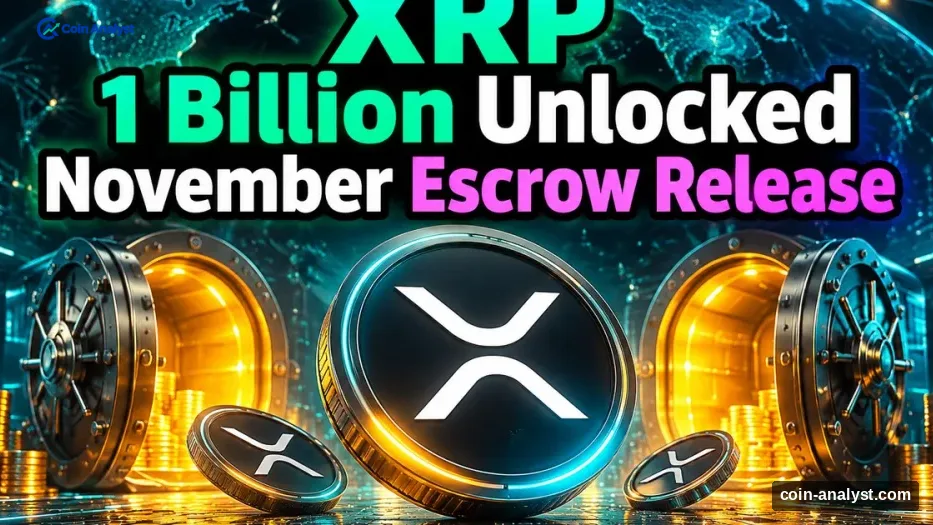
On November 1, 2026, Ripple released 1 billion XRP from escrow, dividing the total into a pair of 500 million XRP transactions. Evaluated at prevailing market prices, this November escrow release carried an approximate value of $1.25 billion.
This follows the standard monthly distribution routine executed by Ripple. Historically, a significant portion of this billion-token release is routinely returned to escrow rather than being dumped onto exchanges or added directly to the circulating supply.
What Happened: Ripple’s November XRP Escrow Unlock Released 1 Billion XRP
Data from Whale Alert, as covered by U.Today, shows that the two transfers occurred during the early morning hours of November 1. Each 500 million token segment held a listed valuation of $626,430,089.
There are no deviations from standard policy here. The release adheres strictly to the timeline established when Ripple locked 55 billion XRP into escrow to be progressively dispensed according to a predetermined schedule.
Combined, the dual transactions amount to 1 billion XRP—valued at $1,252,860,178, or roughly $1.25 billion. Whale Alert flagged the activity as tokens being “unlocked at #Ripple,” though these notices solely verify the escrow departure rather than tracking the subsequent destination of the assets.
🔓 🔓 🔓 🔓 🔓 🔓 🔓 🔓 🔓 🔓 500,000,000 $XRP (626,430,089 USD) unlocked at #Ripplehttps://t.co/ejC9qFmsjb
— Whale Alert (@whale_alert) November 1, 2026
Who Is Behind the XRP Escrow Release?
Ripple remains the entity orchestrating the release. Whale Alert documented the transaction metrics, while U.Today identified it as the company’s inaugural escrow distribution for November.
Ripple has consistently positioned these recurring unlocks as a mechanism to maintain transparency and predictability in its token distribution. However, the exact destination of the tokens, alongside the precise volume retained by the corporation, is not detailed within the escrow mechanism itself.
The system originates from Ripple’s initial choice to isolate 55 billion XRP within escrow, releasing predetermined portions systematically to regulate circulating supply growth in a controlled manner. Outside of this overarching framework, the individual monthly transfers do not come with real-time accounting detailing how the released XRP is ultimately utilized.
Ripple’s Monthly XRP Unlocks and Earlier Returns
According to U.Today, previous months have seen Ripple send roughly 700 million XRP from the unlocked pool back into escrow, retaining the remainder to support operational costs, liquidity requirements, and ecosystem growth. While this reflects past trends, it does not serve as a guaranteed blueprint for November.
For market participants monitoring asset availability, this distinction is critical: although 1 billion XRP left the escrow accounts, the net impact on active supply depends entirely on the scale of any subsequent returns.
Consequently, the headline figure does not equate to a direct net surge in circulating tokens. Historical data indicates that Ripple typically returns a major share of each unlocked batch while keeping the rest for internal purposes. Whether November mirrors this trend will only become evident when subsequent escrow transactions are executed, rather than from the initial pair of transfers recorded on November 1.
Regardless, October was marked by significant developments across the Ripple and XRP ecosystem, including the Swell and XRP Seoul conferences, alongside Coinbase rolling out support for RLUSD. Through Prime, the exchange, and its retail application, Coinbase users gained the ability to trade and manage the stablecoin, facilitating 1:1 conversions using U.S. dollars and other compatible USD-denominated stablecoins.
What the November Unlock Means for XRP Price
Data from CoinGecko indicated that XRP traded at $1.25 at 10:00 UTC on November 1, marking a minor 0.35% gain for the day—an insignificant shift that market reporting does not attribute to the escrow release.
CryptoPotato noted that on the preceding day, the cryptocurrency got caught up in a wider market downturn, sliding from roughly $1.30 down to $1.19 before recovering to $1.25.
Friday’s drop coincided with the largest cryptocurrency hack recorded to date measured in dollar terms. Although XRP rebounded from a multi-month low, news coverage did not link the escrow event to either price movement. By 10:00 UTC, the token commanded a market capitalization of $79,252,451,327 alongside a 24-hour trading volume of $705,450,325.
Analyst EGRAG CRYPTO views the macro chart through the lens of two key boundaries: the 33-month moving average functioning as resistance, and the 77-month moving average providing macro support. The analyst highlights a “magic number” of $1.65 on a monthly closing basis; breaching this threshold could open the door to targets at $8, $13, and $30. While reiterating a separate target of $13.68 and pointing to historical accumulation windows in 2014, 2017, 2020, and 2023—each preceding rallies exceeding 500%—EGRAG acknowledges that historical performance does not guarantee future results.
Conversely, CasiTrades maintains a more conservative outlook on the recent pullback. She contends that the technical framework of the token had already softened prior to the news of the Binance hack, pointing out that XRP repeatedly tested a descending trendline starting October 24. While conceding the hack exacerbated the final leg down, she notes that the market was already primed for a corrective phase and deeper Fibonacci retracements.
XRP Ledger Amendment Vote Is the Next Milestone
The next major focal point for the XRP Ledger is the fixCleanup3_4_0 amendment, which could potentially achieve activation as early as 2:46 PM UTC on November 4, based on XRPScan metrics cited by U.Today. Sustaining validator approval above the 80% threshold is mandatory for activation; a dip to or below 80% will invalidate the proposal and reset its 14-day evaluation timer.
This amendment package impacts a wide array of ledger functionalities, including Single Asset Vaults, the Lending Protocol, automated market makers, the permissioned DEX, trust lines, NFTs, MPTs, escrow, sponsorship, transaction signing, and permission delegation. Furthermore, it unlocks the granular PaymentBurn permission required for Permission Delegation, a feature that originally debuted in October.
The two-week activation window for the amendment commenced on October 21 following a reset in the voting cycle. November 4 represents the earliest possible activation point rather than a certainty, as validator support must remain above the required threshold continuously throughout the entire duration. Even a momentary drop to 80% or lower would cause the amendment to be rejected, restarting the complete 14-day clock and delaying any prospective activation.
The underlying fixes encompass automated market makers, the Lending Protocol, trust lines, NFTs, MPTs, and escrow systems. The PaymentBurn dependency is particularly crucial for Permission Delegation: although the function rolled out in October, users cannot leverage that specific permission tier until the fixCleanup3_4_0 upgrade goes live. This voting process represents an independent near-term milestone for ledger operations, entirely separate from Ripple’s scheduled monthly token releases.
FAQ
01How many transactions made up the November unlock?
Two transfers of 500 million XRP each, both executed during the early morning hours of November 1.
02How much XRP did Ripple originally put in escrow?
As reported by U.Today, Ripple initially placed 55 billion XRP into escrow, distributing portions over time through a structured release mechanism.
03What has Ripple done with XRP from earlier unlocks?
According to U.Today, Ripple has returned approximately 700 million XRP from past unlocks back into escrow, while holding back a portion of the released tokens to cover operational, liquidity, and ecosystem requirements.
04When could the fixCleanup3_4_0 amendment activate?
Activation could occur as early as 2:46 PM UTC on November 4, 2026, provided validator support remains above 80% for the duration of the voting window.
05What happens if validator support falls to 80%?
If support drops to 80% or lower, the amendment is rejected, triggering a restart of the 14-day timer and pushing back activation beyond the initial November 4 target.
This article is for information only and is not financial advice.