Ethereum’s Glamsterdam Upgrade: Can ETH Finally Catch Up with Bitcoin?
Ethereum prepares for its upcoming Glamsterdam upgrade in the fourth quarter of 2026, aiming to enhance layer-1 execution, lower transaction costs, and improve node efficiency to help ETH narrow the performance gap with Bitcoin.

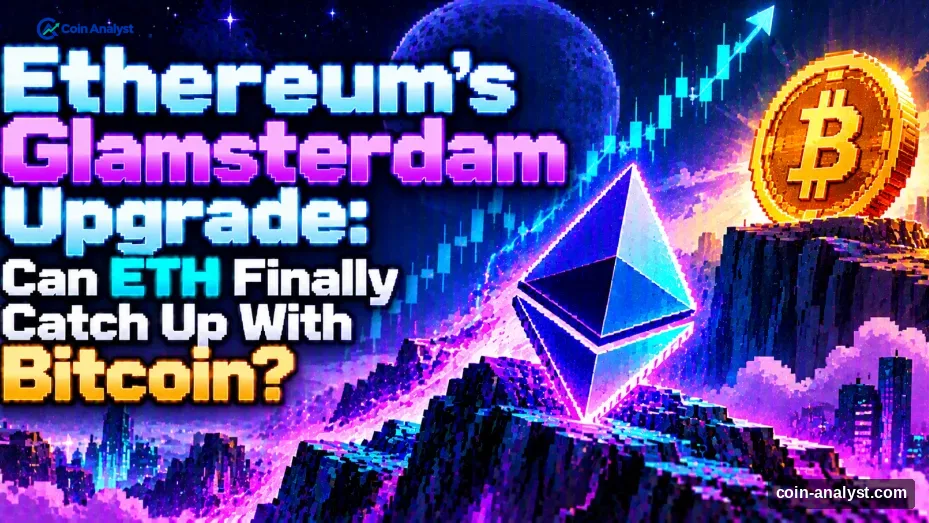
Ethereum heads into the fourth quarter of 2026 backed by a vital protocol catalyst, strengthening market momentum, and a notable rebound during the first half of the year. Together, these developments could finally help Ethereum narrow the performance gap with Bitcoin.
What Is Ethereum’s Glamsterdam Upgrade?
The Ethereum Glamsterdam upgrade serves as the network’s subsequent major hard fork following Fusaka. It integrates modifications to both the execution and consensus layers to scale layer 1 while enhancing validation practicality for independent node operators.
Related: Top 10 Undervalued Cryptocurrencies That Could Outperform Bitcoin in Q4 2026
When Will Glamsterdam Launch on Ethereum Mainnet?
While an exact launch date for Ethereum Glamsterdam remains unconfirmed, developers anticipate its arrival in Q4 2026. Sepolia testing commenced in early October. As is standard for major upgrades, the final activation date relies on testnet stability, client preparedness, and thorough security audits.
Why Glamsterdam Matters for Ethereum’s Next Growth Phase
For years, Ethereum has leaned heavily on layer-2 networks and more affordable data availability solutions for scaling. Glamsterdam redirects greater focus toward layer-1 execution and capacity, even as layer-2 adoption continues to expand in parallel.
How Glamsterdam Builds on the Fusaka Upgrade
The Ethereum Fusaka upgrade centered primarily on data availability and bolstering Ethereum’s layer-2 ecosystem. Glamsterdam picks up where Fusaka left off, placing a heavier emphasis on execution and validation adjustments to pave a more direct route toward increased throughput.
What Will the Glamsterdam Upgrade Change?
The Ethereum Glamsterdam update alters block production, transaction handling, gas accounting, and node synchronization. Each of these modifications aims to boost network throughput without undermining the accessibility of Ethereum validation.
Enshrined Proposer-Builder Separation (ePBS)
Enshrined proposer-builder separation integrates a critical component of block production directly into the core Ethereum protocol. This minimizes certain trust assumptions and permits larger payloads to propagate with adequate processing time.
Block-Level Access Lists and Parallel Processing
Block-level access lists (BALs) specify which user accounts and storage locations will be engaged and altered during a block. This enables validators to execute certain operations concurrently and pre-fetch disk reads. BALs empower Ethereum to harness parallel processing capabilities, eliminating a major bottleneck in execution.
Higher Ethereum Network Capacity
Glamsterdam establishes the necessary infrastructure for expanded future capacity without immediately hiking throughput. By employing extended propagation windows alongside quicker state access, Ethereum can eventually raise the gas limit and dedicate more bandwidth to data. Validators gain additional information and time to handle individual blocks, paving the way for higher transaction volumes.
Lower Transaction Costs
Among the structural modifications arriving with the 2026 Ethereum upgrade are adjustments to transaction gas expenses. Intrinsic gas costs will be altered to render basic transactions more affordable. Expanded capacity can also alleviate congestion, though overarching Ethereum gas prices in 2026 will continue to be governed by demand.
Related: Best Memecoins to Buy in October 2026: 10 Tokens Ready for the Next Rally
More Efficient Data Handling and Node Syncing
Block-level access lists furnish details concerning data access and subsequent state updates. This permits nodes to leverage this intelligence for validation purposes rather than computing every operation from scratch. Consequently, the processing workload required for synchronization drops significantly, boosting the overarching efficiency of Ethereum’s infrastructure at scale.
| Area | Glamsterdam Change | Why It Matters for Ethereum | Potential Impact on ETH |
|---|---|---|---|
| Block Production | Enshrined Proposer-Builder Separation (ePBS) | Moves more block-building logic into Ethereum’s protocol and reduces reliance on external middleware | Could improve network efficiency and strengthen Ethereum’s infrastructure narrative |
| Transaction Processing | Block-Level Access Lists | Helps validators identify accessed accounts and storage before full execution | Supports parallel processing and higher future throughput |
| Network Capacity | Higher Layer-1 Capacity | Creates room for larger gas limits and more activity on Ethereum mainnet | More usage could strengthen demand for ETH |
| Transaction Costs | Lower Intrinsic Gas Costs | Makes basic transactions cheaper and reduces some user friction | Lower fees could attract more activity, but may reduce ETH burn |
| Node Infrastructure | More Efficient Syncing | Reduces unnecessary processing and improves state synchronization | Helps Ethereum scale without excessive hardware requirements |
| Layer-2 Support | Better Base-Layer Efficiency | Gives rollups stronger settlement and data infrastructure | Could reinforce Ethereum’s position as the dominant Layer-2 settlement layer |
| DeFi | Greater Capacity and Lower Costs | Makes trading, lending, and other DeFi activity more efficient | Higher DeFi usage could support ETH demand |
| Tokenization | Improved Institutional Infrastructure | Strengthens Ethereum’s ability to support tokenized assets and financial products | Could attract more institutional activity |
| ETFs | Renewed Ethereum ETF Inflows | Adds a regulated source of demand outside crypto-native markets | Strong inflows could help ETH recover against Bitcoin |
| ETH vs Bitcoin | Potential Relative Revaluation | ETH still trades well below earlier ETH/BTC cycle levels | A successful upgrade and stronger inflows could support ETH outperformance |
| Main Risk | Upgrade Delays | Complex protocol changes may require additional testing | Delays could weaken short-term Q4 momentum |
| Competitive Risk | Solana and Other Layer-1s | Rival networks continue competing on speed, costs, and user growth | Ethereum must convert technical improvements into real activity |
Лучшее место — после H2 “What Will the Glamsterdam Upgrade Change?” и перед H3 “Enshrined Proposer-Builder Separation (ePBS)”.
Why Glamsterdam Could Be a Major Catalyst for ETH
Glamsterdam directly tackles numerous scalability and infrastructure hurdles that have historically weighed on Ethereum’s long-term market competitiveness.
Faster and More Scalable Ethereum Infrastructure
Enhanced throughput can render Ethereum infrastructure increasingly appealing to applications demanding robust settlement capabilities. Developers gain greater flexibility with fewer dependencies on external scaling middleware, while end users experience relief during peak utilization periods. Rising network usage coupled with heightened capacity would reinforce the bullish investment case for ETH throughout 2026.
Lower Fees Could Drive More Network Activity
Exorbitant fees frequently discourage participation, steering transaction volume toward more affordable alternative networks. Ethereum’s shift toward reduced fees positions it to recapture lost value and stimulate engagement across a diverse range of decentralized applications.
Streamlined transactions welcome a broader demographic of everyday consumers and institutional participants. Although Ethereum gas costs in 2026 will still fluctuate according to demand, cheaper base-layer transactions remain a distinct advantage.
Better Support for Ethereum Layer-2 Networks
Glamsterdam bolsters Ethereum’s layer-2 strategy by laying the groundwork necessary for expanded network capacity. Streamlined block generation also allows for larger payload dimensions and sustained data scaling. Layer-2 architectures depend on Ethereum for core settlement, robust security, and dependable data availability.
Stronger Position in DeFi and Tokenization
Ethereum maintains a pivotal role across decentralized finance (DeFi), stablecoin distribution, and asset tokenization sectors. Improved scalability solidifies its status as the premier platform for yield generation and institutional treasury operations. Tokenization demands trustworthy infrastructure, deep liquidity, and dependable settlement timeframes—qualities Ethereum already provides and stands to enhance further via expanded capacity.
Related: Best Crypto to Buy Before the Next Crash: Top 5 Coins to Watch Through the End of 2026
Ethereum vs. Bitcoin: Can ETH Finally Catch Up?
The debate surrounding ETH versus Bitcoin has intensified following Ethereum’s impressive Q3 performance. While ETH has closed some ground on Bitcoin, it still trails significantly from a broader cyclical perspective.
How ETH Has Performed Against BTC in 2026
For much of the current market cycle, Ethereum struggled to match Bitcoin’s pace. Weaker liquidity conditions, lower institutional adoption, and a less straightforward investment narrative made capital allocation toward ETH less compelling. However, this dynamic shifted during Q3 as ETH began staging a more aggressive recovery than BTC. Even in the wake of this rally, the ETH/BTC valuation ratio remains far below previous cycle peaks.
Ethereum’s Q3 Rally vs. Bitcoin’s Performance
Ethereum’s large-cap rally peaked during Q3, delivering a multi-month gain exceeding 70%. Although Bitcoin also exhibited bullish momentum, its gains were more modest at over 40%. ETH successfully recaptured substantial ground relative to BTC, proving that the broader 2026 debate between the two assets can pivot rapidly during a major market upswing.
Why ETH Still Trades at a Significant Discount to Its Potential
Despite anchoring the largest ecosystems in DeFi, stablecoins, tokenization, and layer-2 protocols, Ethereum continues to trade at a substantial discount compared to its previous dollar highs. Skeptics point to rising competition, fragmented layer-2 liquidity, and compressed fee collection as hindrances to value capture. Should network usage growth accelerate past these hurdles, those bearish arguments will be invalidated.
What Could Trigger an ETH/BTC Reversal?
A structural reversal in the ETH/BTC trading pair would likely stem from a confluence of catalysts. While the Glamsterdam upgrade is one such driver, surging ETF inflows and accelerated DeFi utilization could speed up the process. The expansion of tokenized assets could deliver an additional tailwind for Ethereum, aided by any potential softening of Bitcoin’s market dominance.
Ethereum ETF Inflows Add Another Bullish Catalyst
Inflows into Ethereum exchange-traded funds establish an essential demand conduit for ETH, operating independently from direct on-chain activity and network utility. They signal renewed institutional participation and serve to complement the technical enhancements introduced by Glamsterdam.
Ethereum ETF Demand Is Returning
Following an early-cycle lull, spot Ethereum ETFs experienced a clear uptick in demand. This shift in inflows suggests that institutional allocators are reassessing their exposure to ETH. Spot exchange-traded funds offer simplified access, portfolio diversification, and regulatory compliance. Consistent, robust inflows into Ethereum products carry far greater weight for the asset’s trajectory than isolated days of strong price action.
Institutional Interest in ETH vs. Bitcoin
Bitcoin maintains its dominance within the institutional crypto sector owing to its superior market capitalization, deep liquidity, and widespread ETF availability. In contrast, Ethereum offers an alternative avenue of institutional exposure centered around programmable money and decentralized finance, granting investors direct access to DeFi, tokenization, and settlement infrastructure.
Could ETF Flows Accelerate the ETH/BTC Recovery?
Robust inflows into Ethereum ETFs can expedite the recovery of the ETH/BTC ratio by creating steady, sustained purchasing pressure. Relative inflows carry more importance than the raw size of these products. Rapid capital expansion into Ethereum investment vehicles can shift institutional positioning in ETH’s favor, whereas sluggish inflows would constrain its outperformance potential through Q4.
What Could Glamsterdam Mean for ETH Price?
Any price projections for ETH in 2026 should account for underlying fundamental enhancements without overestimating their immediate effect on valuations. While Glamsterdam builds a solid technical foundation for future expansion, broader market liquidity and sentiment will remain key drivers.
The Bull Case for Ethereum in Q4 2026
The bullish scenario for Ethereum through the fourth quarter hinges on the successful rollout of the Glamsterdam upgrade, sustained ETF inflows, and heightened transactional activity. A favorable macroeconomic climate would further complement these elements, establishing ideal conditions for a major altcoin rally. Ethereum is well-positioned to benefit from capital rotation into large-cap assets following Bitcoin’s recent strength, while a smooth technical upgrade would eliminate year-end uncertainty.
Related: Best Altcoins to Buy in October 2026 Before the Next Crypto Rally
The Key ETH Price Levels to Watch
ETH entered October trading near the $2,700 region before experiencing a minor market pullback, making the $2,600 to $2,700 band crucial for near-term trend continuation. A sustained push past $3,000 would solidify the bullish outlook, whereas a failure to defend the mid-$2,500 range could disrupt Ethereum’s Q4 setup.
Could ETH Outperform Bitcoin Before the End of 2026?
ETH is capable of outperforming Bitcoin over the course of Q4 without necessarily establishing new all-time highs. Relative performance is dictated by comparative returns rather than absolute token valuations. Ethereum has already demonstrated superior momentum during the third quarter and could extend its leadership if incoming capital flows and protocol updates continue to fuel the bullish narrative.
The Biggest Risks to the Ethereum Glamsterdam Narrative
Although Ethereum’s Glamsterdam upgrade establishes a compelling technical thesis, various external factors could dampen its reception. Investors should avoid confusing development roadmap milestones with guaranteed price appreciation.
The Upgrade Could Face Delays
Protocol-level upgrades demand extensive testing and coordination across multiple client implementations. Glamsterdam introduces substantial architectural changes that could encounter unforeseen obstacles during the testing phase. For instance, ePBS has already demanded significant engineering efforts prior to mainnet deployment. Similar bottlenecks during testnet evaluations could temper the upgrade’s anticipated benefits.
Ethereum Still Faces Competition From Solana and Other Layer-1s
Solana remains a fierce competitor, challenging Ethereum for dominance in trading volume, payment transfers, consumer-facing applications, and tokenization projects. Other competing layer-1 networks likewise vie for Ethereum’s prospective user base. While Ethereum holds clear advantages regarding security and liquidity depth, retail users frequently gravitate toward faster and less expensive alternatives.
Lower Fees Could Reduce ETH Burn and Fee Revenue
Reduced transaction expenses will directly impact the revenue and token-burning mechanisms generated by Ethereum’s network activity. While lower costs benefit end users, they diminish direct value accrual for ETH holders. The network will need to scale transaction volume substantially to counterbalance the drop in per-transaction value capture.
Macro Conditions Could Override Ethereum-Specific Catalysts
The cryptocurrency market remains acutely vulnerable to shifts in interest rates, global liquidity, geopolitical tensions, and external macroeconomic pressures. Strong fundamentals cannot entirely insulate assets from a widespread market downturn, and climbing yields could weigh on both ETH and Bitcoin valuations. The most favorable Q4 2026 outlook for Ethereum assumes the absence of a broader market crash.
What Comes After Glamsterdam for Ethereum?
Glamsterdam marks a single milestone within Ethereum’s broader roadmap toward massive throughput expansion and enhanced transaction inclusion. Developers continue to pursue parallel strategies designed to scale capacity and elevate the end-user experience across the network.
Ethereum’s Long-Term Scaling Roadmap
Ethereum’s long-term scaling strategy embraces both layer-1 optimizations and layer-2 rollups. Core contributors maintain active development on execution enhancements alongside improvements to data availability and validator efficiency. The network’s tokenomics and upgrade roadmap also prioritize stronger inclusion guarantees, execution-centric account abstraction, and refined settlement finality, with Glamsterdam providing the foundation for these forthcoming advancements.
The Path Toward Higher L1 Throughput
Ultimately, Ethereum must substantially expand its layer-1 capacity to accommodate surging market demand. Achieving higher throughput necessitates expedited validation and state management, objectives supported directly by ePBS and BALs. Extended propagation windows, optimized state handling, and parallel processing frameworks will eventually allow Ethereum to raise its gas limit safely.
Ethereum’s Role in the Future of DeFi and Tokenization
Ethereum’s function as a settlement layer is foundational to numerous decentralized finance applications. Likewise, the tokenization of real-world assets will rely on Ethereum’s settlement guarantees and security parameters. A strengthened layer-1 layer is capable of supporting the demands of these expanding sectors, reinforcing Ethereum’s appeal for institutional financial settlement and custody.
FAQ
01What Is the Glamsterdam Upgrade?
Glamsterdam is the next major hard fork slated for the Ethereum network, succeeding the Fusaka upgrade. It prioritizes execution and consensus layer modifications designed to scale Ethereum’s layer-1 capacity and operational efficiency.
02When Is Ethereum Glamsterdam Expected to Launch?
A definitive activation date for Ethereum Glamsterdam has not been finalized, though developers project a Q4 2026 rollout, with testnet deployments already underway as of early October.
03Will Glamsterdam Make Ethereum Faster?
Glamsterdam is designed to refine Ethereum’s processing framework while laying the groundwork for higher-throughput capabilities. Access lists streamline parallel data handling and state transitions, while enshrined PBS affords block proposers and validators additional time to propagate larger payloads.
04Will Glamsterdam Reduce Ethereum Gas Fees?
Certain transaction types are expected to become more affordable under the updated protocol. While increased network capacity can help alleviate congestion, overarching gas prices will continue to be governed by market demand.
05Will Glamsterdam Increase the ETH Price?
No individual protocol upgrade can guarantee an increase in the price of ETH. While market expectations often front-run upgrades, tangible improvements in network utility are what dictate long-term value.
06Can ETH Outperform Bitcoin After Glamsterdam?
ETH is capable of outperforming Bitcoin should the upgrade successfully attract accelerated capital inflows, though such a shift relies on a combination of multiple favorable conditions.