Best Altcoins to Buy in October 2026 Before the Next Crypto Rally
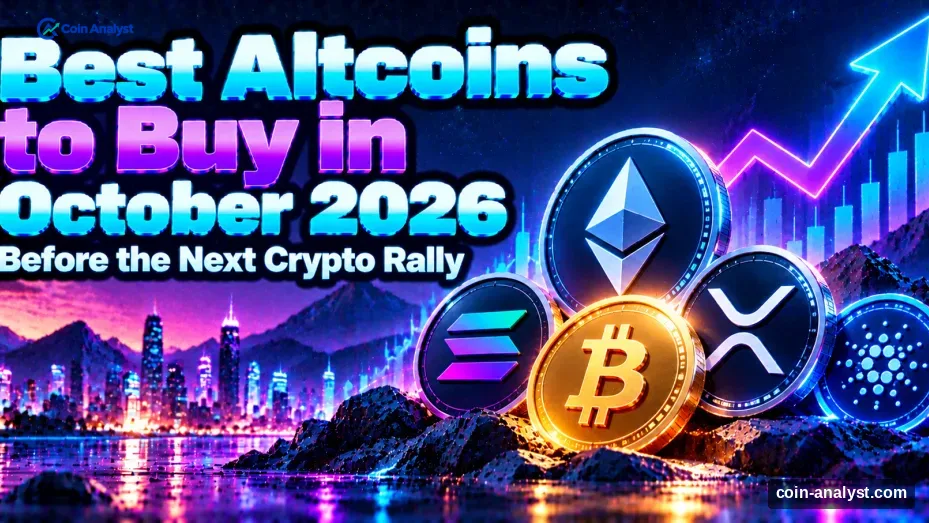
Discover the best altcoins to buy in October 2026 as the cryptocurrency market watches for potential capital rotation from Bitcoin. Key projects like Ethereum, Solana, XRP, Chainlink, Sui, and Avalanche feature unique catalysts heading into the fourth quarter.

October may prove pivotal for the cryptocurrency market following Bitcoin’s robust recovery in the third quarter. Market participants are closely watching to see if capital begins flowing into altcoins.
Ethereum, Solana, XRP, Chainlink, Sui, and Avalanche all head into the fourth quarter with distinct catalysts. However, their potential for upside also comes with varying degrees of execution risk, dilution, and volatility.
Read more: Best Crypto to Invest in: Bitcoin, Ethereum or XRP? What the Latest ETF Flows Reveal
Best Altcoins to Buy in October 2026
The top altcoins to consider for October 2026 merge liquidity, network expansion, upcoming catalysts, and institutional backing. While large-cap digital assets generally provide deeper markets, smaller networks can achieve sharper percentage gains under supportive conditions.
Ethereum (ETH): The Leading Large-Cap Altcoin
Ethereum maintains its position as the premier smart-contract network and a key altcoin to monitor. The network underpins layer-2 architecture, staking, tokenization, stablecoins, and decentralized finance.
An important upcoming catalyst for ETH is the Glamsterdam upgrade. Institutional interest also continues to grow via regulated financial products. Should capital shift from Bitcoin into major altcoins, ETH could stand to gain, though market participants should still monitor economic activity and network fees.
Solana (SOL): High-Growth Layer-1 to Watch
Solana remains a prominent high-speed layer-1 blockchain with robust utilization across consumer software, payments, stablecoins, and trading. Its primary technical milestone is the Alpenglow consensus upgrade, which aims to deliver faster transaction finality while maintaining the current execution environment.
SOL carries a higher beta than many large-cap cryptocurrencies, a trait that can magnify both profits and losses during swift market swings.
XRP: Institutional Adoption and New Catalysts
As October begins, XRP features stronger institutional infrastructure than was present in prior market cycles, with expanded investment vehicles broadening access for traditional financiers.
Development on the XRP Ledger persists across financial infrastructure, tokenization, trading, and payments. An altcoin rally in 2026 could see boosted demand driven by institutional interest, though market observers should differentiate genuine adoption from fleeting speculation.
Chainlink (LINK): The RWA and Tokenization Play
Chainlink serves a critical infrastructure function within decentralized finance and the tokenization of real-world assets. Its oracle network bridges external financial data with blockchains, while CCIP expands this utility by linking disparate ledger networks.
The introduction of CCIP 2.0 reinforces Chainlink’s institutional appeal through compliance tools and flexible cross-chain settlement. Continued adoption of tokenized assets could benefit LINK, though broader network growth does not guarantee direct token-price appreciation.
Sui (SUI): A High-Beta Altcoin With Growing Adoption
Sui is a fast-expanding layer-1 network seeing increased engagement across consumer applications, gaming, stablecoins, and decentralized finance. The Sui Basecamp event in October serves as a prominent ecosystem catalyst that could draw additional attention.
At the same time, SUI brings heightened supply-related pressures and volatility, factors that growth-focused altcoin investors need to weigh.
Avalanche (AVAX): A Potential Comeback Candidate
Avalanche enters the final quarter following the implementation of its Helicon mainnet upgrade, which altered validator economics, gas pricing, and C-Chain execution. AVAX exposure spans custom blockchain infrastructure, institutional tokenization, and decentralized finance.
Achieving a lasting recovery will still necessitate higher capital inflows and elevated user engagement, as software updates alone do not generate permanent token demand.
| Altcoin | Main October 2026 Catalyst | Main Strength | Key Risk |
|---|---|---|---|
| Ethereum (ETH) | Glamsterdam upgrade milestones | Largest smart-contract ecosystem and strong institutional access | Weak fee growth or delayed upgrade progress |
| Solana (SOL) | Alpenglow roadmap | High network activity, stablecoins, payments, and DeFi | High volatility and execution risk |
| XRP | Institutional products and XRP Ledger adoption | Payments, tokenization, and growing regulated access | Demand may depend heavily on market sentiment |
| Chainlink (LINK) | CCIP 2.0 and RWA growth | Strong position in oracles and cross-chain infrastructure | Protocol adoption may not translate directly into LINK demand |
| Sui (SUI) | Basecamp and ecosystem announcements | High-growth Layer 1 with expanding DeFi activity | Token unlocks, dilution, and higher volatility |
| Avalanche (AVAX) | Helicon upgrade | Institutional tokenization and custom blockchain infrastructure | Needs stronger user growth and renewed liquidity |
Why October 2026 Could Trigger the Next Altcoin Rally
A variety of elements could ignite another digital asset rally this year, with macro factors, liquidity, institutional flows, and Bitcoin’s market dominance playing especially vital roles.
Bitcoin Dominance and the Shift Into Altcoins
Movements into altcoins frequently gather momentum once Bitcoin forms a clear trend and its price volatility begins to subside. Changes in Bitcoin dominance can hint at a rotation of capital, where a persistent decline suggests funds are moving toward ETH and alternative tokens.
However, falling dominance by itself does not confirm an impending altcoin season; stablecoin liquidity, trading volume, and overall market breadth must also be considered.
What Could Drive a Crypto Rally in Q4 2026
An uptick in liquidity could act as a significant fourth-quarter catalyst, alongside robust institutional investments that bolster broader market confidence.
Furthermore, technical developments across projects like Avalanche, Chainlink, Solana, and Ethereum present ecosystem-specific opportunities. Macroeconomic health remains essential, as reduced financial pressures tend to foster environments conducive to speculative assets.
Related: Best Arc Memecoins in 2026: Early Arc Chain Tokens to Watch Before They Take Off
Is “Uptober” Still Relevant for Altcoins?
The positive reputation of October stems from Bitcoin’s history of strong gains during previous years, giving rise to the “Uptober” theory. Nonetheless, seasonality should never serve as a standalone investment strategy.
Actual demand, market positioning, monetary policy, and liquidity carry far more weight than calendar trends, and altcoins are entirely capable of sharp downturns during weak October trading periods.
Ethereum (ETH): A Top Altcoin to Buy Before the Next Rally
Ethereum frequently anchors conversations surrounding prime cryptocurrency investments ahead of a broader market upturn, owing to its combination of massive scale and upcoming protocol enhancements.
The Glamsterdam Upgrade and Ethereum’s Next Phase
As Ethereum’s upcoming major network overhaul, Glamsterdam focuses on advancing layer-1 scalability.
Key improvement proposals involve block-level access lists and enshrined proposer-builder separation to optimize data processing and ready the network for enhanced parallelization. While testing milestones scheduled for October may draw increased attention to ETH, mainnet deployment relies on ongoing coordination and successful development.
ETH ETF Flows and Institutional Demand
Investment products centered on Ethereum offer regulated exposure, sparing participants the need to handle private wallets directly.
Continued inflows into these exchange-traded products can buoy ETH during risk-on periods, while sluggish inflows signal tepid institutional appetite. Multi-week patterns offer a clearer picture than single-day sessions, as daily volumes frequently fluctuate.
Ethereum’s Potential Role in the Next Altcoin Season
Ethereum frequently serves as a bridge connecting Bitcoin’s strength to broader speculative activity in altcoins. Strong performance from ETH can lift market sentiment across Layer 2 networks, decentralized finance, and competing smart-contract platforms.
Consequently, a lasting breakout for ETH could encourage wider market engagement, particularly if reinforced by rising on-chain metrics. Even so, the upcoming altcoin cycle may differ from prior instances if institutional funds remain concentrated in a select few assets.
Solana (SOL): Can the Next Upgrade Fuel Another Rally?
Solana stands out as a leading altcoin for 2026, driven by continuous ecosystem growth paired with fundamental network development.
Alpenglow and Solana’s Network Roadmap
Designed to supersede Solana’s current consensus architecture while retaining its execution model, the Alpenglow upgrade aims for transaction finality near 150 milliseconds. Such swift settlement times could greatly benefit financial applications, payments, and trading.
Real-world implementation outweighs theoretical performance, making it wise for investors to track deployment phases, testnet results, and validator adoption.
Solana DeFi, Stablecoins and Institutional Adoption
Solana has cultivated substantial activity within stablecoins, decentralized exchanges, payment solutions, and token issuance. High-frequency use cases are supported by minimal transaction fees, while corporate developers look to the network for settlement options and tokenized financial offerings.
Enduring expansion in decentralized finance bolsters SOL’s foundational outlook, whereas temporary spikes in speculative volume offer less reliable evidence of lasting demand.
What Could Drive SOL in October 2026
Momentum for SOL could be propelled by progress on the Alpenglow upgrade, general ecosystem growth, and positive sentiment toward altcoins. Expanding stablecoin supplies offer another encouraging metric, and rising institutional interest could further reinforce the asset’s market standing.
Nonetheless, SOL remains a high-beta cryptocurrency, meaning downswings can accelerate rapidly if overall market liquidity dries up.
XRP: Is Institutional Demand Creating a New Catalyst?
As one of the most prominent large-cap digital currencies, XRP benefits from ongoing development surrounding the XRP Ledger and the launch of institutional investment instruments.
XRP Adoption and the Growth of the XRP Ledger
The XRP Ledger facilitates decentralized trading, payments, token creation, and various financial tools. Sustainable engagement remains more important than sheer transaction volume, requiring ongoing users and meaningful capital movement.
The tokenization of real-world assets is also gaining importance as traditional financial entities increasingly turn to blockchain infrastructure to issue and transfer value.
XRP ETF Flows and Institutional Interest
Regulated financial vehicles for XRP give professional investors an alternate pathway for market exposure. Robust inflows can sustain demand during positive market conditions and serve as a gauge for institutional enthusiasm.
Still, ETF data should not overshadow broader analysis, as XRP’s performance ultimately ties back to underlying network utility, overall market liquidity, and investor sentiment.
Key XRP Catalysts to Watch in October
Market participants ought to keep an eye on institutional integrations, network activity, and investment product flows. While expanding tokenization efforts can improve XRP’s narrative, tangible adoption is necessary to alter the long-term perspective.
Broad market rotation could likewise benefit the token, though a drop in institutional interest would likely cause momentum to fade quickly.
Chainlink (LINK): A Leading RWA Crypto to Watch
Chainlink maintains its close alignment with blockchain interoperability and the tokenization of real-world assets.
How Chainlink Is Powering Real-World Asset Tokenization
Tokenized financial instruments depend on dependable data feeds and seamless communication across different systems. Chainlink supplies off-chain information—such as pricing data, reserve proofs, and corporate announcements—directly to decentralized applications.
These services simplify interactions between traditional financial systems and decentralized networks, meaning broader adoption of tokenized assets could drive up utilization of Chainlink.
CCIP 2.0 and Cross-Chain Institutional Adoption
With the rollout of CCIP 2.0, features geared toward institutional digital asset management have been introduced, including compliance utilities, enhanced verification layers, and adaptable settlement choices that let institutions tailor cross-chain workflows to their needs.
Successful execution of these integrations will solidify Chainlink’s market stance, though actual utilization holds more weight than simple partnership announcements.
Why RWA Growth Could Boost Demand for LINK
Real-world asset tokenization has the potential to introduce substantial financial value onto blockchain rails, creating a need for robust compliance, security, data, and interoperability mechanisms—areas where Chainlink is heavily involved.
Increased reliance on its services could benefit token demand, though buyers should evaluate how specific offerings translate into genuine token utility and fee generation.
Sui (SUI): One of the Best Growth Altcoins to Watch
For investors hunting for newer layer-1 networks boasting high growth potential, Sui remains an appealing option.
Sui’s DeFi and Ecosystem Growth
Sui accommodates a diverse array of use cases, including consumer apps, gaming, stablecoins, lending protocols, and decentralized exchanges.
An increase in liquidity enhances the network’s utility for both traders and developers, with organic capital providing a more dependable indicator of health than short-term incentive programs.
Continued expansion among developers could help Sui build a resilient ecosystem, though competition within the layer-1 sector remains fierce.
Basecamp and Other October 2026 Catalysts
Set for October, the Sui Basecamp conference could serve as a venue for ecosystem updates and technical announcements, with new product rollouts or demonstrations potentially drawing heightened attention to SUI.
Events rarely guarantee sustained price appreciation, however, as ongoing user expansion and developer activity remain far more critical.
Related: Best Crypto Tokens Under $5 to Buy Before the Next Big Rally
SUI’s Upside Potential and Key Risks
Thanks to its high-beta characteristics, SUI may outperform during broad risk-on altcoin rallies, though that same trait increases exposure to downside risk. Additionally, scheduled token unlocks can introduce selling pressure as fresh supply hits the open market.
Consequently, investors should balance ecosystem evaluations with a careful review of tokenomics and liquidity metrics.
Avalanche (AVAX): Can a Network Upgrade Revive Momentum?
Despite intense competition from emerging ecosystems, Avalanche continues to function as an essential layer-1 network.
The Helicon Upgrade and Avalanche’s Roadmap
The Helicon upgrade went live on the Avalanche mainnet in September 2026, bringing modifications to validator procedures, gas fee structures, and execution logic, alongside Continuous Execution optimizations designed to boost C-Chain efficiency.
These enhancements lay a stronger technical groundwork for future applications, though real-world economic impact will be dictated by actual network adoption.
Avalanche DeFi and Institutional Adoption
Avalanche maintains support for custom blockchain architectures and decentralized finance applications, with institutional tokenization serving as another core pillar of its ecosystem. Tailored networks particularly appeal to organizations requiring high levels of configuration control.
To recapture momentum, AVAX requires a revival in capital and user growth, as infrastructural prowess alone cannot sustain demand.
What Could Drive AVAX in Q4 2026
Adoption of the Helicon upgrade could bolster Avalanche’s technical narrative throughout the fourth quarter. Signs of a stronger decentralized finance footprint, new institutional deployments, or tokenized assets could likewise generate interest.
Even so, overarching market conditions remain the primary driver, and AVAX may face hurdles if liquidity stays trapped within Bitcoin and larger altcoin counterparts.
How to Find the Best Altcoins to Buy Before a Crypto Rally
Investors trying to identify promising altcoins for 2026 should look well beyond immediate price momentum.
Market Cap, Liquidity and Trading Volume
While market capitalization reflects an asset’s scale, liquidity reveals how seamlessly it can be traded. Healthy volume enables cleaner price discovery, whereas thinly traded markets raise the likelihood of price manipulation and heavy slippage.
Large-cap assets typically offer deeper liquidity pools, while smaller alternatives may present higher upside paired with considerably more risk.
Network Growth and Real-World Adoption
Ecosystem growth can be gauged by evaluating active users, transaction value, stablecoin supply, and application revenues. No single metric tells the whole story, but sustainable adoption should outlast temporary promotional drives.
Genuine demand proves most valuable when users consistently pay for network utility over time.
Upcoming Crypto Catalysts and Protocol Upgrades
Network upgrades can enhance security, processing power, or application capabilities while establishing clear market catalysts, as seen with Avalanche’s Helicon, Solana’s Alpenglow, and Ethereum’s Glamsterdam.
Execution is paramount; technical delays or setbacks can rapidly deflate speculative excitement.
Token Unlocks and Supply Inflation
An altcoin’s performance can be heavily influenced by its supply dynamics, as large token unlocks introduce fresh assets that the market must absorb. Investors ought to weigh projected supply against trading depth, noting that smaller projects are often more vulnerable to heavy selling pressure from concentrated token distributions.
Long-term inflation also counts; rapid token issuance can easily negate positive ecosystem advancements.
Read More: Is Chainlink Crypto Ready for the Top 5? Why LINK Could Be the Next Major Altcoin to Break Out
Institutional Demand and ETF Flows
Regulated products have taken on heightened significance for major digital assets. Consistent inflows into ETFs can foster market confidence and deepen liquidity, while persistent withdrawals can yield the exact opposite outcome.
Institutional backing does not eliminate volatility, however, as professional managers can rapidly scale back their exposure when conditions shift.
Best Altcoins for Different Risk Levels
The top altcoins heading into the next potential bull run exhibit markedly different risk profiles.
Large-Cap Altcoins: ETH, SOL and XRP
ETH, SOL, and XRP offer deeper liquidity pools than the vast majority of smaller cryptocurrencies, backed by established infrastructure and widespread recognition. Their scale mitigates certain liquidity hazards, though they remain susceptible to substantial drawdowns.
These assets are generally better suited for investors prioritizing stable ecosystems over maximal speculative returns.
Growth Altcoins: LINK and SUI
LINK ties infrastructure exposure directly to the tokenization narrative, whereas SUI provides higher-beta exposure to an emerging layer-1 network.
Both showcase strong growth themes driven by distinct fundamentals—Chainlink relies on infrastructure adoption, while Sui depends on ecosystem expansion and ongoing layer-1 competitiveness.
Higher-Risk Altcoins to Watch in October 2026
Smaller altcoins can generate outsized returns during speculative rallies, but they can also shed liquidity at an alarming rate during downturns. Factors such as exchange depth, development progress, concentrated ownership, and upcoming token unlocks warrant close scrutiny.
October catalysts should never act as a substitute for thorough fundamental research, as brief market narratives tend to vanish quickly.
What Could Stop the Next Altcoin Rally?
Several hurdles could prevent capital from rotating widely into altcoins.
Bitcoin Dominance Remains High
Even as its price climbs, Bitcoin can continue sucking up the majority of incoming crypto capital, a dynamic potentially reinforced by institutional inflows into highly accessible, regulated Bitcoin products.
A genuine altcoin season typically demands broader market participation, signaled by falling dominance and widening market breadth.
Fed Policy and Global Liquidity
Digital assets remain highly sensitive to shifts in global liquidity and interest rates. A restrictive monetary stance can suppress demand for speculative investments, and climbing bond yields can draw capital away from the crypto market entirely.
While supportive liquidity conditions would improve the outlook, macroeconomic unpredictability remains one of the market’s primary external threats.
Weak ETF Flows and Institutional Demand
While institutional capital can drive momentum across major digital assets, a sustained shift in direction could undermine market confidence. Furthermore, exchange-traded products run the risk of concentrating capital within a narrow subset of cryptocurrencies.
Consequently, inflows into Bitcoin do not automatically translate into an altcoin surge.
Token Unlocks and Selling Pressure
Significant token unlocks can introduce a flood of new supply even during favorable markets, with early backers occasionally utilizing price rallies to lock in gains. Projects with high expected future dilution require careful evaluation.
Robust demand can successfully absorb new supply, but sluggish markets may struggle under the weight.
Best Altcoins to Buy in October 2026: Final Factors to Consider
Ethereum, Solana, XRP, Chainlink, Sui, and Avalanche enter October with unique catalysts and inherent risks. ETH brings institutional depth and scale; SOL merges active usage with the Alpenglow roadmap; XRP profits from expanding institutional access.
LINK offers exposure to tokenization infrastructure, SUI provides higher-beta ecosystem expansion, and AVAX aims to recapture momentum post-Helicon.
None of these assets can promise gains during the next crypto rally. When evaluating the best altcoins for October 2026, market participants should prioritize adoption, liquidity, supply mechanics, and execution.
The most favorable backdrop would unite improving market breadth, ongoing institutional demand, and supportive global liquidity, with declining Bitcoin dominance potentially signaling a rotation.
FAQ
01What Are the Best Altcoins to Buy in October 2026?
Prominent altcoins to monitor based on current catalysts include ETH, SOL, XRP, LINK, SUI, and AVAX. Their risk profiles vary considerably, making it crucial for investors to evaluate liquidity, adoption rates, and token supply beforehand.
02Could Altcoin Season Start in Q4 2026?
An altcoin season could materialize if market breadth broadens and Bitcoin dominance declines, supported by steady institutional demand and healthy liquidity.
03Which Altcoins Have Major October 2026 Catalysts?
Ethereum has milestones tied to Glamsterdam, Sui is hosting its Basecamp event in October, and Solana’s Alpenglow roadmap alongside Chainlink’s CCIP 2.0 also deliver vital development catalysts.
04What Are the Best Altcoins for Growth?
SUI and LINK offer distinct growth exposure, though their underlying risk profiles differ. SOL also pairs large-cap liquidity with significant ecosystem expansion and higher-beta traits.
05What Could Trigger the Next Crypto Rally?
Potential drivers for another rally include expanding global liquidity, institutional inflows, protocol updates, and broader market participation, with Bitcoin’s performance and macroeconomic conditions remaining core variables.
06What Should Investors Check Before Buying Altcoins?
Essential considerations include liquidity, network adoption, token supply, token unlocks, protocol progress, and institutional interest, alongside an assessment of downside risks before chasing short-term price momentum.
07What Should Investors Check Before Buying Altcoins?
Factors such as liquidity, network utility, supply and demand dynamics, token unlocks, protocol development, and institutional interest require close attention. Investors should evaluate potential downside risks prior to purchasing altcoins based strictly on short-term speculation.