Trump Unveils $215M Quantum Push as Bitcoin Security Fears Grow
The Trump administration has announced a $215 million quantum computing contest as part of a $6 billion science initiative. Meanwhile, Europol has warned that future quantum technologies could pose security risks to vulnerable Bitcoin holdings.

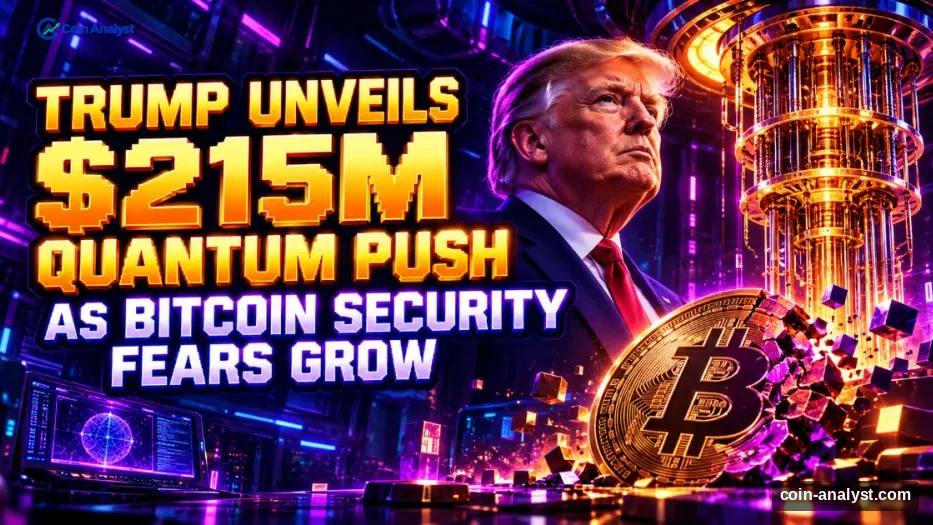
More than $6 billion in science initiatives has been revealed by the Trump administration, featuring a $215 million quantum computing contest. Meanwhile, European officials have called on cryptocurrency developers to adopt safeguards to protect future digital asset investments.
The initiatives—encompassing plans for quantum technology, artificial intelligence, health, and space through public and private investments and research activities—were unveiled on October 8 at the White House during the Science: A New Golden Age Summit. The quantum technology plans do not incorporate measures to safeguard cryptocurrencies.
Trump’s $215M Quantum Competition Targets Reliable Machines
On September 17, the U.S. Department of Energy launched the Quantum Genesis Q Competition, unveiling eight scientific challenges during a meeting. The contest aims to build functional, fault-tolerant quantum computers for use in fields such as physics, chemistry, and materials science.
Participants must prove they can achieve 100 logical qubits alongside hundreds of millions of error-free operations. Individual awards for select applicants could reach up to $1.5 million. Furthermore, a $100 million prize is designated for 100 logical qubits, while two separate $50 million prizes are available for 150 and 200 logical qubits, respectively.
This $215 million in proposed funding is pending congressional approval and has not yet been awarded, with business proposals due by October 19, 2026. Additionally, a separate $45 million laboratory research program will support research and development for both hardware and software.
Read More: US Government Moves $770M in Bitcoin to Coinbase Prime: Is BTC Facing a Massive Sell-Off?
Europol issued an advisory on October 7 warning that quantum computers capable of cracking public-private key pairs to access private keys could potentially be leveraged to steal cryptocurrency. The Europol advisory points out that the primary threats to cryptocurrency center around wallet signatures rather than the underlying blockchain technology.
Such attacks cannot be executed using present-day computer technology, and the timeline for their emergence remains uncertain. Europol suggests a gradual shift toward quantum-resistant encryption. CryptoQuant founder Ki Young Ju calculates that the public keys for roughly 6.89 million BTC are vulnerable to these kinds of attacks, though this does not indicate that the funds are currently in danger of theft.
Alternative signature technologies are currently being tested by Bitcoin developers to protect against quantum computing threats, though network-wide consensus on adopting new standards has not been reached. Custody service providers like BitGo and Silence Laboratories have also tested alternative signature technologies.
AI Commitments and Research Funding Expand the Package
The Genesis Mission Consortium has secured $2.4 billion in AI-related hardware and software contributions pledged by eleven technology companies. Specifically, Nvidia committed $1 billion in donations, while AMD and OpenAI pledged $500 million and $200 million, respectively, with Google and Anthropic each pledging $150 million. These contributions represent private donations rather than spent federal funds.
Additional proposed initiatives comprise $1 billion directed toward regional computing facilities and $1.8 billion allocated for a virtual biology project. Additional funding for X-Lab programs includes over $310 million for various initiatives and $100 million for doctoral fellowships.
Plans for nuclear-powered space missions—including a 2028 journey to Mars—were recently outlined in announcements by NASA and the Energy Department. None of these updates indicate that quantum computing poses a threat to cryptocurrencies.