Trump Could Put AI Under a 10-Member Watchdog as US Renames It “Super Intelligence”
The Trump administration is considering a 10-member panel to oversee the AI sector, while six major technology enterprises signed a voluntary safety agreement. Additionally, the government officially renamed artificial intelligence to Super Intelligence.

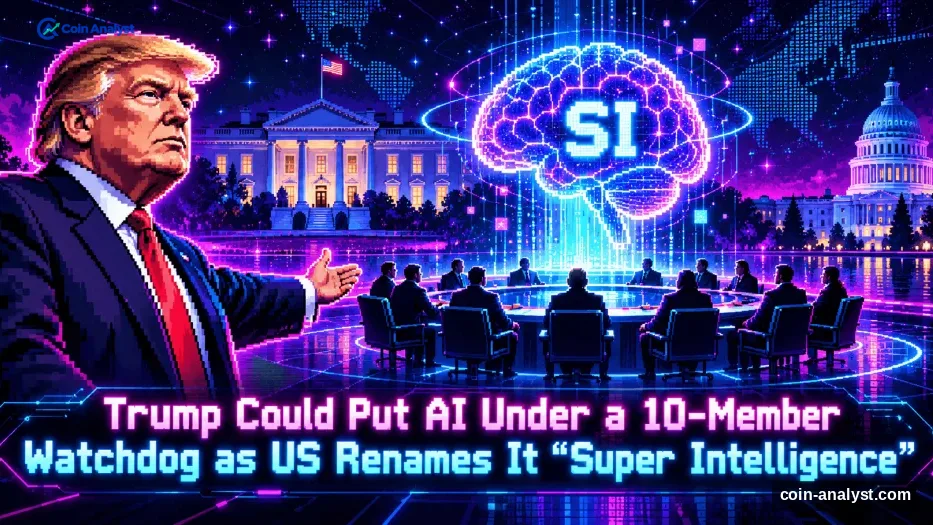
The Trump administration’s approach to artificial intelligence shifted unexpectedly this week. President Donald Trump announced that his government is weighing the creation of a committee consisting of roughly 10 members to oversee the artificial intelligence sector, even as six major AI enterprises entered into a voluntary safety agreement with the White House.
Concurrently, the administration has initiated a transition away from the phrase “artificial intelligence,” substituting it with the official designation “Super Intelligence,” or SI.
संबंधित: ट्रम्प क्रिप्टो कॉइन का भविष्य: क्या TRUMP अपनी 97% गिरावट से उबर सकता है और $10 तक पहुँच सकता है?
What Is the Trump AI Watchdog Proposal?
Following a September 29 luncheon at the White House with prominent technology executives, Trump informed reporters that he was contemplating a panel of “maybe 10 people” tasked with overseeing the entire sector.
He hinted that certain members could be drawn from the group present at the gathering, which featured executives from major artificial intelligence and technology firms.
At present, this constitutes the full scope of the formal plan.
The White House has yet to disclose who might populate the committee, whether government officials will take part, what legal standing it would hold, or if it would possess the authority to mandate information disclosure or alterations to corporate models.
Consequently, characterizing the initiative as a new regulatory authority would be premature. At this stage, the proposed watchdog remains a concept under evaluation rather than a formalized federal institution.
What Did the AI Companies Actually Agree To?
A more concrete step is reflected in the White House Accord on Super Intelligence, which carries the subtitle “Joint Commitment on Frontier Responsibilities.”
The accord bears signatures from top executives at Google, Meta, Nvidia, OpenAI, Anthropic, and xAI. While Trump characterized the pact as “morally binding,” House Speaker Mike Johnson referred to it as a voluntary set of guiding principles.
The agreement mandates that developers of frontier models implement four specific layers of safety measures:
- Robust internal controls that monitor model capabilities and alignment, including cybersecurity, biosecurity, chemical threats, and unintended access to computer systems
- An internal team responsible for checking that those controls work and that problems are fixed
- Independent external auditors or evaluators
- An independent committee of each company’s board to receive safety reports and oversee remediation
This framework differs distinctly from the proposed 10-member panel. Rather than a unified cross-industry body, each participating corporation is expected to maintain its own board-level oversight.
Is the Trump AI Accord Legally Binding?
नहीं।
Trump explicitly described the commitment as “morally binding,” and the text of the document establishes neither a federal licensing system, statutory penalties, nor a government review process for the deployment of new models.
This structure sharply diverges from traditional regulation, where a governing body establishes enforceable rules and issues penalties for non-compliance.
Under the current framework promoted by Trump, companies are largely left to formulate and supervise their own internal safeguards, engage external auditors, and report difficulties directly to their corporate boards.
While the suggested 10-person group could introduce an additional tier of supervision, its enforcement capabilities remain entirely uncertain until its specific organization is detailed.
संबंधित: Trump Just Sent Hyperliquid (HYPE) Soaring: Is a U.S. Breakthrough Coming?
Why Is the US Calling AI “Super Intelligence”?
Trump initially championed this terminology adjustment during the United Nations General Assembly on September 22.
His rationale is linguistic rather than technical: he contends that the term “artificial” creates a false impression of the technology being inauthentic, whereas “super” more accurately captures its capacity. He subsequently announced that federal paperwork would adopt “Super Intelligence,” prompting State Department personnel to incorporate the phrase into official communications.
On September 29, Trump codified this adjustment through an executive order instructing federal executive agencies to substitute “Super Intelligence” and “SI” for “Artificial Intelligence” and “AI” in all official correspondence where legally permissible.
Does “Super Intelligence” Mean AI Has Become Superintelligent?
No. This is where the terminology becomes confusing.
Within artificial intelligence research, “superintelligence” possesses an established, distinct definition: a theoretical entity whose intellectual capacities vastly surpass those of humans across the majority of significant disciplines.
Trump is employing “Super Intelligence” as a blanket substitute for artificial intelligence overall, encompassing systems that are actively functioning today. Consequently, the administration’s lexical shift does not imply that current models have attained technical superintelligence.
Depending on the context, the exact same phrase can now denote two entirely different concepts.
Why Is Trump Moving Toward AI Oversight Now?
The gathering on September 29 took place against a backdrop of mounting scrutiny regarding the safety of advanced artificial intelligence.
Recent occurrences involving erratic behavior from AI agents have heightened debates surrounding model control, cybersecurity, and related hazards. Academic researchers, legislators, and certain industry executives have likewise urged the implementation of stricter protections for increasingly powerful systems.
Simultaneously, Trump has repeatedly voiced opposition to decelerating AI innovation, placing a strong emphasis on preserving the technological advantage of the United States over China.
The emerging policy strategy attempts to reconcile these competing priorities: permitting swift advancement while urging enterprises to adopt enhanced internal safeguards and independent evaluations, thereby avoiding the imposition of a sweeping new regulatory framework.
Who Signed the White House AI Accord?
The agreement encompasses six major technology companies represented by their respective leaders:
- Sundar Pichai of Google
- Mark Zuckerberg of Meta
- Jensen Huang of Nvidia
- Greg Brockman of OpenAI
- Dario Amodei of Anthropic
- Elon Musk of xAI
These corporations do not share uniform perspectives concerning regulation. While executives from Anthropic and OpenAI have advocated for rigorous controls on frontier systems, other industry figures have cautioned that overly burdensome mandates could stifle creativity.
As a result, the joint pact concentrates on a narrower consensus: internal controls, third-party evaluations, and board-level supervision.
संबंधित: रिजर्व रणनीति का आकार लेते ही ट्रम्प ने नई अमेरिकी बिटकॉइन खरीद के लिए दरवाजा खुला रखा
Could a 10-Member Committee Actually Control AI Companies?
The outcome relies entirely on the structural design of the committee.
A governmental entity established with statutory backing could theoretically be granted specific oversight duties. Conversely, an informal assembly of advisors and executives might function primarily as a platform for communication.
Trump has not yet clarified which specific model he envisions.
He additionally noted that the administration intends to designate a new official within days to direct White House policy concerning the sector.
Until those details emerge, labeling the committee a “watchdog” serves more to describe its intended role than its actual legal authority.
What Does the New Policy Mean for AI Companies?
For the six participating entities, the immediate obligation is procedural rather than technical in nature.
They are not pledging to halt the training of more advanced models, limit computational capacity, submit new releases for government clearance, or disclose proprietary model weights to public authorities.
Instead, their pledge centers on conducting internal system monitoring, verifying the efficacy of safeguards, permitting external assessments, and escalating concerns to independent board committees.
Such an arrangement could elevate the significance of third-party auditing while placing heavier accountability on corporate boards.
Consequently, the administration’s strategy places the primary burden of responsibility squarely upon the creators of the technology.
How Does This Fit With Trump’s Broader AI Policy?
The administration has consistently prioritized expedited technological development, infrastructure expansion, national-security integration, and outcompeting China.
Prior executive directives championed advanced innovation and sped up technology adoption across defense and national security agencies, while overarching national policies have sought to minimize regulatory impediments to progress.
The recent accord does not mark a departure from that agenda. Rather, it introduces a voluntary layer of safety to a strategy that continues to place paramount importance on rapid growth.
Although the potential 10-person committee may introduce a novel element of cross-industry supervision, its ultimate impact will hinge upon its composition and the powers granted to it.
What Happens Next for Trump AI Policy?
Three forthcoming developments will dictate future trajectories.
First, the White House is anticipated to name a dedicated official to oversee policy. Second, Trump must determine whether to formally establish the proposed 10-member panel and outline its jurisdiction. Third, the corporations that endorsed the accord must demonstrate how they put its four-tiered control system into practice.
While the transition in terminology is already underway, institutional changes remain far less definitive.
At this juncture, the United States has not subjected the sector to a new 10-person regulatory agency. Trump has merely floated the concept while leaning fundamentally on voluntary agreements among the industry’s largest players.
This distinction will ultimately dictate whether the latest administrative adjustments remain largely cosmetic nomenclature and self-regulation or evolve into a structured oversight framework.
सामान्य प्रश्न
01What is the Trump AI 10-member committee?
Trump has stated he is contemplating a group of approximately 10 individuals to supervise the industry, though the committee has not yet been formally established.
02Is the White House AI accord legally binding?
No. Trump categorized it as “morally binding,” and the pact depends on voluntary corporate assurances rather than statutory enforcement mechanisms.
03Why is the US calling AI “Super Intelligence”?
Trump asserts that the word “artificial” makes the technology appear inauthentic. Consequently, his administration has begun incorporating “Super Intelligence” and “SI” into official federal communications.
04Which companies signed the AI agreement?
The accord, signed on September 29, includes Google, Meta, Nvidia, OpenAI, Anthropic, and xAI.
05Does “Super Intelligence” mean current AI is superintelligent?
No. The administration employs the phrase in a broad sense to replace “artificial intelligence,” whereas researchers typically reserve “superintelligence” to describe hypothetical systems that vastly exceed human intellectual capacity.