सितंबर में बढ़ोतरी के बाद फेड ने 10-2 के बहुमत से दरों में बढ़ोतरी रोकी
The Federal Reserve maintained its benchmark interest rate at 3.75%-4% following a 10-2 vote, pausing monetary tightening to evaluate economic data. Chair Kevin Warsh defended the decision while noting that future rate increases remain possible.

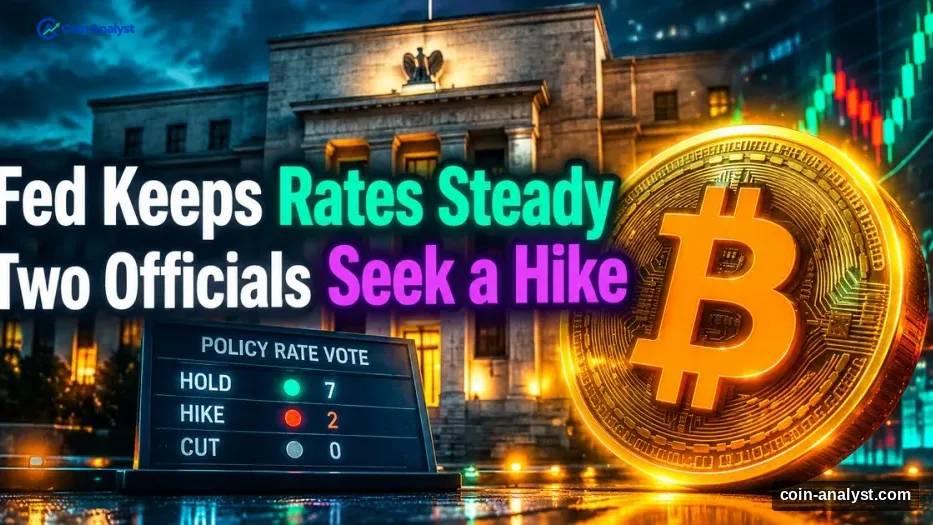
On October 28, 2026, the Federal Reserve maintained its benchmark interest rate at 3.75%-4% following a 10-2 vote. Cleveland Fed President Beth Hammack and Governor Lisa Cook advocated for a quarter-point rate hike. This decision halts the monetary tightening that resumed in September, though another interest rate increase remains a possibility for December.
Chair Kevin Warsh stated that the central bank remains dedicated to driving inflation down. The anticipated pause provides officials with additional time to evaluate incoming economic data. Nonetheless, Cook and Hammack preferred an immediate increase in borrowing costs.
Fed Rate Decision: Holds at 3.75%-4% After September’s Increase
What did the Fed decide on October 28?
During its Wednesday meeting, the committee kept the federal funds target range steady. While ten policymakers supported the pause, Cook and Hammack favored raising the rate to 4%-4.25%.
Read More: How Federal Reserve Policy in 2026 Is Shaping Bitcoin’s Next Move
The September meeting brought the Fed’s first rate increase since 2023, which received unanimous backing from all policymakers. In October, however, the majority opted to wait, despite characterizing economic activity as strong and inflation as elevated.
How widely expected was the pause?
Prior to the 2 p.m. ET announcement, the CME FedWatch tool estimated the probability of no change at roughly 90%. Markets had fully anticipated a hold, although concerns persisted regarding the possibility of another hike prior to the end of the year.
A more pressing question was whether Warsh’s remarks and the official statement would strengthen expectations for a December tightening. Even a predicted pause can leave cryptocurrency and other risk-sensitive assets confronting a restrictive policy environment.
Warsh Defends the Pause as Cook and Hammack Seek Action
How did Kevin Warsh explain the decision?
Warsh described the U.S. economy as resilient, attributing financial uncertainty and elevated inflation to geopolitical events. He positioned the decision as a component of the committee’s broader strategy rather than a reaction to a specific calendar date or economic report.
“It’s our responsibility to get inflation down,” he noted during the press conference, according to CryptoPotato. He added that Americans have contended with inflation exceeding the committee’s target for nearly six years.
When questioned about why policymakers might choose to pause now only to raise rates in December, Warsh pointed to the overarching goals of monetary policy. The next course of action will rely on how the economic and inflation outlooks evolve.
Why do the dissenting votes matter?
Cook and Hammack sought to continue monetary tightening immediately following the September increase. Their preferred quarter-point adjustment would have raised both limits of the target range.
According to Bitcoin Magazine, this marked the first instance since 1992 that a regional bank president and a Fed governor dissented together on the same side. Although the majority vote carried the decision, the pairing highlighted an atypical division.
<
What did Warsh say about political pressure?
When asked about President Donald Trump’s appeals for lower rates, Warsh stated that “politics played no role” in the outcome. The meeting took place just days ahead of the November 3 midterm elections.
Furthermore, he expressed reluctance to issue forward guidance outside of a crisis environment. Investors are consequently tracking upcoming reports and the committee’s inflation targets rather than depending on a fixed timetable for future actions.
July’s Split Hold Led to a Unanimous September Hike
What happened at the July meeting?
At the July 29 meeting, the Fed maintained its target range at 3.50%-3.75% via a 9-3 vote. Reuters reported that Dallas Fed President Lorie Logan, Minneapolis Fed President Neel Kashkari, and Hammack all sought a quarter-point rate increase.
Officials remained divided over whether persistent price pressures warranted immediate intervention. Debates regarding how long the central bank could hold off were already being influenced by the inflation outlook and disruptions in the oil supply.
During the July press conference, Yahoo Finance reported that Warsh welcomed the internal disagreement, describing it as “a real family fight.” He argued that debate within the committee can result in better policy choices.
What changed between July and October?
All 12 policymakers voted to raise rates in September, concluding a prolonged pause that began in 2023. Minutes from that session indicated that most officials believed another rate hike would likely be appropriate before the close of the year.
October introduced another split concerning timing. While Hammack once more supported a rate increase, Logan and Kashkari supported a hold, and Cook aligned with Hammack in dissent.
Thus, a divided pause in July was followed by a unanimous rate increase in September and another divided pause in October. Policymakers have alternated between favoring a wait-and-see approach and supporting tighter monetary policy.
Strong Growth and Elevated Inflation Keep Tightening in Play
What changed in the Fed’s economic assessment?
The October policy statement elevated its characterization of economic activity from a “solid” pace in September to a “strong” one. It also noted that employment gains have matched workforce expansion, leaving the unemployment rate largely unchanged.
This combination affords the Fed the flexibility to concentrate on inflation without needing to cite a significant deterioration in the labor market as justification for a pause. Warsh’s characterization of a resilient economy mirrored the official statement.
Additionally, the committee removed previous language specifying when a rate hike might assist in returning inflation to its target. Instead, it indicated that additional data will dictate the suitable policy stance.
Which inflation pressures are keeping officials concerned?
During the 12-month period ending in September, consumer prices advanced 3.7%, while gasoline prices rose 9.1% during the month of September alone. With inflation sitting above the committee’s 2% objective, officials weighed the pros and cons of another rate increase.
U.S. crude oil settled at $99.90 per barrel on October 27. The conflict between the U.S. and Iran has constrained global oil supplies, driving up fuel and shipping costs that can eventually filter down to consumer prices.
These energy expenses complicate the policy outlook. Economic activity remains robust while inflation stays high, and Warsh has identified ongoing geopolitical developments as a persistent source of uncertainty.
Bitcoin Faces High Treasury Yields Alongside ETF Demand
Why does this Fed decision matter for Bitcoin?
CoinGecko data showed Bitcoin trading at $81,087 at 22:28 UTC on October 28, marking a 24-hour gain of roughly 0.31%. This modest daily shift placed the broader policy outlook, rather than any dramatic price reaction, at the forefront.
Implementing another rate hike would prolong the financial pressure stemming from high interest rates. Because Bitcoin generates no yield whereas government bonds offer investor returns, Treasury yields directly impact the appeal of riskier alternative assets.
The 10-year Treasury yield finished trading on October 27 at 4.99%, down from a peak of 5.31% on October 5. These yields provided the background investment climate as the Fed debated whether prevailing inflation justified another rate increase.
What recent buying has supported crypto demand?
Spot Bitcoin exchange-traded funds registered $110 million in net inflows on October 26 and $176 million on October 27, bringing cumulative inflows to $286 million across the two sessions leading up to the announcement.
These inflows demonstrate that demand for investment products persisted despite expectations of tighter monetary conditions. Sustained purchasing activity could potentially mitigate some of the downward pressure created by elevated yields and uncertainty regarding December.
Risks Center on Inflation Persistence and December Expectations
How likely was another increase before the decision?
Ahead of Wednesday’s announcement, market estimates placed the likelihood of a quarter-point rate increase at the December meeting above 70%. Minutes from the September gathering similarly suggested that most officials viewed an additional hike as likely appropriate by year-end.
While a December tightening remains entirely possible, officials will evaluate incoming data released ahead of the meeting. The October statement explicitly linked the appropriate policy stance to the arrival of further economic information.
Robust economic activity and stubborn inflation would strengthen the argument for a rate hike, whereas a more positive inflation trajectory would offer grounds to prolong the pause.
<
What could make the coming weeks difficult for crypto investors?
Energy expenses, employment statistics, and inflation releases all have the capacity to alter projections regarding how restrictive monetary policy must become. Because Warsh has steered clear of offering strict forward guidance, every major economic release carries weight for the subsequent decision.
Federal Reserve communications have historically coincided with significant cryptocurrency market volatility. For instance, approximately $481 million in crypto positions were liquidated within 24 hours following Warsh’s Jackson Hole address in August.
While steady ETF demand may absorb some selling pressure, hotter inflation readings or growing expectations of a rate hike could weigh heavily on crypto sentiment. The interplay between investment flows and the central bank’s policy path will determine the ultimate market balance.
November Data Comes Before the December 8-9 Meeting
Which releases will shape the next rate decision?
The October employment report is scheduled for release on November 6, followed by October inflation figures on November 10. Both reports will feed directly into the Fed’s evaluation of price stability and employment.
The jobs data will update the committee’s perspective on whether hiring has continued to match workforce growth. Meanwhile, the inflation metrics will test whether price pressures are progressing toward the 2% target following September’s high reading.
Additionally, the November 3 midterm elections introduce another political milestone to the crypto investor calendar, though Warsh maintained that politics exerted no influence on October’s policy choice.
What will the Fed decide in December?
The committee is set to convene next on December 8-9, at which point it will release updated economic projections. By then, policymakers will have reviewed the November data releases when considering the necessity of a rate increase.
While October’s pause left the question of further tightening open, September’s minutes revealed a prevailing inclination toward a year-end hike. The upcoming decisions will be accompanied by fresh projections offering a broader perspective on the economic outlook.
Cryptocurrency holders will monitor whether incoming indicators validate the stance of Cook and Hammack or justify maintaining the pause. October’s outcome left both scenarios viable, with interest rates remaining at their post-September levels.
सामान्य प्रश्न
01Which officials voted for a rate increase?
Cleveland Fed President Beth Hammack and Governor Lisa Cook voted against the October rate hold. Hammack had previously advocated for an increase in July, a meeting that featured three dissenting votes.
02What interest-rate range did the dissenters prefer?
They advocated for a target range of 4%-4.25%, which would have raised the upper and lower limits established in September by a quarter of a percentage point.
03When did the Fed last raise rates?
The Fed’s most recent rate increase occurred in September 2026, supported by a unanimous vote of all 12 policymakers, marking the first hike since 2023.
04What inflation goal is the Fed trying to reach?
The central bank targets an inflation rate of 2%. Consumer inflation stood at 3.7% year-over-year in September, keeping price stability at the center of ongoing deliberations.
When are the next jobs and inflation reports due?
The October employment report is slated for November 6, and October inflation figures are due on November 10, both arriving prior to the committee’s December meeting.
05When is the next Fed meeting?
The upcoming policy meeting is scheduled for December 8-9, 2026, during which the Fed will also publish updated economic projections alongside its rate decision.
06How much entered spot Bitcoin ETFs before the decision?
Spot Bitcoin ETFs registered cumulative net inflows of $286 million across October 26 and 27, with the larger daily total occurring on October 27 at $176 million.
यह लेख केवल जानकारी के लिए है और वित्तीय सलाह नहीं है।