
सर्किल के शेयरधारक ने $2B के यूएई क्रिप्टो सौदों को लेकर ट्रंप पर मुकदमा किया
A Circle shareholder has filed a lawsuit against President Donald Trump alleging that UAE crypto deals involving World Liberty Financial and Binance breached the Foreign Emoluments Clause and harmed Circle.

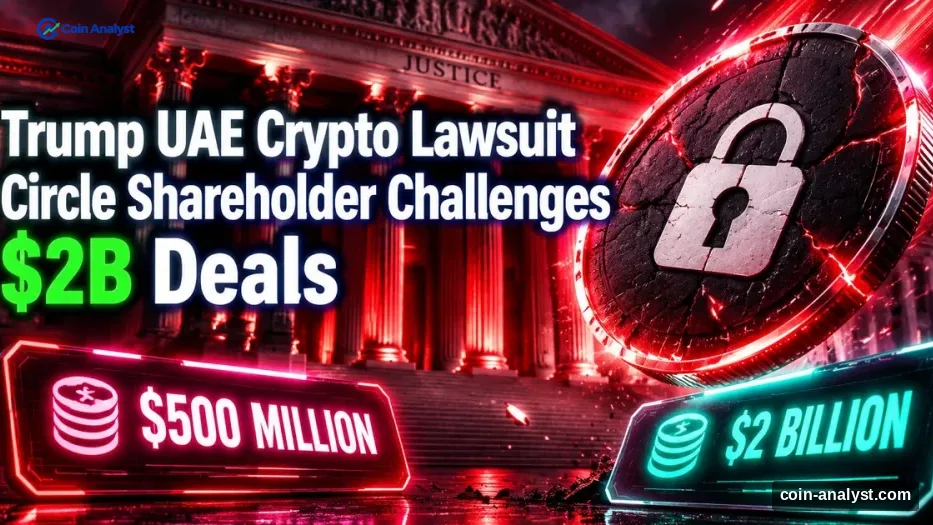
A lawsuit regarding UAE crypto dealings involving President Donald Trump was filed on Thursday, Oct. 22, 2026, by J. Benjamin Greenberg, a Circle shareholder. The complaint alleges that two transactions connected to the United Arab Emirates breached the Constitution’s Foreign Emoluments Clause and caused harm to Circle. Specifically, the case points to a $500 million agreement for a 49% stake in World Liberty Financial alongside a separate $2 billion investment in Binance financed through World Liberty’s USD1 stablecoin.
Filed in federal court in Washington, the complaint asks for judicial remedies addressing the alleged constitutional breaches as well as the disgorgement of any profits determined to be unlawful. These allegations have not yet been evaluated by a court, and Circle has clarified that it took no part in initiating the lawsuit.
What the Trump UAE Crypto Lawsuit Alleges
Two transactions at the center of the complaint
According to Greenberg’s filing, funds tied to the two UAE-associated deals delivered benefits to Trump and his digital asset enterprise while pulling business away from Circle. Because Circle’s USDC competes directly with World Liberty’s USD1, the complaint asserts that the arrangement provided World Liberty with an improper competitive edge.
The initial agreement involved an investment vehicle supported by a member of the UAE ruling family purchasing a 49% interest in World Liberty for $500 million. The second transaction saw Abu Dhabi-headquartered MGX deploy USD1 to back a $2 billion investment in Binance.
What Greenberg wants from the court
The legal action requests a judicial declaration that these transactions breached the Foreign Emoluments Clause, alongside an injunction barring Trump from taking prohibited payments from foreign sources absent congressional consent. Furthermore, Greenberg asks for the return of unlawful profits and an accounting or disclosure covering other foreign cryptocurrency-related payments.
Docketed as *Greenberg v. Trump* in the U.S. District Court for the District of Columbia, the action names Trump, World Liberty, U.S. Special Envoy to the Middle East Steve Witkoff, and associated entities as defendants, as identified by Cointelegraph.
Who Is Involved in the Circle Shareholder Case?
Greenberg and Circle
Greenberg is a Circle shareholder and software engineer who was employed by the firm from January 2016 through September 2018. He states he is pursuing the action on Circle’s behalf as an individual equity holder rather than as an official corporate representative.
Citing his holding of 10,000 ordinary shares of Circle acquired as compensation during his tenure, Greenberg frames the proceeding as a derivative lawsuit seeking relief for the company.
Circle released a statement noting it “did not initiate, direct, authorize, or participate in the filing” while declining further comment on ongoing litigation. This distinction underscores that the lawsuit outlines Greenberg’s personal claims rather than an official legal action brought by Circle.
World Liberty, Trump and the UAE-linked entities
World Liberty Financial is a crypto venture launched by Trump and his sons. The complaint also targets Witkoff—alleged to have assisted in facilitating the deals—alongside entities tied to the Trump family and World Liberty.
Established in 2024, World Liberty counts members of the Trump and Witkoff families among its creators, including Steve Witkoff’s son Zach. An affiliate of the Trump family holds roughly a 38% stake in the enterprise.
As reported by CNBC, the investment vehicle acquiring the 49% stake was backed by Sheikh Tahnoon bin Zayed Al Nahyan, the UAE national security adviser. Tahnoon also chairs the Abu Dhabi fund that participated in the Binance investment.
Corporate defendants named in the suit include WLF Holdco, Stablecoin Holdco, and DT Marks DEFI LLC, which serves as the vehicle through which the Trump family holds its stake in World Liberty and receives revenues. The complaint claims these holding companies purposely interfered with Circle’s operations to cause financial harm.
How the $500 Million Stake Deal and $2 Billion Binance Investment Fit Together
The World Liberty stake purchase
Days prior to Trump’s January 2025 inauguration, an entity backed by Tahnoon agreed to commit $500 million for a 49% share of World Liberty. The complaint maintains that Trump collected upwards of $75.5 million from this transaction following his assumption of office.
In contrast, World Liberty informed *The Wall Street Journal* that Trump played no part in the equity transaction. This narrative diverges from Greenberg’s claims regarding post-inauguration proceeds, leaving the court to evaluate whether the agreements violated constitutional boundaries.
The USD1 payment to Binance
During 2025, MGX utilized World Liberty’s USD1 stablecoin to finance a $2 billion stake in Binance. The lawsuit contends this move amplified the worth of Trump’s cryptocurrency holdings as part of the broader conflict outlined in the litigation.
These figures apply to distinct arrangements: $500 million represents the agreed valuation for the 49% stake in World Liberty, while the $2 billion reflects the Binance investment executed via USD1. The filing does not assert that the entire $2 billion was transferred to Trump.
The Complaint Also Challenges Administration Decisions
Greenberg’s legal filings draw attention to official policy decisions regarding enterprises connected to Tahnoon. These encompass the Department of Commerce’s 2025 greenlighting of advanced Nvidia AI chip exports to an Abu Dhabi artificial intelligence company chaired by Tahnoon. Months subsequent to the World Liberty investment, the administration broadened UAE access to cutting-edge U.S. AI semiconductors, benefiting state-backed G42 and similar firms.
Additionally, the complaint references a Treasury Department bureau’s conditional authorization granted in August 2026 for a World Liberty trust bank jointly held by the UAE government and the Trump family. Greenberg characterizes these determinations as actions favoring family commercial interests, though these assertions remain unproven in court. Both actions were examined by Spectrum News in its reporting on the complaint.
Why the Case Puts Circle and USDC in the Picture
Greenberg’s competition argument
Greenberg asserts that disbursements to Trump-associated entities siphoned business away from Circle, placing USDC at a competitive disadvantage against USD1. His argument positions the alleged constitutional infraction as a direct source of market injury to Circle and its investors.
The core legal question centers on whether advantages derived from entities connected to foreign states trigger the Foreign Emoluments Clause, which bars federal officials from taking foreign government benefits without congressional permission. Adjudicating these points requires reviewing both the complaint and defenses before any conclusions are reached.
Circle’s separation from the filing
Circle has publicly distanced itself from the litigation, confirming it neither authorized nor directed the action. While this statement clarifies that the suit is not a corporate initiative, it does not settle Greenberg’s assertions regarding competitive damage.
This separation similarly limits the legal conclusions that can be drawn regarding USDC. Although the complaint asserts commercial injury to Circle, no tribunal has validated this claim or determined that USDC incurred losses directly from these arrangements.
What the Lawsuits Main Figures Represent
$500 million and 49%
The $500 million figure designates the purchase price agreed upon by a UAE ruling-family-backed investment vehicle for a 49% interest in World Liberty. According to the complaint, Trump garnered in excess of $75.5 million from this transaction after taking office.
$2 billion and USD1
The $2 billion figure signifies MGX’s allocation toward Binance executed via World Liberty’s USD1 stablecoin, per reporting on the case. It is separate from the World Liberty equity purchase and should not be misconstrued as direct payments to Trump.
Reported crypto income is a separate figure
CNBC noted that Trump’s 2025 financial disclosures reflected over $1.4 billion in cryptocurrency revenue, which included nearly $800 million linked to World Liberty. These aggregate disclosure figures encompass wider digital asset operations and do not represent the specific sums alleged to stem from the two UAE-connected transactions.
World Liberty’s native token, WLFI, declined from approximately 45 cents in August 2025 down to roughly 5 cents by the close of June 2026. This depreciation occurred prior to the lawsuit, involved an asset distinct from USD1, and does not reflect a market reaction to the filing.
Responses and Legal Risks in the Trump UAE Crypto Lawsuit
Defendants reject the allegations
World Liberty representative David Wachsman dismissed the claims as “without merit,” emphasizing the firm’s adherence to U.S. laws and regulatory frameworks. The White House characterized the lawsuit as frivolous and disputed assertions of conflict of interest.
Bill Burck of Quinn Emanuel, legal counsel for World Liberty, stated that the complaint “sounds more like a partisan press release than a lawsuit,” noting his familiarity stemmed from media coverage. Conversely, Greenberg’s attorney Matt Pelikan of Evergreen Legal maintained: “We’re suing to stop the corruption and to force President Trump to return the profits to American taxpayers.”
While the complaint contends the deals breached constitutional rules and harmed Circle, the defendants dispute these assertions. The court has yet to determine whether the behavior violated the clause or if Greenberg has established standing for his claimed damages.
<
What could shape the case
The litigation pivots on the nature of the two UAE transactions, their alleged links to foreign state benefits, and Greenberg’s assertions of competitive injury to Circle. Judicial rulings on these matters will dictate whether the requested remedies and financial returns can be granted.
The financial figures referenced in the filing must remain distinct: the equity acquisition, the Binance commitment, and general disclosures involve entirely separate metrics. Combining them into a single payout to Trump misrepresents the underlying allegations.
What Happens Next in Greenberg v. Trump
The case is pending in federal court
The action remains before the U.S. District Court for the District of Columbia. Current reporting lacks dates for hearings or scheduling orders, meaning subsequent milestones will depend on upcoming legal filings and judicial determinations.
Parallel scrutiny may arise from Congress. Lawmakers have requested details regarding the UAE agreements and indicated that commercial dealings involving the Trump family could draw further probes should Democrats secure subpoena authority following the 2026 midterm elections. The lawsuit was initiated less than a fortnight prior to those midterms, with early voting already underway across multiple states.
<
The requested remedies
Greenberg’s demands include a court judgment regarding the alleged constitutional violations, prohibitions against accepting unauthorized foreign payments going forward, and the recovery of profits deemed unlawful. He additionally seeks an accounting and disclosure of other foreign crypto payments.
Coverage from CryptoPotato outlined the denials issued by World Liberty and the White House alongside Circle’s insistence that it did not take part in the filing. Any ultimate resolution remains entirely up to the court.
सामान्य प्रश्न
01What does the Foreign Emoluments Clause restrict?
The clause bars federal officeholders from accepting payments or other advantages from foreign governments without obtaining congressional consent. Greenberg utilizes this provision as the constitutional foundation for his challenges to the two transactions.
02How was USD1 used in the Binance investment?
During 2025, Abu Dhabi-based MGX utilized World Liberty’s USD1 stablecoin to back a $2 billion investment in Binance. The lawsuit contends this arrangement provided benefits to Trump-related crypto holdings.
03Who backed the purchase of the World Liberty stake?
An investment vehicle backed by a member of the UAE ruling family agreed to acquire a 49% interest in World Liberty for $500 million. The complaint asserts that Trump secured upward of $75.5 million from this transaction after taking office.
04Why is Steve Witkoff named in the case?
Steve Witkoff, serving as the U.S. special envoy to the Middle East, is designated as a defendant because the complaint alleges he aided in facilitating the foreign-linked transactions.
05Does the lawsuit claim the full $2 billion went to Trump?
No. The $2 billion figure applies to MGX’s investment in Binance executed with USD1, whereas the complaint addresses the separate $500 million World Liberty stake acquisition and associated alleged proceeds.
06What could the court order if Greenberg prevails?
Greenberg asks for rulings on the alleged constitutional infractions, bans on prohibited foreign compensation, and the disgorgement or accounting of profits found unlawful. The court has not yet ruled on these demands.
07What evidence or arguments will the court consider?
The litigation focuses on the terms and impacts of the two UAE transactions, the constitutional framework cited by Greenberg, and his assertions of damage to Circle. Defendants contest all allegations, leaving the case pending.
यह लेख केवल जानकारी के लिए है और वित्तीय सलाह नहीं है।