Chainlink ने प्रमुख नियंत्रण छोड़े बिना बैंकों के लिए Swift ब्लॉकचेन लेज़र खोला
Chainlink ने एक नई पेशकश पेश की है जो वित्तीय संस्थानों को लेनदेन को सुरक्षित रूप से प्रमाणित करने के लिए अपनी क्रिप्टोग्राफिक कुंजियों पर पूर्ण नियंत्रण बनाए रखते हुए Swift के ब्लॉकचेन लेज़र तक पहुंचने में सक्षम बनाती है।

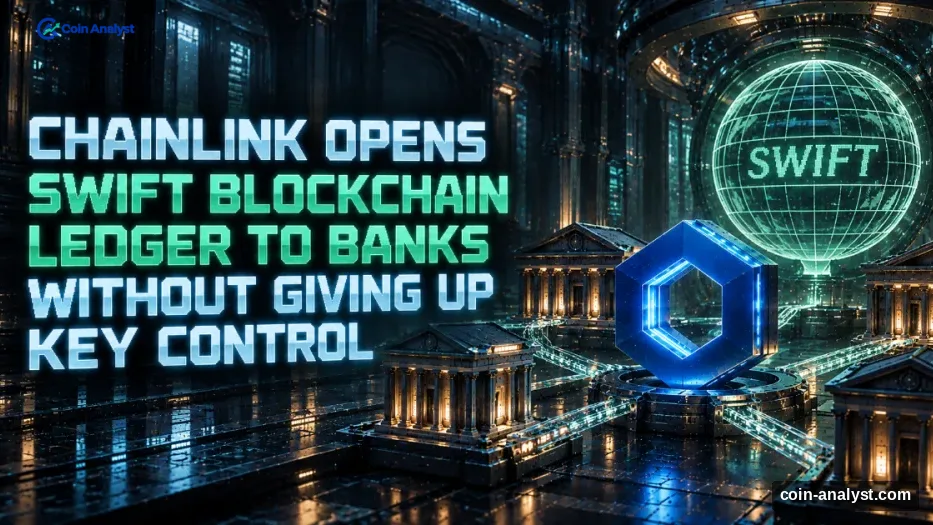
Chainlink has introduced a new offering that lets financial institutions access Swift’s blockchain-based ledger while retaining full control over the cryptographic keys required to authenticate transactions.
Unveiled on Sept. 28, the initiative relies on the Chainlink Runtime Environment (CRE) service to bridge existing institutional systems with applications on a shared ledger developed by Swift.
This architecture incorporates secure self-signing capabilities. Because banks keep hold of their own transaction-signing keys, the CRE functions as an intermediary layer granting them access to the ledger.
According to Chainlink, financial institutions can leverage a tokenized payment system without surrendering signing authority to outside parties or compromising operational safeguards.
The framework supports the deployment of smart contracts between banks operating on the Swift blockchain. Under this setup, tokenized deposits continue to function as bank liabilities maintained directly on the banks’ own blockchains.
Swift’s shared infrastructure assists in verifying and settling payment obligations among participants. Final payment settlements can also utilize alternative settlement mechanisms, including correspondent relationships and real-time gross settlement systems.
This development builds on previous cooperative efforts between Chainlink and Swift aimed at advancing blockchain interoperability within institutional finance. Earlier initiatives successfully combined Swift communications with Chainlink tools to help legacy financial institutions connect with tokenized asset networks and blockchains.
Read More: Is Chainlink Crypto Ready for the Top 5? Why LINK Could Be the Next Major Altcoin to Break Out
Previously, in 2025, Chainlink and UBS collaborated to implement digital asset workflows utilizing CRE and Swift messaging.
Swift’s proposed ledger is engineered to enable round-the-clock international commercial bank payments through tokenized commercial bank deposits, bypassing the need for a public cryptocurrency intermediary.
Swift emphasizes that this ledger is designed to complement—rather than replace—its traditional financial messaging offerings, operating alongside existing banking solutions to deliver a shared blockchain infrastructure for member institutions.
The project is presently in a restricted pilot testing phase. Back in July, Swift reported that 17 banks across six countries had shown interest in testing tokenized-deposit services.
Participating entities include ANZ, BNP Paribas, BNY, Citi, DBS, HSBC, Standard Chartered, UBS, and Wells Fargo, among others. More than 40 financial organizations participated in the design of the ledger.
Swift notes that the primary use case is facilitating 24/7 cross-border payments. Banks can use the new capability to dispatch tokenized transactions to fellow network users during nights and weekends, settling those transfers through separate payment methods later. Down the line, potential applications might expand to encompass programmable payments and transactions involving digital assets.
Read More: Ethereum’s Next Upgrade Could Change the Network Forever: What Vitalik Is Planning for 2030
Chainlink has not yet specified which pilot bank will be first to deploy the new CRE service, nor has a concrete adoption timeline been provided by pilot participants. Swift reiterates that the ledger service remains strictly in a limited pilot capacity.
Ultimately, the framework grants banks access to Swift’s blockchain ecosystem while preserving their institutional capacity to greenlight transactions and utilize established payment networks.