Tether Freezes $550 Million in Iran-Linked USDT as Senate Report Raises New Questions
Tether has frozen approximately $550 million in Iran-linked USDT throughout 2026 following a Senate investigation and increased U.S. sanctions enforcement targeting cryptocurrency networks.

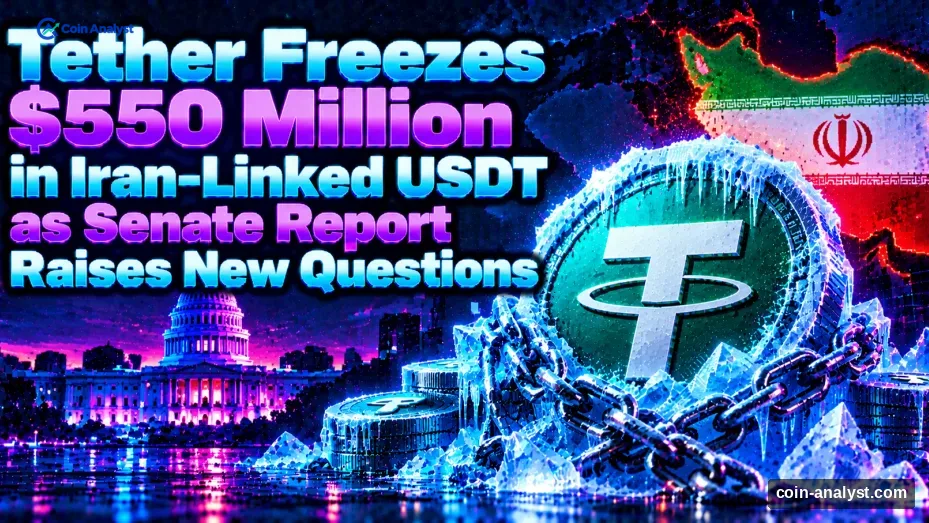
Tether has seen nearly half a billion in Iran-linked USDT freezes in 2026 as Washington tightens sanctions enforcement. The announcement follows a Senate investigation into USDT use across hundreds of Iranian-linked wallets, highlighting the dual nature of stablecoins.
Dollars can travel across the globe in minutes from a token exchange, but the centralized issuer has the power to halt transfers at any moment authorities connect an account to sanctions.
Related: Bitget Hack: $351 Million Drained as Withdrawals Freeze and Crypto Exchange Scrambles to Contain Fallout
Tether Freezes $550 Million in Iran-Linked USDT
Tether says actions involving USDT led to approximately $550 million of related Iran assets being frozen during 2026. U.S. authorities associated the involved wallets with Iran’s Central Bank or sanctions network. The company presented the actions as proof of cooperation with American and international authorities. Meanwhile, a Senate investigation has closely scrutinized Tether Iran USDT activity.
Tether’s Latest USDT Freeze Figures
The largest freeze occurred in April 2026 and involved more than $344 million in USDT across two addresses. Tether acted after receiving information from OFAC and U.S. law enforcement. Authorities later identified those addresses as digital currency identifiers connected to Iran’s Central Bank. Another action followed in July, involving more than $130 million across four wallets.
Tether says its Iran-linked USDT freezes totaled approximately $550 million during 2026. The revealed freezes in April and July represent most of that figure. These numbers represent one of the year’s largest stablecoin sanctions enforcement campaigns.
How Much USDT Is Linked to Iran?
The $550 million figure does not represent all USDT that are directly or indirectly connected to Iran. Rather, it reflects assets that were frozen as part of specific enforcement actions in 2026. Measuring the overall scale of Tether Iran USDT is significantly more challenging.
A Senate investigation examined 846 cryptocurrency wallets sanctioned or blocked in connection with Iran. Investigators found that 84% had transacted in USDT. That percentage represents a high level of exposure to the stablecoin, but does not necessarily mean that 84% of their overall transaction value consisted of USDT.
Which Wallets and Entities Are Involved?
Some of the most significant wallets have connections to Iran’s Central Bank, which has been placed under U.S. sanctions designations. Other addresses are associated with broader Iranian sanctions networks that have been identified by American authorities. The investigation has also examined wallets connected to entities accused of funding Iranian-linked groups.
Authorities have paid close attention to TRON addresses since there is considerable USDT activity on that blockchain. Several wallets that were frozen during 2026 have operated on the TRON network. An address that appears in a wider transaction chain does not necessarily mean that it is owned by a sanctioned entity.
This distinction is particularly important when discussing Iran-linked crypto wallets, since blockchain connections can range from direct ownership to several steps removed in a transaction.
When Did Tether Begin Freezing Iran-Linked USDT?
Tether has supported law-enforcement freezes for years rather than initiating its sanctions controls in 2026. Its ability to blacklist addresses has existed much longer, and the company has expanded its cooperation with authorities as USDT has been adopted more widely across the globe.
Enforcement has focused more noticeably on Iranian assets during 2026, however. April represents the $344 million action, followed by another major freeze in July. September then brought Tether’s disclosure that total Iran-linked freezes had reached approximately $550 million.
Read More: $320M Bitcoin Hack: What Really Happened to Liquid Network?
This sequence demonstrates how Tether sanctions compliance can react to new government designations, and explains why centralized stablecoins are significantly different from assets that do not have an issuer-controlled blacklist.
| Category | Figure / Detail | Significance |
|---|---|---|
| Total Iran-Linked USDT Frozen in 2026 | Approximately $550 million | Shows the scale of Tether’s sanctions enforcement |
| April 2026 Freeze | More than $344 million | Largest disclosed Iran-linked USDT action |
| July 2026 Freeze | More than $130 million | Another major enforcement action involving four wallets |
| Wallets Examined by Senate Investigators | 846 wallets | Addresses sanctioned or blocked over alleged Iran connections |
| Wallets With USDT Activity | 84% | Shows USDT’s presence among the examined addresses |
| Main Network in Major Cases | TRON | Significant Iran-linked USDT activity occurred on TRON |
| Entities Involved | Iran-linked networks and sanctioned entities | Includes addresses connected to Iran’s Central Bank |
| Tether Enforcement Method | Wallet blacklisting | Prevents targeted addresses from transferring affected USDT |
| Blockchain Visibility | Public transaction history | Allows investigators to trace transfers between addresses |
| Further Freezes | Possible | Additional wallets could face restrictions after new sanctions or investigations |
Why Is Tether Freezing USDT Linked to Iran?
The freezes form part of a wider U.S. campaign targeting Iranian financial networks and sanctions evasion. Washington has particularly focused its attention on digital assets as an alternative to traditional banking infrastructure. Stablecoins receive a special focus due to their dollar linkage and rapid settlement.
U.S. Sanctions Targeting Iran’s Crypto Networks
U.S. sanctions restrict transactions involving identified Iranian institutions, individuals, and financial networks. Authorities have been adding cryptocurrency addresses to sanctions designations more frequently in recent months. This method enables investigators and businesses to identify specific blockchain addresses that are connected to restricted entities.
The Treasury has increased its focus on digital assets during 2026 and identified that sector as one that requires additional enforcement. Iran crypto sanctions now extend beyond banks and traditional payment systems, since wallets, exchanges, brokers, and stablecoin infrastructure can be connected to sanctioned entities.
Tether can take direct action when authorities provide actionable information. This capability presents another sanctions enforcement mechanism which is not available with fully decentralized assets.
How USDT Is Allegedly Used to Move Funds Around Sanctions
The Senate investigation has alleged that Iranian financial networks use USDT to move value outside the jurisdiction of conventional banking infrastructure. A dollar-linked token can travel across borders without relying on correspondent banks for every transfer, enabling stablecoins to support legitimate commerce and possibly facilitating sanctions evasion.
Investigators have argued that USDT can be part of Iran’s larger shadow banking infrastructure, since funds can pass through exchanges, brokers, intermediaries, and multiple addresses before arriving at their destination.
The transparency of blockchain transfers represents opportunities for investigators; however, all transaction records are publicly available and can be examined for evidence once a particular address has been identified within a network.
Tether’s Cooperation With Law Enforcement
Tether says that it works directly with U.S. and international authorities on investigations that involve illicit finance. According to the company, its cooperation has enabled more than 2,900 investigations globally, with more than 1,600 cases involving U.S. law enforcement.
The Iran-related freezes demonstrate how this cooperation can unfold. Authorities can identify addresses and provide information, while Tether can restrict balances of targeted USDT which are connected to known Iran-linked wallets. This approach does not require shutting down an underlying blockchain.
This structure enables law enforcement to obtain an unusual combination of blockchain visibility and issuer-level control. Cash does not have the same level of public transaction history, while decentralized cryptocurrencies do not have a comparable central freezing function.
What Tether Says About Its Compliance Measures
Tether has rejected arguments that USDT represents a safe haven for sanctioned actors or criminal organizations, stating that its wallet freezing capabilities and cooperation with authorities demonstrate stronger enforcement.
Management has emphasized the transparency of the blockchain, since each public USDT transfer creates an on-chain record which investigators can examine later. Transactions cannot simply be erased after funds have moved through addresses.
Tether sanctions compliance therefore combines monitoring, government cooperation, and blacklist control. Critics question the speed at which such measures always occur, while the company argues that it acts as soon as authorities provide credible and actionable information.
Senate Report Raises New Questions About Tether
The new Tether Senate report represents a more complicated picture than the company’s freeze announcements alone. Senate Democratic investigators argue that USDT has become a central part of Iranian financial networks, focusing particularly on sanctioned wallets and the effectiveness of Tether’s controls.
What the Senate Report Says About USDT
Investigators have examined 846 wallets that have been sanctioned or otherwise blocked due to alleged connections to Iran. According to the findings, 84% of these addresses had conducted transactions involving USDT. The report portrays the stablecoin as a major component of Iran’s international financial infrastructure.
Researchers have also examined a subset of addresses associated with terrorism-financing allegations. USDT activity featured prominently among these wallets as well, though those findings do not necessarily imply that ordinary USDT transactions involve sanctioned activity.
The focus instead remains on a specific population of previously identified wallets, which is an important distinction when interpreting the report’s percentages and conclusions.
Concerns Over Sanctions Evasion and Illicit Finance
The central concern involves USDT sanctions evasion through networks that operate outside traditional banks. Stablecoins can transfer large dollar-denominated values quickly across borders, simply by having compatible wallets and access to blockchain infrastructure.
Senate investigators have argued that these characteristics support the ability of sanctioned networks to maintain connections to dollar liquidity. Intermediaries can move funds through several addresses before converting them elsewhere.
Those same transfers are visible on public blockchains, since investigators can follow transaction histories after identifying relevant addresses. The dispute partly revolves around how quickly issuers should act when warning signs emerge.
Read More: FBI Crypto Crime Forum Targets Scams, Hacks and North Korean Threats
Why Tether’s Role in Global Crypto Transfers Is Under Scrutiny
USDT occupies a unique position due to the enormous role in global cryptocurrency markets which it plays. Traders use the stablecoin for settlement, exchanges, cross-border transfers, and dollar exposure. Users with unstable local currencies treat it as an alternative savings instrument.
The scale of compliance decisions can therefore affect substantial amounts of capital, since Tether blacklisted wallets immediately lose the ability to transfer their affected USDT through normal token functions. Consequently, the issuer has powers which decentralized cryptocurrency networks generally do not provide.
Regulators therefore examine Tether from two directions, since they question how criminals might use USDT while relying on Tether’s centralized controls to halt targeted funds.
How Tether Responded to Previous U.S. Concerns
Tether has emphasized its direct cooperation with American authorities as concerns have intensified. Its recent statements have highlighted investigations, wallet freezes, and sanctions enforcement as indicators of USDT’s traceability rather than its suitability for illicit finance.
Previous criticism has often focused on the response times and identification of suspicious wallets. Tether has defended the credibility of law-enforcement information as the proper basis for intervention, which reduces the risk of freezing addresses based on unverified allegations.
The debate is unresolved, with policymakers wishing to disrupt illicit networks faster, while stablecoin issuers avoid arbitrary restrictions for legitimate users.
How Tether Can Freeze USDT on the Blockchain
USDT operates differently from Bitcoin, since Tether controls the token’s smart-contract administration. This design presents technical powers over specific addresses, which become particularly important when sanctions enforcement or criminal investigations take place.
What Happens When Tether Blacklists a Wallet?
Tether can add an address to its blacklist through administrative functions programmed into supported USDT contracts. Once blacklisted, that address loses the ability to transfer affected tokens normally, while the blockchain itself continues operating without interruption.
The tokens do not automatically disappear simply because Tether blacklists an address, however. The contract prevents the targeted wallet from using its USDT normally, and further action typically depends on legal instructions and the circumstances of the case.
A Tether USDT blacklist therefore behaves differently from freezing a conventional bank account. The restriction occurs at the token-contract level rather than through a bank’s internal ledger.
Can Frozen USDT Still Be Moved?
Blacklisted USDT generally cannot move through normal transfers from the restricted address, making the tokens economically unusable. Moving other unrelated blockchain assets from the same wallet may still be technically possible, however.
The restriction applies to USDT controlled by Tether’s token contract, and does not give the company control over every asset stored at that blockchain address.
This distinction is important for Tether-blacklisted wallets, since a wallet may contain several tokens while Tether only controls the USDT issued through its contract.
How Blockchain Investigators Track USDT Transactions
Investigators can follow USDT since public blockchains maintain permanent transaction histories. Analysts examine transfers, timing, wallet relationships, exchange deposits, and recurring transaction patterns. Clustering techniques can identify addresses that may belong to the same service or network.
Additional information can come from centralized exchanges and other regulated intermediaries. Know-your-customer records may connect blockchain addresses to real identities, and investigators can combine off-chain records with on-chain transaction histories.
Tracking does not make attribution automatic, since sophisticated networks use intermediaries, exchanges, bridges, and multiple addresses to complicate analyses. Every additional transfer can, however, represent another permanent data point.
Why USDT Is Different From Decentralized Cryptocurrencies
Bitcoin has no company capable of blacklisting a Bitcoin address at the protocol level. Tether operates differently, since a centralized issuer creates and administers USDT. This structure provides capabilities that are unavailable to Bitcoin’s decentralized network.
Centralization presents advantages and trade-offs, however. Authorities can request targeted freezes, potentially preventing sanctioned funds from moving, and users must accept that the issuer can restrict tokens under specific circumstances.
The Tether USDT freeze mechanism is therefore an indicator of this difference, since USDT uses blockchain infrastructure while not relinquishing all centralized control over the token.
Iran’s Use of Crypto Amid U.S. Sanctions

Iran has faced extensive restrictions on access to international financial infrastructure for years. Digital assets provide another channel for transferring value when traditional routes become challenging, but different cryptocurrencies offer significantly different levels of control and traceability.
Why Iran Has Turned to Cryptocurrency
Cryptocurrency can facilitate international transfers without requiring every payment to pass through correspondent banks. This feature is particularly valuable for users and businesses that face restrictions on traditional financial access. Iran-linked networks have therefore explored several forms of digital assets.
Sanctions pressure incentivizes finding alternative settlement mechanisms, since Bitcoin, stablecoins, and other cryptocurrencies can all play different roles within these networks.
Using cryptocurrency does not eliminate sanctions risk, however, since exchanges can block customers, issuers can freeze tokens, and investigators can trace public blockchain transactions.
The Role of Stablecoins in Cross-Border Transactions
One major advantage stablecoins offer is price stability, since USDT aims to track the U.S. dollar and enable accounting and settlement. Businesses can transfer dollar-like value without the short-term price risk associated with Bitcoin.
Liquidity is another factor, since USDT trades across numerous exchanges and blockchain networks, providing users with many potential routes for transfers. This broad availability explains its importance in legitimate global markets.
The same characteristics can attract sanctioned networks, however, and USDT Iran sanctions enforcement focuses on a payment instrument which has utility far beyond illicit transactions.
Related: China Calls Crypto an “Accomplice” to Espionage: What Does It Mean for Crypto Market?
How Iran-Linked Crypto Activity Has Evolved
Earlier crypto sanction cases often centered heavily around Bitcoin and exchange accounts. Stablecoins have become more important as their liquidity and adoption have expanded, with USDT now offering deeper markets and faster settlement across several networks.
This shift in focus within Iran-linked activity has coincided with wider market trends, as authorities identify stablecoin addresses directly within sanctions notices and issuers can implement restrictions.
This change also improves investigators’ ability to disrupt funds once they have been identified, since a decentralized asset may remain transferable while Iran-linked USDT can become immobile after Tether blacklists the address.
The Difference Between Direct and Indirect Links to Iran
Not every wallet interacting with an Iran-linked address is owned by an Iranian government entity. Blockchain networks create long transaction chains which involve exchanges, brokers, businesses, and ordinary users. A direct designation carries different implications from several degrees of transactional separation.
Compliance systems therefore examine more than simple proximity. Analysts investigate transaction size, frequency, timing, counterparties, and known ownership information.
This distinction becomes important when discussing Iran-linked crypto wallets, since overly broad interpretations could incorrectly categorize legitimate users who unknowingly received funds with distant connections to sanctioned addresses.
What the $550 Million Freeze Means for Tether
The case demonstrates both the reach and limitations of centralized stablecoin compliance, with Tether able to stop targeted USDT once authorities have identified relevant addresses. However, policymakers debate whether issuers should detect suspicious networks earlier.
Tether’s Growing Compliance and Sanctions Controls
Tether has expanded its enforcement capabilities as USDT has grown, and the company highlights cooperation with hundreds of law-enforcement bodies and thousands of investigations. Consequently, sanctions controls have become a central part of its regulatory positioning.
The approximately $550 million figure provides Tether with a substantial example of these tools in action, though the Senate report questions whether previous intervention always occurred quickly enough. Both developments can coexist, as Tether freezes major amounts of tokens today and lawmakers examine whether historical compliance controls fulfilled their expectations.
Could Tether Freeze More Iran-Linked USDT?
Additional freezes are possible if authorities identify more wallets connected to sanctioned Iranian entities. Public blockchain records can enable investigation into new relationships, and previously unknown addresses may become apparent through exchange records or seized information.
Future action would depend on evidence, sanctions designations, and cooperation between authorities and Tether. A wallet’s indirect connection alone does not necessarily imply that Tether will blacklist it.
The current Iran crypto sanctions campaign indicates continuing scrutiny, which could expand the number of affected USDT addresses.
What the Case Means for USDT Holders
Most ordinary USDT holders face no direct effects from the Iran-related freezes. Tether targets specific addresses rather than disabling USDT across an entire blockchain, but the case highlights counterparty and compliance risks associated with centralized stablecoins.
Users receiving funds from unknown sources can encounter tokens that are connected to suspicious transaction histories. Exchanges may apply their own compliance controls even if Tether has not blacklisted an address.
For regular holders, the broader lesson concerns USDT’s centralized structure, with Tether able to intervene at the token level when sanctions or cases arise.
FAQ
01Could U.S. Regulation Change Tether’s Approach?
Yes, future U.S. stablecoin rules could have an impact on Tether sanctions compliance and reporting requirements. New legislation may establish additional obligations for foreign issuers serving American markets, and regulators could require stronger anti-money-laundering controls or faster responses to sanctioned addresses.
Any impact would depend on the final rules and their jurisdictional reach. Tether already cooperates extensively with U.S. authorities, and some rules could merely form a formalization of practices that already exist.
02What Happens to the Frozen USDT Next?
Frozen USDT generally remains restricted while authorities determine the next legal steps. A blacklist does not automatically transfer ownership to the government, and seizure or forfeiture can require separate legal procedures.
Outcomes will therefore vary between cases, with authorities potentially seeking forfeiture, but other funds remaining frozen during investigations or sanctions enforcement.
03Can Tether Recover or Destroy Frozen Tokens?
Tether has technical capabilities that extend beyond simply blocking transfers, and the company can support processes involving frozen token balances depending on legal instructions and the relevant contract.
This action does not automatically occur after every blacklist, however, and a Tether USDT blacklist should not be confused with immediate token destruction. Freezing represents the first restriction.
04What Happens if a Wallet Is Frozen by Mistake?
A mistaken freeze would require review by Tether and possibly the authority connected to the action, with wallet owners needing to provide information that the restriction should not apply. The process depends on the reason behind the blacklist.
Centralized control creates a potential for mistake, and users can submit arguments or evidence to have a wallet unfrozen.
05Can Users Avoid Interaction With Blacklisted Addresses?
It is impossible to exclude all risks since cryptocurrency transactions can be made through multi-hop transfers, which may have passed through blacklisted addresses. Reputable exchanges and compliance services scan addresses for sanctions lists and other risks; businesses dealing with large volumes of USDT transfers could consider additional blockchain controls.
This does not mean that ordinary users should ignore receiving large sums; the freezing of $550 million in stablecoins in 2026 is a reason to be wary of such transfers. While USDT provides fast Tether blockchain transactions, this coin has one of the most centralized structures among cryptocurrencies, giving Tether a powerful tool for control and compliance.