
Arc Chain’s First Week: $410M in DEX Volume and the Rise of the Argus Launchpad
Circle's new layer-1 blockchain Arc generated $410 million in DEX volume during its first 24 hours, driven largely by memecoin activity on the Argus launchpad despite its payments-focused design.

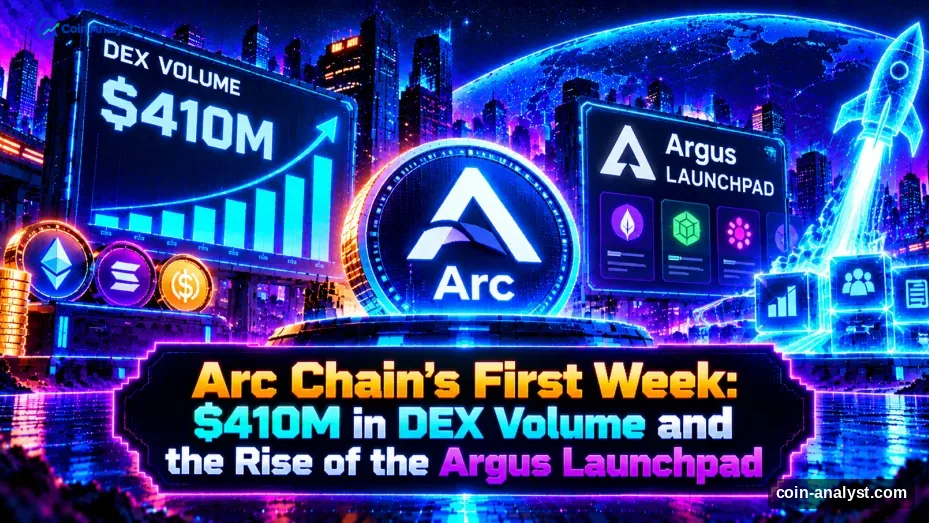
On September 16, 2026, the Circle-developed layer-1 blockchain Arc launched its mainnet. Decentralized exchanges on the network processed roughly $410 million in trading volume during their first 24 hours. Memecoin launchpads generated approximately 82% of that activity, rather than the stablecoin payments that Arc was built to handle.
That distribution is crucial for anyone preparing a token launch on the network. Arc debuted boasting institutional support and a payments-focused narrative, but its opening week closely mirrored the launch phase of other new blockchains: a massive wave of newly minted tokens, the vast majority of which went entirely unnoticed.
Related: Circle Launches Arc Studio AI Agent to Build Full-Stack Onchain Apps From Simple Prompts
What Is Arc?
As an EVM-compatible layer-1 network, Arc supports standard Ethereum tools and Solidity contracts natively. Its standout architectural choice is its gas mechanism: transaction fees are settled in USDC instead of a volatile native asset, ensuring transaction expenses remain steady when measured in dollars.
The platform went live alongside Circle and 11 initial validators, featuring major institutions like BlackRock, Visa, and Mastercard. That roster highlights Circle’s vision for Arc as a venue for payments, settlement, and tokenized assets—even though early network usage gravitated elsewhere.
Where the Day-One Volume Came from
Argus, a memecoin launchpad operating concurrently with the network’s debut, served as the single largest contributor. During its initial 24 hours, Argus generated $202.35 million in volume and facilitated the creation of 83,751 tokens—accounting for roughly half of Arc’s overall day-one DEX volume.
Through v4 hooks, Argus automatically deploys new assets into Uniswap v4 pools and allows creators to configure fixed buy and sell taxes. Every swap within these pools applies the designated tax in addition to standard trading fees, altering the financial dynamics of exchanging those assets.
The Visibility Problem Arrives on Day One
Generating upwards of 83,000 tokens daily makes individual discovery exceptionally difficult. Activity metrics—including transaction counts, unique traders, and volume—drive the rankings on tracking screeners such as GeckoTerminal and DexScreener. Any token failing to record trades within its first hour quickly disappears from “new pairs” listings and rarely recovers visibility.
This trajectory mirrors Solana’s experience with Pump.fun alongside Base’s journey with its native launchpads. Pairing a new network with a frictionless token creator floods the ecosystem with thousands of coins, forcing market attention onto the tiny fraction that generate immediate traction.
Related: Circle Takes Arc Multi-Asset as EURC and cirBTC Go Live on CCTP
What’s Different about Launching on Arc
- Dollar-denominated gas. Because transaction fees are settled in USDC, project teams can budget campaigns directly in dollars without speculating on fluctuating gas token prices, offering greater predictability than networks relying on volatile assets.
- Taxed pools. Fixed buy and sell levies are enforced across Argus pools. All trading activity—whether driven by everyday users, promotional strategies, or market makers—absorbs this tax, making assets with a 5% tax significantly costlier to trade actively than zero-tax alternatives.
- Uniswap v4 hooks. Legacy analytics or trading tools designed for v2 or v3 architectures may prove incompatible with v4 pools and their custom hooks. Developers should verify v4 compatibility before depending on any tooling.
- Thin early liquidity. Brand-new networks begin with shallow market depth, meaning single large trades can heavily impact prices in either direction.
How Launch Teams Are Responding
Established multichain infrastructure adapted rapidly. Boost Legends—a Telegram-based Solana volume bot (@boostlegends_bot, solanavolumebot.com) that also operates on Ethereum, Base, and BSC—deployed a specialized Arc utility, boostlegends_arc_bot, less than a week after the mainnet release. Team documentation explicitly highlights the pool-tax constraint: because creator-configured taxes apply to automated bot transactions on Arc, they must be factored directly into campaign planning.
Wallet trackers, launchpad aggregators, and token screeners are integrating Arc compatibility at a comparable velocity, matching the pace expected from networks experiencing such high initial activity.
What’s to Watch in the Coming Weeks
- Whether the volume holds. Initial activity metrics on nascent blockchains usually drop steeply once the launch hype cools. Day-one volumes should be evaluated as ceilings rather than reliable baselines.
- The mix between memecoins and payments. Circle heavily promotes stablecoin utility. Sustained dominance by launchpad tokens would cause Arc to resemble a speculative trading environment more than a dedicated payments infrastructure.
- More launchpads. As observed on Base and Solana, Argus’s market share is likely to contract as rival launch platforms emerge.
- Tax design. If high-tax tokens consistently trail low-tax alternatives in trading volume, creators will likely gravitate toward lower default fees.
FAQ
01What is Arc?
Created by Circle, Arc is an EVM-compatible layer-1 blockchain where transaction fees are settled in USDC. The network debuted on September 16, 2026, alongside Circle and 11 inaugural validators, including Mastercard, Visa, and BlackRock.
02What is Argus on Arc?
Argus functions as a memecoin launchpad on Arc. During the network’s first 24 hours, it generated $202.35 million in volume and created 83,751 new tokens. Assets deployed through Argus enter Uniswap v4 pools equipped with fixed buy and sell taxes.
03Do I need ETH for gas on Arc?
No. Arc utilizes USDC for gas fees, meaning users must hold USDC in their wallets to cover transaction costs.
04Can volume bots run on Arc?
Yes. Boost Legends supports Arc tokens through boostlegends_arc_bot. Given that Argus pools assess a tax on every swap, those fees must be calculated as an inherent part of any volume campaign’s expenses.